

 Spotify

 Amazon Music

 Apple Podcasts

 YouTube
210: Tea, Drugs, and Jesus - Only Nixon Can Go to China

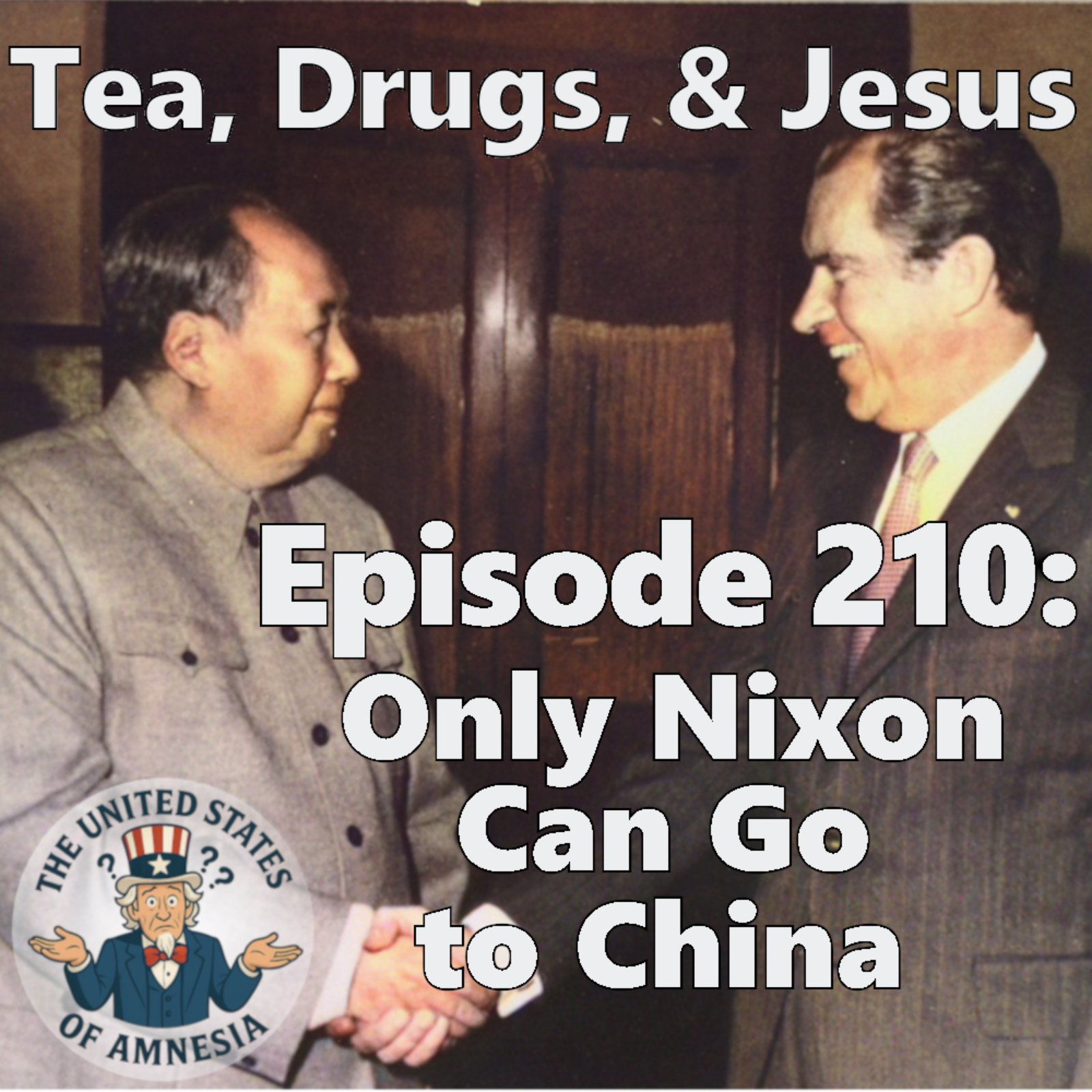
When Chinese "volunteers" intervened in the Korean War in 1950, American relations with the People's Republic of China fell into an icy abyss from which they did not emerge until President Richard Nixon made his momentous decision to transform world politics by visiting Beijing in 1972. In the United States, the "loss" of China to what Americans thought of as monolithic "world communism" led during the intervening two decades to the "Red Scare," the "Lavender Scare," blacklisting, and growing U.S. involvement in conflict in Southeast Asia — all while American policymakers ignored, fired, and even ruined the reputations and careers of experts who tried to give them advice on the realities of China, Vietnam, communism, and international relations during the Cold War.
0:00 In the afternoon, Kennedy said he wanted to talk first about Southeast Asia. You will find that the information in this area will be an endless entanglement, responded de Gaulle. Once a nation has been aroused, no foreign power, however strong, can impose its will upon it. You will sink into a bottomless military and political quagmire, however much you spend in men and money. I hope you will not say that in public, Kennedy said. Of course, the Frenchman replied. I never speak to the press. Never. De Gaulle added another thought about that part of the world. Perhaps the Russians are backing the Pathet Lao insurgents because they, too, are nervous about Chinese expansion. The idea was too much for Kennedy.
0:46 The Americans still saw a monolith that they called the Sino -Soviet bloc. Kennedy's response was clever, but wrong. He said that the Soviet Union and China were like Caesar and Pompey, that they would become enemies again only after vanquishing a common foe. Now, what does this mean? Well, we are now in the wonderful world of monoliths. And monoliths are great because this is... an artificial construct that we have that we periodically construct in order for us to understand complicated situations and at the same time get them wrong because anytime somebody is going to talk to you about monolithic communism or monolithic islam or monolithic this or that they probably don't know what they're talking about because there's always seems when we're dealing with nation states and this is going to have like a huge impact on our post -World War II foreign policy thinking. And this is something that we're going to explore in this episode.
1:50 Welcome to the United States of Amnesia. We are the podcast that reminds us of what we have forgotten. It is often said that history repeats itself. Mark Twain allegedly said that history doesn't repeat itself. but it rhymes. But over time, many topics have become clouded by biases and oversimplifications, or have become mythologized and now are misunderstood. Misunderstanding means learning the wrong lessons from history, perhaps, or even learning nothing at all. And that can leave us poorly prepared for history's next rhyme.
2:41 After World War II and the Korean War in 1950, American relations with the People's Republic of China fell into an icy abyss from which they did not emerge until President Richard Nixon made his momentous decision to visit Beijing in 1972. We in the United States were fearful of monolithic communism in the form of Russia and now China. and its expansion. And that led to two decades, and then some, of silence. Today we're going to look at the consequences of our failure to understand China. It is important before going on that we review some of the notions that were held, not just by policymakers, but by the general... population. The Chinese nationalist government of Chiang might have replaced a corrupt Manchu empire, but it reproved every bit as adept, if not better, in pocketing money and goods, particularly those from overseas. Small wonder as the Chinese economy was devastated at the end of World War II with hyperinflation and the loss of significant portions of the means of production, both industrial and agricultural.
3:51 Finally, it is important, Chiang was never able to consolidate control over China at any time during the 22 years that he was in power. 1927 to 49, so it was highly unlikely that he could initiate democratic reforms, much less Christian -based democratic reforms at that. Neither Chiang nor the people of China were in any way poised to become a Christian democracy. was supported by passages that people plucked out of the Bible as necessary to the second coming of Jesus in some quarters. These soothsayers would transfer their expectations for pending end times to Israel, which became established shortly before Chiang had to flee to Taiwan, with many of the best of China's imperial treasures. as well as its gold reserves and any cash and military equipment that it could make off with. Israel was established in 1948. Yes. And the nationalist government fled to Taiwan in 1949. Yes. So they were one year apart. Yes. So, I mean, you see a lot of the same talk about the establishment of this Christian country in China as the fulfillment of biblical prophecy. This would hasten the second coming of Christ. That would hasten. It was basically about... Jesus and the word of God being preached in all countries throughout the world here. And so by having this happen in China, this is a precondition. And the second coming of Jesus,
5:22 this is the rapture. Yeah, the rapture. That we'll get into in another episode. Yes, we will get into some of this in another episode. But it's about the rapture. It's about the second coming. So there is, in the sort of geopolitical analysis, the reasons why we're supporting Chiang Kai -shek. is not necessarily because he's viable, because the story sounds good. You know, they're printing the legend, so to speak. From this vantage point, people would insist that Taiwan was China, and this would be an article of faith among the American right for decades after. And we should probably clarify here, just to make sure everybody's on the same page with us, that officially, You have two governments in one country. Both governments maintain this. They maintain there's only one China. The People's Republic of China governs all of it except for Taiwan. And the Republic of China, which is the nationalist government, which was the one that Chiang Kai -shek led, governs only Taiwan. But just for people who might be confused by this, neither one claims that there are two separate countries. It's two separate governments, both of which claim to be the legitimate government of the entire country.
6:40 That's still going on today. And that still is the case today. The focus of this episode is going to be how the unreasonable expectations, the incomplete understanding of the actual state of affairs in China had a negative impact on all aspects of American society. And this was led by ignorant demagogues, whose ideological descendants still exercise a malevolent impact upon society today. And I think we know who we're talking about. For the time being, communism became the third rail in American politics. The Republicans could use it to combat the New Deal and Democrats had to be seen as being more fanatical anti -communists. They otherwise could be otherwise they'd be portrayed as being soft on communism.
7:23 So this dates back to the 1930s. Yes. I mean, but the New Deal is still controversial. You know, it is still controversial. And people, you know, like we get this bullshit about communism. You know, like communism, people and it's usually from people who do not know what communism is. Yeah. A lot of people will claim that anything, even let's say, you know, more left leaning people come up with is somehow communist in nature. They'll default to that or at least socialists, they'll say. Yes. And actually, it isn't. The United States doesn't really have European -style socialism, let alone communism, except for tiny pockets of political outsiders. There is a Communist Party, I suppose, in the United States. Mainly made up of FBI agents. Yeah, and there's a Socialist Party. But people tend to default to that. Even though there really is nothing even remotely similar in the United States to even really European -style socialism. Nobody is advocating, as they do in Europe, public ownership of the means of production. Exactly. And that is what makes something communist. That is what makes something socialist.
8:25 Most of the population, even with the experience of World War II, did not really have a good idea of the real dynamics of international affairs. They did go to the movies and they learned from the movies that events like World War II were part of a global international conspiracy. conspiracy, beginning with attacks in China, in Manchuria, followed by the fall of Ethiopia, Austria, Spain, Czechoslovakia, Poland, Denmark, Norway, the Low Countries, and France, to the international Axis conspiracy. While this was great for morale purposes, it had nothing to do with reality. And the riff that people are going to take on this is going to have nothing to do with reality. What I just quoted is from Casablanca. There's like a scene in Casablanca where they list all this stuff about Rick Blaine running guns to Ethiopia and so forth. And it's all about like this is all intertwined and interconnected. The Axis countries, though, were not actually functioning that way. And this is kind of something that we might want to consider about how Russia and China are going to cooperate with each other.
9:35 The Axis countries were generally working at cross purposes with each other, and they did not consult on war aims at the same degree as, say, Roosevelt, Churchill, and Stalin did. There is a sense that only a nuclear -armed communist alliance could have come into being with... Another international conspiracy like the ones that people are seeing at their local movie theater during World War II. So let's clarify here then. So people go to the movies after World War II. Yeah. They see movies telling them that there was a big Axis conspiracy against the world. Say like where low -level agents would know when Pearl Harbor was going to happen. Right. Then we have the Cold War has begun. Yes. And so they are transposing that false idea. That false dynamic, really. That false dynamic of how the Axis powers worked in World War II, which had been a major experience in all their lives fighting World War II. They're transposing that into the Cold War environment. And they are assuming that the movie's depiction of the way the Axis worked is the way this communist bloc actually works in real life. Yes. That is exactly it. And you're going to explain to us how that is not true at all. That is not true at all. We're going to get into a lot of that about how that is not true at all. But demagogues, anti -communist demagogues, would actually play on this. And I'm not going to say that they were lying because
11:06 they probably didn't know one thing from the other about communism, but they kind of took that and ran with it. And this is going to affect U .S. society in the 50s and in the 60s as well. So communism was viewed as a conspiracy that was nothing less than a disease aiming to destroy the American government and capitalism through infiltration, espionage, and revolution. Communism was viewed almost in religious terms in which all inherents were incapable of having differing viewpoints or any other goal than the elimination of American capitalists. system, and its military might. And so there began a pursuit for Moscow's fifth columnist. Hunting Communists was the road to success if one was a Republican in the late 1940s. Richard Nixon, who we will encounter again and again in this period, came to prominence in his prosecution of Alger Hiss, a member of the New Deal establishment who was at least communist -curious, but not exercising nearly the sway over post -Cold War planning that right -wingers imagined. What do you mean by fifth columnists?
12:31 Fifth columnists, this is a word that actually came out of the Spanish Civil War. And General Franco said that he had four columns surrounding the city of, I think, Madrid, and one column inside. So these are people that infiltrate and subvert and undermine the hegemony of a society. to support the adversary. And Franco, that's Francisco Franco, he was the fascist leader of the nationalist rebellion against the Spanish Republic, and eventually he became the caudillo, the fascist ruler of Spain for decades after the end of the Spanish Civil War back in the 30s. While Nixon managed to eventually become...
13:17 Eisenhower's poorly appreciated vice president. There's also Joe McCarthy and his stooge and Trump mentor, Roy Cohn. And they made real progress in ruining innocent people's lives throughout the government. In addition to communists, they led the charge to ban homosexuals from government service, in collusion with J. Edgar Hoover. Cohn described himself as a heterosexual who liked to sleep with men. McCarthy was a frequent visitor to the White Horse Inn, a Milwaukee gay bar, and there are persistent rumors that Hoover was having an affair with his deputy, Kai Tolson, and he liked to wear women's clothing. Were they alive today, these pillars of the anti -communist movement would be crashing Grindr along with their MAGA heirs. The Lavender Scare, as it became known, was masterminded by three gay men who pressured Eisenhower to ban homosexual employment in the federal civil service. But the Lavender Scare was just a subset of the blacklist in which people were accused of being communist, frequently on the most flimsy of pretext. There were a series of patriotic groups who, in the post -1949 environment, were able to libel people of even just liberal views as being tools of Moscow. One group that was targeted were, as we mentioned before, the China hands. These were the guys who were involved with the China white paper. They had provided a lot of the insights into this. And as we discussed in our last episode, the... China white paper was kind of a lightning rod for proponents and
14:49 patrons of Chiang Kai -shek's government. And it was something that Madam Chiang Kai -shek rallied forces to undermine an attack. So they did go after Dean Acheson, who was the person who released the China War white paper. And Acheson was who at the time? Secretary of State. Okay. But the people who actually were taken out. in reaction to this were the China hands. These were our experts, not just really on China, but on Asia, other than, say, Japan. So let's clarify. So the China hands were the people, and we discussed the people going back and forth in an earlier episode between the Chinese communists and...
15:35 General Joseph Stilwell. And they were providing Stilwell with favorable, their favorable impressions of the communists. Perhaps a little too favorable, but yes. Yeah, as agrarian reformers who were democratically inclined and all of that that they told him, which Stilwell thought, he thought the same thing. Yeah. That's the China hands you're talking about. That is who I'm talking about. And this is, and the, the, and Chung Kai -shek, Madam Chung, et cetera, of course, did not want this white paper they put together because it, It basically blamed Chang for the failure of his own government by his inability to be an effective leader. And this is so counter to what fanboys like Claire Chenault or Henry Luce, the publisher of Time Live, or Congressman Judd from Minnesota. All of these people were like strong proponents of Chiang Kai -shek. And of the Republic of China. And the Republic of China.
16:35 The nationalist government. The nationalist, yes. The white paper questioned that. The white paper questioned their effectiveness. And so naturally that made the writers of the white paper communists. Of course. Because they were in favor of China being taken over by communists. They were fifth columnists. They were fifth columnists. They are undermining our ability to really understand it with their poisonous. gossip about Chiang Kai -shek and corruption and all these other things. This is what they're opposed to, what they're talking about when they're trying to root out communist subversion. It's people like that. So if Stilwell had not died in October of 1946, he would have been labeled a communist by these people. In all likelihood, yes. I was just going to add that the lavender scare you mentioned earlier. began in the late 1940s and continued through the 60s. And it was a period in which thousands of gay employees were fired or forced to resign from the federal workforce because of their sexuality. Well, not all of them were gay. It's like, you know, there's no, it's like you can't, you know, unlike drug testing, you can't like, you can't like, you know. There's no test. There's no test for it. You know, it's like you can't like, you know. piss in a bottle and basically if it comes out purple, then basically you're gay. No, it's like if you if you were like, I don't know if you patronize the ballet too much or, you know, you you you had a roommate and, you know, you had had a roommate for like 10 years. You know, they would question whether
18:06 or not, you know, well, what's really going on there? If you threw a party and not enough women came. Yeah. You're probably gay then, right? Yeah. I mean, there's some things that are obvious. You know, if you get busted at the public bathroom across the street from the White House, which was a cruising area, yeah, you probably were, you know. And it didn't matter whether you had a security clearance or not. This was inconsistent with behavior for federal employment. In terms of what happened, to get back to the China hands, none of which were accused of being gay. They were just accused of being subversives, just to make that clear. But because they were correct in assessing Chiang Kai -shek, and they actually blame Chiang Kai -shek for being incapable. And again, this is, you know, you think about the stuff Claire Chenault's talking about, about him being like one of the one or two important people in human history here or in our time.
19:11 This is quite the comedown for a lot of people. This is not what they have been led to believe all this time, and it is very difficult for them to adjust. We discussed in a previous episode Claire Chenault. He was the U .S. Army Air Force's commander in China during World War II and was a great supporter of Chenault. Chiang Kai -shek and Madame Chung had very warm relations with them and was one of their champions in the United States. And continued to be so for the rest of his life. After he left the military. Yes. After World War II. Yeah. So what happened to the China hands? So in the time -honored manner. of the government, they were fired for their positions with the State Department because they were right, something we are seeing today in certain other contexts. One might be questioned for being wrong in making an assessment, but being right at the wrong time and forecasting the wrong outcome does tend to get one fired, as we recently saw with senior analysts on Venezuela. Well, they were fired for being right. That's true. The people who fired them were not thinking that they were firing them as revenge because they were right or something. No, they were firing them because they thought that they were presenting a pro -communist position by saying that there was something wrong with the government fighting against the communists. And then this was part of a monolithic communism. Therefore, if you supported any of it, you were supporting all of it. Therefore, it made you an enemy. I mean, there's a lot to it. That goes into saying they were fired for being right. Some people knew
20:43 that this was bullshit. Sure. Some people knew this, and this was something that was being done to get very noisy, very critical, very popular, very populist even, people in Congress off their back. So this is almost like they want to sacrifice, so we're going to give them these guys. What are we giving up by giving them these guys? You know, we can kind of see some echoes. So when you say giving them these guys, let's be clear. The China hands. No, I know that. What I'm trying to say is let's be clear for our listeners. By giving up these guys, you're saying by firing these people and getting them out of government.
21:24 Yes. The people who were the China hands who were correct about how incompetent and corrupt the nationalist government in China was. By firing them, you were appeasing the populists, the anti -communist types, the very fervent anti -communist types. And to some people, that was a sacrifice worth making, and you're going to say that it was not, right? It was not. That's what we're getting into here. It was totally not, because basically what you're doing is you're killing off all your expertise, unlike what we're seeing today. And essentially, this is going to come back to bite us in the ass when we're looking at other parts of Asia, because we're not...
22:04 They may be called the China hands, but you don't really have expertise in Asia. The only other country that you have expertise in Asia is Japan. And so a lot of these guys were dual -hatted to look at other parts of Asia and understood other parts of Asia. I mean, to go back to, and I'll introduce him again, Theodore White. Theodore White, who was Henry Luce's... Time magazine, China correspondent. He also covered Indochina and Thailand. And the same thing worked with some of these guys. They had areas of expertise in Indochina and elsewhere. They had a certain understanding about how China related to those places. And without that level of expertise, without this fact -based analysis, you're going to end up with people making stuff up that sounds good, that is consistent with a fundamentally false worldview. And for those who don't know, Indochina was what is now Vietnam, Cambodia, and Laos, just so everybody knows where that was. It was a French colony at the time called French Indochina. To carry on here, the American government eliminated all its expertise in Asia to atone for the victory of Chairman Mao. When exactly did this take place? This took place
23:37 over a period of time. I mean, the white paper comes out in 49, so most of these guys are still, most of the China hands, and we're talking 20 years plus, in some cases, of expertise. People had lived in China, people had been at the embassy, etc. They didn't have much of a political pull because these guys are always living outside of the United States. So they're kind of expatriates on the government dime here. So this is happening roughly between 49, end of 49, where things start cooking, all the way up to the mid -50s. And we don't just see this with China. We also see this. with some of the Russia hands as well.
24:22 They were a little bit cagier and capable of dealing with this. But anybody who had kind of understanding of either of these countries, why the hell are they interested in them? What is that all about? Clearly - So you're probably a communist if you're interested in Russia. Yeah. You're probably a communist if you're interested in China, or at least the communist side of China, mainland China. I mean, just to divert a little bit, I mean, Chips Bolin was Eisenhower's selection for ambassador to Russia. And he was part of a group of people similar to the China hands who was an expert in Russia. He had done time at the embassy. They were a strong, hard line against Stalin. And yet for some reason, various populist anti -communist thought he was a communist because he had spent time in the Soviet Union.
25:15 And it took a lot of heavy lifting to get somebody who is opposed to Stalin, who hates communism. You cannot go. No one can go. I mean, I went to Russia in 92. You cannot go there and see the mess that that place is in certain areas without coming away with a sentimental attitude about communism. You're just going to be disgusted by it. All of this, maybe you're going to get into this, and that's fine if you are, but all this brings up a curious kind of a juxtaposition here in my mind, all right? In the last episode, when we were talking about the Chinese Civil War. What came out of that was sort of an idea that while the United States wasn't really thrilled with the idea of the communists taking over the country, we also, our government, gave up on the nationalist government as a viable government that could defeat the communists. Because they didn't see them as a viable alternative. Yeah, and our priorities lay elsewhere. Our priorities lay in Korea and in Japan. Korea, because it's a good buffer for Japan. against, well, the Soviet Union and China. So in other words, what I'm trying to get at here is it seems like there's this sudden break. So people aren't really caring that much about what happens in China, frankly.
26:34 In fact, they're caring less as the 40s wear on. They're caring less in the government as the civil war goes poorly. They're caring less and less. Their focus is elsewhere. The nationalist government retreats to Taiwan, which you could see coming for a while. before it happened. Yes. But now suddenly, like turning a light switch, everyone's searching, everyone's communist hunting and going after everybody because there must be a bunch of communists who let this happen. But at the time, no one was really caring that much that it happened. So what's this? Well, what's going on? What's this light switch that turns? All right. It's not so much a light switch. I should have a different light switching on here. Okay. All right. So within the government, you know, you're correcting your characterization.
27:20 But other branches of the government, say within the Congress and within – So you're saying within the executive branch, what I described was kind of the attitude. Yes, that's kind of the attitude. Yeah, OK. More or less of the people who's – there are, as we discussed in the last episode, there were proponents like Secretary of Defense Johnson who were very strong pro – Lewis Johnson. Lewis Johnson. Yeah, OK. So – Who are pro -what? Who are pro -Cheng. Yeah. And Johnson really didn't want the white paper to go out at all. Okay, right. He was totally opposed to this. He thought that it unfairly castigated Chiang Kai -shek. And then you have other people because, you know, Claire Chenault is still advocating for Chiang Kai -shek, as we talked about in the last episode. And then you have people in Congress like Congressman Judd and other. People, to include Richard Nixon. And their attitude as the fall is happening is just, we just need a little bit more money. A little bit more money. I mean, we spent billions upon billions upon billions trying to prop up Chiang Kai -shek. And he is just totally uninvolved with this towards the end. He actually resigns. Who is? Chiang Kai -shek. He is totally uninvolved. He becomes disassociated with the whole situation. In the United States?
28:48 In China. He ends up stepping down from his leadership position and goes to Taiwan. And goes to Taiwan. He goes to Taiwan. But he led the nationalist government in Taiwan. His government went with him, right? Yes. But there were still people who were remaining. As part of the, I mean, because 49, it's a process that this is happening. Yeah, there was still fighting in China in 1950. Yeah. Actually, yeah. Okay. So you're saying he, what you're saying is he left the nationalists on the mainland behind. Yeah, he just, he. He moved to Taiwan. Yeah. He was running things on Taiwan, but he left them to their own devices, basically. Okay. You know. All right. I'm with you on that.
29:29 So, I mean, this is actually. it actually supports this notion that he was an ineffective leader. He is not Winston Churchill in 1940. He is kind of a mediocre general who got lucky, is what we could ultimately say about him. But for all these other people, he is this shining, towering figure that is going to change China. Forever. So maybe I'm getting ahead of myself here, but then apparently there was this huge communist conspiracy which undermined him, which is the only reason he lost, I suppose, right? But before we come to that. They kept focusing all the corruption and stuff. Yeah. Now, before we come to that, though, what I still want to get into here is there is a change then in the United States government and its attitude toward China, where in 1948, 49, we're just letting it go. and focusing our attention in East Asia elsewhere. But then from 1950 -ish onward, we are now suddenly in high dudgeon over what went on in China. There is a remarkable change that happens there, and a fairly sudden one, it seems to me. Well, it's not... Because you also had people who were, you know, the China hands and such, right? Saying, well, you know, Chung is a terrible leader and it's not going to work. And, you know, we should make some kind of accommodation with the communists because they're the ones who are going to take
30:59 over. Truman even hoped that there would be a Tito -like. Marshall Tito in Yugoslavia split from the Soviets, that there'd be some kind of a similar split there, which did eventually happen, but not right away. Or what Truman ultimately wanted was he wanted a third option that was neither Chiang nor Mao, but there would be like the good... Yeah, there'd be a coalition government that would work things out. The good people of China would come together when Mao's communist... government failed, these people would come in and overthrow him, etc. So that was the state of play when Chiang Kai -shek left for Taiwan. There's a remarkable change in attitude that happens within a year of that, which is what you're getting into. Yeah, because these people, the people that had always thought very highly of Chiang Kai -shek, and they are people... More in the Congress, I would say, more wishing to score debating points against the Democrats, against Truman and the Democrats. These guys are basically saying. There is communist influence on our foreign policy. There's communist influence.
32:15 So these are Republican people in Congress? Republican people in Congress. Senators in Congress. Yes. Okay. Led by McCarthy, or at least... Well, no, McCarthy's not there yet. McCarthy... Okay, 52. McCarthy is who makes the name, but McCarthy basically... McCarthy was just a drunk, you know. I mean, he was a drunk and basically he went out to dinner one night with one of the Jesuits from Georgetown, forget his name. And McCarthy's like, I can't seem to come up with an issue. And this guy from Georgetown basically says, how about communism? That might be something you might want to consider. So if I'm understanding you then, I just want to make sure this is clear, like we're all on the same page here. If I'm understanding you then, so. The executive branch was having its own internal arguments about policy back and forth. The idea of a big conspiracy being behind all this arose out of Congress.
33:05 And the Republican Party. Well, okay, but they're in Congress. So it arose out of Congress, which is where this all came from, which then began affecting the executive branch. It didn't originate in the executive branch, this whole idea of a big conspiracy or something. That originated from Congress, and you're saying from the Republican Party. And also press. Were there no... like more conservative Democrats who thought this way? Was it really? I mean, the parties had more overlap in those days than they do now. And so I wonder, like, I don't know. I wonder, like, how many more conservative Democrats there were who agreed with this and less conservative Republicans who disagreed with it. I don't think that anybody was really pro -Mao or wanted to accommodate Mao. And ultimately... In either party. In either party. Yeah, okay. You know, you had these civil servants, who advocated, say, closer ties or recognition. Really, it comes down to recognition of the People's Republic of China. As the legitimate government of China. As the legitimate government of China. That was really what they were advocating.
34:14 And that sounds like a little issue to us, but really, the real name for the China lobby was the Committee for One Million to prevent recognition of communist china so the debate kind of wound up being people who were not in favor of mao and the communists taking over china but accepted it as a fact as a fact as inevitable and also accepted the idea that the nationalists had screwed up their war effort and their government so much that this was an obvious outcome of it right some kind of combination of those thoughts and we have to deal with the world the way it is then you had these other people who were pro uh chung to the end pro -republic of china as the only legitimate government and then there's a there's a big is at least a big overlap if not a total overlap between them and these populist demagogue types who are rising up out of congress and saying there must be a communist conspiracy behind all of this and i mean is that a fair way to characterize all these different things coming together or one other aspect okay yeah the other aspect of this is that they would always say All Chiang needed was just a little bit of a push towards the end, and he could have triumphed.
35:32 This is kind of what they were saying in World War II, isn't it? Yes. That didn't really change that much. No. But the China lobby is important to consider. That, again, to bring something up that we talked about in the previous episode. That's being funded by the Song family. So let's get very clear then. It's the AIPAC of its time. When you talk about the China lobby, you're talking about the pro -Chung Kai -shek, pro -nationalist government, pro -people on Taiwan. No, no, no, no. I am talking about the people in Congress and the press. who are getting funded by the Song family to support Chiang Kai -shek on Taiwan. We're saying the same thing in two different ways. What I'm trying to simplify it, though, these are the people who were pro -Taiwan, pro -Chiang Kai -shek, pro -Republic of China. That's who the China lobby is. Don't get that confused with the China hands, who are the people who were more, what's the right word, more accepting of, more realistic about the fact of Mao and communism. Being inevitable. Being inevitable.
36:33 So the China lobby and the China hands are two different terms we have to keep separate so that everybody understands what they are. And they're the opposite. That's why I'm saying they're the opposite. So the China lobby opposes the China hands and vice versa, right? That's the way to think of it. Wasn't there also a perception that the communists in China would link with the communists in... the USSR. Oh, yes, they were. I'm just going to say it out loud because that's the monolith that everybody was afraid of. That's the big boogeyman. There was communism and every country was the same. There were no nationalist considerations, no geographic ones. It was all communism. That's the light switch. Well, yes, and also nuclear weapons. If you want to talk about a light switch, we'll go back to what I was saying at the beginning.
37:22 If you want to talk about what flipped the light, The thing that flipped the light is nuclear weapons by the Soviet Union and Mao taking over China. That's what changes everything. Which happened in the same year. Yes. Within the same season in fall, you know, September for the nuclear blast and or at least when we knew about it, when we were able to figure this out. It wasn't like the Russians announced this. They were rather secretive people. But they knew that we would figure it out. And then in October. October 1st, you end up with Mao taking over Beijing and kind of setting up a government there. That is kind of, if we're going to say that's the light switch, that's the light switch there. Just so everybody knows, the Soviet Union detonated its first atomic bomb in 1949. We, of course, did in 1945. We used it, Alamogordo, New Mexico. We tested it, and then we dropped the bombs. Oppenheimer. Yeah, and then we tested Oppenheimer. We tested the bombs on Hiroshima. We used the bombs on Hiroshima and Nagasaki. That was all in 1945. The Soviets came up with their own atom bomb in 1949. And then their own hydrogen bomb, which is a whole next level kind of a weapon, was 1952 or 1953, I think it was, was the first Soviet hydrogen bomb. I'm just playing a timeline out for people that aren't that familiar with it. Because the whole nuclear thing. You know, you have these highly sophisticated weapons. There's all these reports about atom bomb spies and so forth with
38:54 the Rosenbergs and various other. And these are fair things to say because, you know, with the exception of Ethel Rosenberg, who was executed for just being in the wrong place at the wrong time by Roy Cohn, all of these guys were actually involved in getting nuclear secrets to the Soviet Union. So there were. The right wing did have a point when they're talking about security problems and security issues regarding nuclear secrets, and that this is part of an overall... That part, I would say, yeah, that is an international conspiracy to steal nuclear secrets from us. For having a unified theory about how to take over the world and to destroy the United States and capitalism, there's a lot of propaganda there, but there's not a lot of reality there, I would argue. And how close were Stalin and Mao anyway? They hated each other. Well, let's just say Stalin kind of viewed him with a certain degree of disdain, kind of like what we were talking about at the end of last episode, where he kept Mao waiting.
40:03 in Moscow. And then Mao was willing to put up with stuff from Stalin because at this point, Stalin's a legend. Stalin knew Lenin. He was part of the Russian Revolution. He had kind of built the Soviet Union out of nothing and had taken this backward place and made it into a real world superpower. And also Mao kind of needs him. But Mao kind of resents this. ultimately, because Stalin's going to give him so much, but he's also going to get him involved in the Korean War, like we discussed last time. And I don't think Mao was actually ready to get involved in the Korean War. He was looking for three to five years of peace and prosperity there in order to rebuild the state. The whole thing really comes down to this, and it goes beyond just the Soviet Union or Russia and China, right? Is that because of the theory of Marxism -Leninism, It has the idea the international proletariat is going to rise up and overthrow the capitalist oppressors and all that. That's the theory. Now, that's impractical and wrong, but that's the theory. And so you can tar anybody who's communist or pro -communist with that because that's what the theory says. But in fact, from the very beginning, it took on a nationalist type of character. The Soviet Union was pursuing Russian interests that predated. and have gone on since communism ended there. And communism was an organizing principle
41:37 to get together a movement, a government, to overthrow things like colonial oppressors and things. But that's how it wound up actually getting used in the 20th century in most cases. And in most cases, the leaders of these countries, or the communist insurgent leaders or things who took over the country. Particularly after World War II. After World War II. They were actually focused on the national interests of their country. Now, sure, they might not like capitalists very much. Sure, they may not be big on the stock market. Sure, they may decide to set prices themselves and not let the market economy do it. There's all sorts of communist things they do. But they're not focused on supporting an international communist movement, really. They might give some lip service to it. They're focused on their country's interests.
42:19 And that happens over and over again. Russia, China, Vietnam, Cambodia, Laos, you name it. Wherever communism is, North Korea, wherever communism has taken over. They're looking out for their own interests in their own country, not for some international movement, no matter how much lip service they give to it. And I mean, one of the reasons that they would be naturally anti -capitalist is because a lot of these places were either colonies or used as colonies or exploited by capitalist systems. So they're not going to be like, you know, junior achievement proponents here. They're going to be opposed to this system, which exploited people and used them as... you know, nothing better than animals in some cases.
43:00 Yeah, like, you know, gee, let's have the Dutch, French, British, you know, whoever, all come back and take over again after World War II, right? Now, you know, people would say, well, let's not. And then here's a leader who happens to be communist, who can put together a movement, an army, you know, a military to throw the colonial suppressors out and like that, right? Who are you going to side with? And I mean, communism was very seductive to people after World War I. It was like this was the way of the future. But the idea of monolithic communism was very seductive to Americans. But see, that's what I learned in school. That's what I was taught. And remember... And it just wasn't fully the case. During the 50s, let's just say... things are going to go from bad to worse. It was very seductive to us, and it took us a long, long time to learn that it was not the case that there was monolithic communism, because we didn't really want to hear it. Nope. Because we talked in earlier episodes, I've said this over and over again in these podcasts, right? The United States wants everybody to be Americans and thinks that they want to be Americans. We've been trying to export a revolution since 1776, as I've said more than once. So because of that, if people actually don't wind up being like Americans, I don't know, they follow a communist leader. Or an Islamic leader. How could that be? We're the good guys.
44:16 Everyone has to be like us. How could that be? It must be because of some dark conspiracy. Yeah. And hey, that dark conspiracy, monolithic communism, this whole international movement trying to undermine us and overthrow us and make everybody evil and wrong and bad. And that's a very seductive argument to a lot of Americans. It still is. It worked. It still is today, by the way. Yeah, it drove policy for decades. And it offers you a simple answer to a complex situation, doesn't it? Yeah. How do we understand the world around us? Well, I have one simple answer for you. There's this dark conspiracy, right? You don't have to know anything about Vietnam or China or Russia or their history. All you have to know is there's a dark conspiracy. And that can be exploited by people who are prone to thinking that way.
44:58 So it's very seductive for Americans as well. I would like to return back to de Gaulle. And de Gaulle understood the world, I think, better. Charles de Gaulle. Charles de Gaulle. Leader of the Free French in World War II. And president of France from 1958 to 69. And de Gaulle had a, you know, I think de Gaulle just had a really good sense about the world. He basically never used the term Soviet. He always referred to them as Russians or Russia. And he would say... And that's significant because the Soviet Union really was sort of the Russian Empire, you know, in a different form. And on steroids to a certain degree. It always was something that was pursuing Russian national interests. So what de Gaulle said was that nationalism is the problem. Leaders use ideology for their own purposes. Lenin's communism was different than Stalin's. Khrushchev's was different than Stalin's. The Soviet Union was a construct, de Gaulle observed, but Russia is real. And we could say China, Chinese communism is a construct. But China is real. So this is more sophisticated, a more sophisticated understanding about the world than anything we were advocating
46:31 in the 50s and the 60s. So in America, communism was very much in the eye of the beholder. And so I'd like to just sort of talk a little bit about some of the nonsense that we had. It's funny now, but I should emphasize this kind of screws us up in terms of... What happens afterwards? We've already like gone in and done this mass bloodletting within the federal government. And this is applied. The firing of all the China hands. Yes. All the expertise has gone. And it's not just the government, but it's like it's the entertainment industry. It's people who write books. The blacklist. The blacklist. All of these people are kind of like harmed for this. This idea of global international monolithic communism, which. is something that doesn't really exist.
47:23 And people do not necessarily understand what it is that they're talking about. I mean, it's kind of like, you know, back post 9 -11, all sorts of people climbed out of the woodwork claiming to be experts on terrorism who had never, never had anything to do with it. And all of a sudden they could walk into a room and they would insist on the most. idiotic things that you could possibly imagine as being fact here. And so such was the thing in communism, in this case. So I want to give an example of this. This is my favorite one. It's an obscure one. So Stalin was the last of the kind of intellectual Bolsheviks, and he would turn his attention to kind of arcane topics, and he'd write on them. And so one of the items that Stalin wrote in 1950 was a pamphlet called Marxism and the Problems in Linguistics. And it is what the title actually says. It is a book or a pamphlet on linguistics. Stalin probably didn't write the whole thing. He had someone to do that for him, but it reflected his ideas.
48:36 Sounds like a real page -turner. Oh, I read it, and it is. Now, John Foster Dulles, the Secretary of State under Eisenhower, also read it. And he drew a slightly different conclusion than I did or you might. He saw this as nothing less than Stalin's Mein Kampf. Because they all have to have a Mein Kampf. Mein Kampf was Hitler's, you know, plan for global domination. Manifesto for global domination. Yes. Wrote in the 20s. And it was intended to undermine Russian, to undermine Western intellectual. frameworks, and it was supposed to act as a kind of means of subverting our society. Again, fifth columnist and things like that. It brings into question the fundamental aspects of Western thought and Western society. That's how he read this. It is boring as hell, because I did feel compelled to read this when I was in graduate school. It's not clear that Stalin really made it through this book himself, even. But as official takes on Marxism went, it was probably not as bad as C. David Schein's book. He was one of the men that the otherwise heterosexual raccoon lusted after and was the author of a six -page pamphlet
50:08 which time turned. an error -ridden but remarkably succinct pamphlet on Russian Marxism. So the United States, as it moved to take on Russia, the Soviet Union, China, or monolithic communism, really lacked a good understanding. It had gone down the road to fantasy land. Because, I mean, part of this is, like you said, disappointment with the outcome. Why did they not want to become us? Oh, well. World War II was, to a lot of Americans, was supposed to forge a whole new world. And that new world that it sought to forge was ruined by these people. Yes. By these damn communists.
50:58 Right. Which is kind of true. I mean, if you did believe in what what Roosevelt wanted to have in the world of the future, communists did ruin that. But they were going to ruin it all the time because that's actually the way the world works. The world doesn't want to be a bunch of Americans doing things the way Americans would do it. It's not about, you know, like it's hard enough to get people to think about the good of the nation when you think about this. Just people in general, not leaders, but people in general normally are thinking about their own. Lots in line in any country in any country. Yeah, you know any society they're gonna think about their own comfort their own ability to operate there Yeah, that's gonna be their focus. Yeah, and so it's hard enough to get a leader of a country who is maybe putting the interest of the nation as Paramount concerns to think about the concerns of the world That's not the way the world works. Yes, you know, but sometimes you have an event You know that is so overwhelmingly and obviously important, let's say World War II, that people have no choice but to care about the future of the world and feel a vested interest.
52:05 They feel like they've achieved something. They thought they had achieved something beyond just winning a war. They thought they had created a new world. And Americans, again, are prone to doing this kind of thing. But that new world didn't play out the way we had wanted it to. And that's your disappointment. So in that case, you really did have, I think, in the late 40s, people were turning back to their own lives. But there was a disappointment, just like there was after World War I, that not that much had come of it, it turned out. But it didn't go as far as World War I. We didn't retreat into isolationism. We didn't... you know, refused to join the League of Nations, we joined the United Nations, that kind of thing. We were the architect behind the United Nations. Yeah, it was different. Well, we were the architect behind the League of Nations, too. We just decided not to join. Yes. But, you know, it's not like we gave up on the world the way we did after World War I. We did engage with the world for the next, well, 75 years anyway, until 2015, when someone we know came down that escalator. But anyway, that's a whole other thing.
53:08 I don't want to talk about it right now. But I mean, just the point is that we did engage, but there was disappointment with how things had gone. And it was those damn communists who had created the problem. I'm going to like just to go back to the escalator here. If we will just put things in context, current events in context, you know, this is at the end of this massive effort that we're undertaking in the Middle East. We're not exactly pleased with how that came out either. You know, like what do they want? What more do they want from us? So we're getting way ahead of ourselves here. But yes, that's more of a World War I type of reaction.
53:48 You know, people don't like us, don't want to do what we want. So I guess I'll just retreat into myself now. I'm better off that way. Or I'm going to basically reject all my allies and try to take territory from them or annex them because it's like, This sort of like global coalition leader role did not bring me the satisfaction that I was looking for in these campaigns in the Middle East. And because I've invested a totally unrealistic vision for that part of the world, just as much as I invested an impractical vision for China. You're talking about Afghanistan and Iraq. Well, but the idea behind the guys in that. that Bush was leading there was that they were going to remake the whole Middle East.
54:36 Do not think that this was not limited just to Iraq and Afghanistan. So Marshall's referring to the neoconservatives, the neocons. We're getting way far afield here. But we need to come back to the topic. But since Marshall, you know, is mentioning these guys, I mean, there was an idea that after September 11th, this created an opportunity, right? The bad guys had finally gone too far by knocking buildings down and killing 3 ,000 people in one day and all those terrible things that happened that day. And we're going to react to it. And we're going to react violently and significantly to it. But while we're at it, let's try to achieve something instructive for us. But guess what the constructive thing was going to be? A democratic... Let's convert all these places into Americas. And I guess Afghanistan, too, although that was a little bit more fanciful.
55:20 Let's convert them all into... But it didn't mean they didn't believe it. Right. Let's convert them all into Americas. They'll be our friends. We can have commerce with them. We can base military forces there, so less bad things come from that part of the world. And democracy will catch on. Yeah. In the region. If you just give them a chance, because they want to have democracy like American democracy. They all want it. This was... said openly. Oh, yeah. I remember. In 2002, 2003, when we got over the initial shock, this was national policy. Yes. There was an idea that was put forth that if you were a democracy, democracies don't go to war with each other. Now, I would just offer this, because they're looking at World War II. People have what I call the history channel mentality, where they understand everything from World War II on up because there's film of it.
56:08 And if you go back further, going back further is just, there's no film. So we can't think about those sorts of things. You see this. Most of the countries that went to war with each other in World War I had parliaments. They had plebiscites. They had voting. They had all these institutions. So, so much for not going to war with democracies. I was at meetings where that was brought up. And maybe this is finally getting us back to where we were talking about China and such. But I mean, the argument was that when you brought this up with people, the argument was that they revised it. And they said, well, since 1945, democracies have not gone to war. Well, that's a smidgen of history. Okay. Right. And maybe that's a change forever. But maybe things will go back to the way they were before. Also, we just don't really know. Right. That was where the thinking of 20 -ish years ago. was and i was in the meetings where those those kind of things were said those kind of yeah i'm glad you're bringing that up those kind of things happen i guess maybe this can bring us back to china but when you think about our efforts in afghanistan in particular and you had talked about how uh how ridiculous it was to think you could modernize and christianize and etc um china with such a low literacy rate and everything well that's afghanistan isn't it it is You know, I mean, we're kind of making that mistake again.
57:28 We're getting ahead of ourselves. I want to get back to China and talk about, you know, what happened in the 50s. But you see the problem cropping up again and again and again. And I mean, it's like, again, when you get to just this is a parallel with China. This is a total parallel with China. Yeah. There is this idea that Afghanistan is this holistic thing. And there's this idea that China is this holistic thing. Because it's like it's too hard to try to understand the specifics. And this is what I consider to be a major failing when we're framing policies like this, where we'll do things like we'll put the thumb on the scale when we're talking about 1945 and no wars against democracies, or we're talking about... A country and that country is, as far as we're concerned, this country is its own holistic thing. And there are not divisions, there are not seams within society that make bringing them into the world of democracy and the good of the nation state incredibly difficult, if not impossible. We see in World War II, we conquered Germany, we conquered Japan, and they both became allies and democracies. So let's just do that everywhere. Yeah. But that is almost like, you know, that's an example. Those examples, you know, and we also rebuilt Europe, too. You know, we rebuilt Europe. There were all sorts of miracle countries like Italy. The activities in Iraq, after we went into Iraq, were very much based on what we did in Europe and particularly
58:59 Germany. Yeah. They were modeled directly on that. Worked out rather differently. But anyway, but but you can see it. This is something that only works in exceptional cases as opposed to the norm. And China, I would argue, is the first of those cases where we're making assumptions without the benefit of facts. You know, in terms of the nationalists versus the communists. Just in terms of like just how settled. China actually is to be able to adapt to reforms. I mean, to get to the point, if anybody walks away from this is Chiang Kai -shek never consolidated control over all of China. We acted like he did. And we acted like, you know, all these people that live there, they were just thirsting for Coca -Cola and movies and popcorn and the American way of life here. And perhaps they would like Coca -Cola and popcorn and movies, but that didn't mean that they all wanted to necessarily have an American form of government or that it would, you know, that that kind of thing would take root there. They probably wanted to get over not having any famine first. They probably wanted to get over, yeah, they probably liked that rice and things and fewer floods and less dying. Yeah.
1:00:13 So that you could, you know, afford a Coke and go to the movies. You need to have stability before you can move on. Yeah. But if we can think about... Getting back to this idea of monolithic communism and the fact that we do not have a good understanding of what monolithic communism is and that it is actually a number of countries. It's not a movement. Well, I would rephrase that. I mean, we did not understand. We did not have a good understanding of world communism. Yes. We did not understand that it was not monolithic communism. Yes. And that, in fact, the term world communism probably doesn't have a whole lot of meaning. There are countries out there that are communists, but they may be at odds with each other. They may have nothing in common. They may not really want to be even allied with one another. None of those things were taken into consideration. It's much simpler to say it's all monolithic. Simple answers to complex problems, right? It's all monolithic. We have to fight all of it. Well, this is the domino theory. The domino theory fueled that. Yes. Domino theory, which we talked about last time, which was this notion. which I think is kind of irrational that, you know, that a lot of Chiang supporters were in favor of was, OK, if China falls, all of Asia falls, India falls, you know, Southeast Asia falls. Well, I wouldn't go so far as to say it was irrational. I would say that it was wrong and it misunderstood the situation. The reason I say I wouldn't say it's irrational is because you did have all of Eastern Europe come under
1:01:44 the Soviet thumb. and become a bunch of communist satellite countries. Yes. It is not unreasonable to say if we don't oppose communism in Asia, we'll have the same thing happen there. Well... Now, but would it have the effects we were thinking it would have? And the answer is no. No. It would not come out the same way. Right. Well, because the distinctions that people are... I would argue, though, just based on the rhetoric that we're seeing at the time, that they're like saying, if this, then that. And I don't see enough evidence to support that. I get what you're saying, but what I'm saying, though, is that it's not, I wouldn't tar it as being irrational at the time.
1:02:25 We now look back on it and we say it was wrong and it doesn't make any sense. But at the time, it wouldn't seem irrational at all. If you factor the hysteria in there, sure. Well, the hysteria, but also given the fact that Eastern Europe fell. Yeah. And came under communist control. That mattered a lot to people. I don't want to get into that, but I would say that each one of those countries in Eastern Europe fell through different means. They didn't just fall because somebody flipped the communist switch. They fell because the Soviet army came through. Well, yes. That's what happened. They made sure that a communist government got put in charge. And there's subversion. I'm not saying it's the same. But let's not get into that. I'm not saying it's the same. I'm just saying that it's not completely irrational to think that way, given the events of the time.
1:03:14 To get back to both China and the Soviet Union, as the 50s are wearing on, there are real differences between the two countries. The problem that the United States had was a tendency to avoid being reasonable or developing a deep understanding of these two adversaries of the United States. And to kind of try to look for nuance domestically, domestically, politically, could be a disaster because no one wanted to be seen as soft on communism. Of either political party. Of either political party. And I mean, you know, it got to the point where you end up with, you know, the Republicans trying to take an extremely hard line. And then the Democrats coming up with just ridiculous notions. You know, Hubert Humphrey, Hubert Humphrey, for example, the great liberal, he was actually advocating concentration camps, concentration camps for communists. In the United States. In the United States. So because he did not wish to be, he was not pro -communist, but he didn't want to be seen as soft on communism. So you're getting this almost bidding war going on. Who could be the biggest hard -ass here? And this is the mentality that is affecting our way of understanding, for want of a better term, the communist world. But also, I would argue that
1:04:48 we have certain opportunities which we're not necessarily availing ourselves of. Yes, we have Tito. Tito very publicly, there's no question about that Stalin hated Tito and Tito hated Stalin and Tito kicked everybody out of Yugoslavia. What's going on between China and Russia during this period is much more subtle because it's not really in their interest to advertise just how far apart they are on certain issues. Tito, for those who don't know, Marshal Tito, he became known as, he led the Yugoslav partisans, his very famous part of World War II, against the German and Italian occupiers during World War II in Yugoslavia. And after the war, the kingdom of Yugoslavia was not going to come back. He took over as a communist government, but he very quickly, was it 1947 that he split? He very quickly split from the Soviet bloc and became his own.
1:05:51 his own entity within the communist world, very different relations with the communist world than other countries had. Terrain favored him, so he could get away with that. Yugoslavia was a very rugged, hard place to invade, and the Soviets just kind of left him alone and let him go his own way. You know, it's our old problem, Mr. Logistics here. You know, moving an army... all the way down to Yugoslavia. Best to let it go. Just let it go. It's not that important. And we talked about how President Truman had kind of hoped that there'd be a Sino -Soviet split along the same lines, that China would go the way of, say, Tito and become a separate pole of communism, which actually wound up happening over time, but wasn't obvious in 1950. Well, what we're seeing happen throughout the 50s is Now taking a very dim view of Stalin's successors, Stalin, I think, more or less tricked the Chinese into intervening in the Korean War in the 1950s.
1:06:49 You know, hi, I've unleashed Kim. What are you going to do to prove yourself as a real live bona fide partner here that I'm providing $300 million in aid to? And let's pull that string a little bit further, too. You know, you're talking about misunderstanding China, right, and misunderstanding monolithic communism. Stalin was not really a supporter of Mao in the way people might think. He actually preferred Chiang Kai -shek, to be honest. And he actually had some idea maybe that he didn't really want a strong China. No. Just like the British. Yeah, because a strong China would be a threat to the Soviet empire, right? And a strong communist China undermines leadership in the world. In the communist world. So he would have been happy maybe with having China split into occupation zones or something and the Soviets would occupy part of it or something like that.
1:07:45 He didn't really want to have a strong or unified China. No. And I mean, this is actually, if we want to look at De Gaulle's statement about Russia is the reality here, this is kind of Russia's policy towards China as well, to kind of try and grab what you can. But we didn't know any of this about the Soviet Union or about China. We just assumed a monolithic. Or we didn't want to hear about it. We're going to get into that. We're going to get into some of that. Let's get into that. Let me just talk about ground truth here. Ground truth is that as the 50s bear on, the Soviet Union, and in particular Khrushchev, who Mao just could not freaking stand at all, was doing all sorts of things that Mao did not like. First of all, there's this de -Stalinization.
1:08:44 thing that's that khrushchev is advocating and khrushchev came in in 50 really 50 53 it's it's they don't have an orderly system for succession well stalin died in 53 yes then there was uh malenkov for like a couple of years no stalin i mean So Khrushchev had the general secretary position. Okay. Malenkov was head of state. Head of state. Okay. And people didn't quite understand how things worked over there. Yeah. That it's the general secretary. Who pulls the strings. Who pulls the strings. Yeah. So really it was Khrushchev. Yeah. And then he became really the head of state. He had to consolidate power and he had to get rid of some of his old prevalent colleagues. In the mid -50s. In the mid -50s.
1:09:26 Yeah. Okay. Good. And he's in the process of doing this. And one of the things, you know, usually when you take power, there's one of two things you can do as far as your predecessor. One is to idealize him, and the other is to demonize him. And Stalin, you know, was perfect for being demonized given all the things he had done in terms of, yes, he had made the Soviet Union to world power, but he'd killed millions of people in the process. And Khrushchev was kind of looking more towards consumer goods and services. accommodation with the West so that you didn't have to spend so much on the military. This is not what Mao wants. Mao wants confrontation with the West.
1:10:11 He wants to make sure that he's getting what he needs in order to defend against the West. And two of the things militarily that he wants from the Soviet Union are a navy, which... The Russians don't really want someone with a big navy out in the Pacific fleet. It is their Achilles heel. They have very limited production capabilities, repair capabilities, etc. If they're going to dominate Asia, they're going to need to have their own forces need to dominate. And giving China the means to build a navy at the time looked really bad to them. And then second, There was this matter of a nuclear device, which as Khrushchev grew to meet Mao, he thought, no way in hell am I giving this guy the bomb, where he might use it and then suck me into some sort of war with the United States, which becomes a big -time nuclear war as far as I'm concerned. So Khrushchev is kind of reneging on some of the promises that are made, and this is not winning him any friends with Mao. with Mao. And so, for example, in 1958, when Khrushchev visited Mao on a state visit, he was subjected to hundreds of petty slights, including being housed in a mosquito -ridden guest house and insulted throughout meetings
1:11:41 behind the scenes. In front of everybody else, they're all smiles, but Mao's like screaming and yelling at him when the doors are closed there. There are numerous examples of what we can see developing in these areas, and I would argue that we're starting to see certain slight indications. And, you know, usually you can get this by looking at the press and seeing, you know, just to reveal some of the art of criminology, who gets seated next to whom, what order you mentioned in the caption, and so forth. And people who in the late 50s are looking at Chinese and Russian press, they're seeing some interesting, subtle statements that they think bear watching and that are indication of a growing split between China and Russia. Now, Khrushchev is seeking peaceful coexistence. And Mao wants more confrontation, including engaging in 1960, in the late 50s and early 1960, Kimoy and Matsu, which are islands off the coast of Taiwan, trying to provoke something there. So this is kind of screwing with people, because if you look at press, and I did in college
1:13:12 as a paper, it's like... The coverage of Khrushchev went back and forth. He's either Mr. K or he's like this thug. He's like this guy who's sitting out there extolling the advantages of American corn. Or he's some guy, some crude guy with a shoe. Who wanted to go to Disneyland, as I recall. He also wanted to go to Disneyland, too. He wanted to go to Disneyland. And they wouldn't let him because security issues. And Khrushchev was kind of angry about this. And he's like, what sort of secrets? are going on in Disneyland. And he banged his shoe on the table. When was that? At the UN. That was at the UN. And this was like 1960, 61. Well, you know, and the thing is funny because Mao was saying more or less the same thing. You know, he wasn't using the US as his benchmark. He was using Britain. Let's see, the soundbite was, we will bury you. That's what Americans took away from it, not all this more, you know, detailed stuff about, oh, I'm only talking about industry. No, no, it sounds more like I'm gonna... attack you or something, you know, anyway. So, but what we're seeing here is we're seeing between 1958 and 61, a whole series of ideological disputes and an aid reflecting ongoing disenchantment between China and the Soviet Union. This we did not understand because we'd gotten rid of our most experienced experts on China and the Russian contingent as well.
1:14:39 was somewhat cowed given the circumstances that was prevailing within the intelligence community at the time. I have heard it said that the growing split was detectable as early as 1956. Yes, it was. Which would make sense because that's when Khrushchev had really consolidated his power and was really... Really going full at it with destabilization and looking for peaceful coexistence with... And I mean, until he consolidated, he's not going to be able to advocate something as radical as peaceful coexistence. That's something to keep in mind about the Soviet Union at the time. And so the split is thought to have really happened by, what, 1960? Well, I'm going to give you a point, a data point here. The first writing in the United States, and of course, it's academic writing, that talks about a split between the Soviet Union and China is 1962. So let's just figure 60 -62 is when people in academia felt that there was sufficient evidence. for this.
1:15:43 But the evidence would date to before 1952. Yes, it would have to. Maybe that's where the 1956 through 60 kind of discussion comes from. Well, I mean, there's little, if you look at the material, there's little indications here and there that come up. And it's like, unless you're looking at this stuff every day. deep, penetrating understanding of the adversary, you're not going to necessarily know this. It's not something you can just like give somebody some tradecraft and say, here, go look at this and not understand the context. You have to understand the context. I mean, and so if you're going to do intelligence on another country, the stupidest thing you can do is accuse people who know a lot about the country of being favorable toward that country just because they know a lot about it. Yes. The whole idea. of intelligence work is to know a lot about your adversary. And if you're doing your job right, you should be able to go back to your own people and explain your adversary in his own terms to them what he wants to do. And that's not advocacy.
1:16:36 And why he thinks it'll work and why maybe you should think about what he wants to do because maybe he's right. You better prepare for that. That doesn't mean you're on his side. You're not advocating. You're just telling people what he says and what he thinks, your adversary. We're getting back to what you were saying before, the stupidity of firing everybody who knew anything about... china russia etc because they were saying things you didn't want to hear yes because they were saying things that made the other side sound well i mean i guess if you're small -minded about it so well you sound like you're favoring them no i'm telling you how they think and you need to know this yeah you need to understand this this is we're not here to be your cheerleader yeah we're here to explain what you know that would be their attitude We are here to explain something. It makes us stronger if we understand the other side, not weaker if we understand it.
1:17:25 Because that way we can outfox them instead of being their dupe. And dupe was kind of, I mean, I'm just going to say dupe was kind of what we were because they didn't necessarily want this to come out that they had had a split and neither did we. What we're starting to see in this period, this late 50s, early 60s period, is there's little data points that are starting to appear in the Russian and Chinese press. However, let's bring in our friends over at CIA and talk about some of the national intelligence estimates that were done there. This is actually taken from a study which we'll have a link to in the blog. It's a very informative study because it actually looks at the actual material. All of this stuff is declassified, by the way. But there's also the marginalia for these national intelligence estimates included, so you know what policymakers are thinking. What they're writing in the margins, their comments. I'm going to cite both of those.
1:18:43 So in 1956, the intelligence community concluded that although differences continued, so they were aware of these differences, they said common objectives and China's dependence on Russia for technological assistance would prevent any significant deterioration of relations through 1960. Now, I'm going to call bullshit on this for two reasons. One, Russia can do whatever the hell it wants. There is no interest that Russia couldn't, like, stab China in the back here. And, you know, just because China's dependent upon you, just as Chiang Kai -shek experienced, that doesn't mean that we are dependent upon him necessarily. So I kind of think that's an odd... conclusion to come to. There were no differences noted in the follow -up national intelligence estimate that Moscow and Russia would have any alternative than to sustain their close ties with each other. Moscow and China. Moscow and Russia. I'm sorry, Moscow and Beijing. And Beijing, yeah. Would have no alternative other than to sustain their relationships.
1:19:58 And then there's a third NIE that said that although further differences were coming up. I mean, it's almost like watching a frog being boiled in water here because, yeah, there's more, there's more, but nothing's going to change. And they're basically concluding that Russia and China would remain strongly allied through 1965. And NIE, for those who are not tracking, that's a national intelligence estimate. So it's a major document that describes what the intelligence community assesses to be the case. It can be on different topics. But it generally is intended for a high -level audience. The president. The president and basically assorted colleagues and so forth. Very limited distribution there. But, I mean, as this is going on outside the CIA, where opinions over the split included people who insisted. that Russia was promoting, there were people who were insisting that the Russians were promoting this sort of idea of differences between itself and China as deception.
1:21:06 So senior policymakers tended to disregard intelligence assessments of an estrangement between Russia and China as being too theoretical, too... infertile and too contrary to continuing signs of our cooperation between the Soviets and Chinese. Other commentators, ranging from Walt Rastow, who is a senior official within the Kennedy -Johnson administration, senior foreign policy advisor, and Assistant Secretary of State Walter Robinson, insisted that as Moscow and Beijing remain committed to communism, so it's like It's not the nation. They're not thinking about the nation state. They're thinking about communism. I was going to say, if you think about this where you're accepting as a fundamental truth that there's monolithic communism, then these ideas become logical and reasonable. Yes.
1:22:02 The fundamental problem is that the premise is false. There isn't monolithic communism. Once you pull that out from under it, the whole thing falls apart. But if you're committed to that idea, which they were, It's nonsense to say that there's estrangement. Maybe it's a plot on their part. All of that. I'm going to come back to this because I actually have a personal anecdote involving one of these people who were reading these national intelligence estimates that I got to talk to back in 82. But I'll come back to that. So Vice President Nixon asked if there was anyone who thought Khrushchev might be seeking to build up the appearance of difficulties between the two countries. Nixon was vice president from 53 to 61 under Eisenhower. Yes. And he was also a presidential candidate in 1960. In 1960. And so he was also part of the whole China lobby, just to reiterate that. And he's looking, you know, Nixon's like - So those are the pro -Republic of China, pro -Chung Kai -shek people. Yes. So he is very much thinking, this is just nonsense.
1:23:10 This is a false front that's created. He was a cold warrior. Yes. You know, but you can be a cold warrior without necessarily... So this one, let me give you this quote, which I think speaks volumes. We're going to go all the way up to the top here. President Eisenhower's take on the possibility of a split was as follows. He had talked to President Chiang Kai -shek. And he said it was impossible for the Chinese communists to split from the Soviet Russians. He stated emphatically that the communist bloc works as a bloc and pursues a global scheme and that no party to the bloc could take an independent action. Quote, unquote. This was Chiang Kai -shek.
1:23:58 This is Chiang Kai -shek speaking to President Eisenhower. So might we think that President Chiang Kai -shek has. an agenda here that might be in play to try and convey this information to President Eisenhower. Well, we might. Or we might view him as another Winston Churchill, which we talked about earlier. Or Moses, or Abraham Lincoln. Or perhaps. I mean, he had this status in the thinking of the time of being this great leader. Yes. But it's like, He, Eisenhower added that he himself saw nothing that would cause him to disagree with this position, including consultations with other leaders. So this is how heavy this whole notion of monolithic communism is. It's all the way at the top. It's within consultations with other leaders. I would argue we're not thinking critically, you know, and critical thought just. to sort of like think about the dynamic here. All right. Thinking critically about stuff, thinking, you know, speaking truth to power, as we saw with the China hands. That gets you fired. That gets you accused of being a communist. You are suddenly no longer employable in your field. You are reduced to building furniture.
1:25:23 Yeah, you're blacklisted. Yeah, and that's what happened to one of the China hands. They ended up having to set up like a little furniture. They built mid -century modern furniture out in California. But it's like, nice living, but it's like this guy probably... is an OK furniture maker, but he really understands China. He has so much. So the people that came after, they're not really going to push strongly against these notions that are held by the upper reaches of the U .S. government, because there's been some heads on pikes to give examples of what happens when you do that. Sure. But they say they also have a simple explanation for the world, which is within itself coherent. End to end complete.
1:26:10 There is a monolithic communist movement. Everything can be explained that way. Then you start to apply your critical thinking to, OK, given that that's the case, then we can start thinking critically about what it all means. That means that Chiang Kai -shek is right. That means that, you know, anybody saying there's some kind of split. No, that's just that's just information that's been planted. They just want us to think that so on and so forth. Right. It follows. Let's talk about the impact of monolithic communism and its impact on foreign policy. Supposed monolithic communism.
1:27:01 All right. Supposed is actually a good way to put this. There you go. Because I happened to have the opportunity when I was an undergraduate at Emory in 1982 to meet and interview Dean Rusk. And Dean Rusk was Kennedy and Johnson's Secretary of State. So from 61 to 69? Yes. The whole time? He was in there the entire time. 1961 to 1969. I mean, for someone who, you know, for such a high position, I mean, people don't usually stick around. Rusk stuck around the whole way through. I will say this, you know, I don't want to dance on his grave, but he was not really, he was a good administrator, but he wasn't necessarily someone with a bold new vision. He was more like...
1:27:50 carrying out policy. But when he was carrying out policy, he basically said, you know, this whole notion of monolithic communism is what we had as a principal element to go into Vietnam. Yes. You know, it was like... Here's the next to the dominoes that's getting ready to fall. Yes. And again, it's because we do not understand what's going on that leads us down that path. I mean, it was said that if Vietnam falls, then Laos and Cambodia will fall. And Thailand? And Laos and Cambodia, well, they did fall, but that's a separate thing. That's us doing stuff. Yeah.
1:28:30 Thailand did not fall. Burma did not fall. India did not fall. But that was the thinking, is that they would all fall. That they would all fall. One after the other. And then the next thing you know, it's going to be Australia and New Zealand. And then finally they're going to be here and we're going to be in a world defenseless. It'll be Mexico. It'll be California. It'll be Texas. Yeah. Yeah, right, right. That's the way the thinking went. That was, you know. Yeah. And so, as we heard at the beginning, monolithic communism is very much the position not just of Rusk, it's not a minority position. There are other people in the administration like Walt Rostow, who is involved in foreign policy making as well in Kennedy and Johnson, but it's also Kennedy himself. And that's why I wanted to lead off in this section. of our story with that particular exchange between him and de Gaulle here. Richard Nixon, just to move ahead with this, Richard Nixon was very much a hawk when we get into Vietnam.
1:29:31 There were doves, but they weren't really, you know, you're arguing with monolithic communism. And at that time, monolithic communism is practically an official policy. of the U .S. government. And when you say Nixon was a hawk while we were getting into Vietnam, what time frame are you talking about? When he was a congressman? Well, we weren't getting involved when he was vice president because that's when we start actually going in and having some involvement with South Vietnam. It happens under Eisenhower. And we have... We start supporting various governments in there. I don't want to get into all of them because it's really a revolving door at one point.
1:30:14 But always we're supposed to be supporting them because monolithic communism, domino effect, because we believe in monolithic communism. And we're not really looking at the nationalist component about this at all. And I've said to you, Mike, personally, the nation state is the fundamental component. of the world here you know in terms of determining outcomes in terms of making um of decision making people make decisions based on what's good for their nation that's what happened over and over again in communist countries yes so with nixon nixon you know the title of this section is only nixon can go to china uh nixon kept trying to convince himself and others that reports of the non -existence of monolithic communism was only a conspiracy, finally bit the bullet as our involvement in Vietnam grew. So give us some time frame here, though. So he was advocating this in the 50s, that it was monolithic communism.
1:31:19 Yes. Now he was out of office, right? Yes. From 61 until he won the presidency. 68. So he took office in 69. 69, yeah. differentiate for us exactly when these things were happening? Well, what happens, I think, for a lot of people, it's not so much Vietnam that proves the point. It's the fact that China and Russia start actually competing for land, islands in the Amur River. And all of a sudden, if you look at what people are concerned about, they're worried about This sort of like rogue China state that is in no way beholden to To the Soviet Union which had detonated its own atomic bomb which had detonated something 64 Now, it didn't have any kind of nuclear systems the way the Soviet Union and the United States did, but it did have the bomb.
1:32:22 It did have the bomb. Two things that happened, like in 64, Khrushchev gets removed from office and Brezhnev comes in, and this is all in October. And then China explodes its first nuclear bomb, neither of which had any impact on the election whatsoever. I'm not sure you're referring, just so people know, to the fighting over the islands. Yes. Fighting over the islands, you're referring to the Usuri River incident. Yes. Was a border conflict that happened in 1969. And the Chinese and the Soviets fought for, I guess, a couple of months, was it? They confronted each other for a couple of months and there was actual fighting.
1:33:07 People died fighting over an island or a couple of islands or something in the Usuri River along the border. But even before that, the rhetoric had reached a fever pitch. between the two countries, between the Soviet Union and China. You know, they saw each other in increasingly acrimonious terms here. March 1969 was when the fighting took place. There was some pretty intense combat, actually, including Soviet tanks and all sorts of things were fighting. So, this total, I mean, if anything blew the notion of monolithic communism out of the water, nothing like having the monolith go to war with itself did that. Well, and, you know, when you think about it, there were other things. North Korea, I know the communist Chinese, you know, intervened in the Korean War in 1950, in late 1950. Of course, they did that. But North Korea was really an ally of the Soviets. more than it was of the Chinese. North Vietnam was a Soviet ally. And there were reasons for that.
1:34:07 Because Vietnam and the Chinese had not gotten along very well over the centuries. Over the centuries. And so, you know, the enemy of my enemy is my friend kind of thing. Once we realized communism wasn't the monolithic creation of our own imagination, it took many steps and missteps to get Nixon going to China and setting in motion the steps necessary for a normalization of relations and coming to terms with Mao's China. This would have been easier had we had a more realistic understanding of China and not the fantasy world of monolithic communism. Both us and China, when Nixon went there, both us and China both wanted this alliance. They both wanted to get together because we wanted some help in Vietnam and China wanted some help. China was diplomatically isolated.
1:34:57 by its separation from the Soviet Union. The funniest one actually took place in Warsaw. Some U .S. diplomats found out that some Chinese officials were going to be at a communist Polish fashion show. So some senior officials from the embassy basically showed up with the intent of basically... by chance, encountering the Chinese and wishing to pass a diplomatic note saying, we would like to have conversations with you about normalizing relations here, or establishing relations, establishing a dialogue. And the Chinese came, they looked, they went. And they managed to get away without the U .S. diplomats actually being able to encounter them inside the facility where this fashion show was taking. So you had a U .S. diplomat chasing the Chinese car down the streets of Warsaw with this note in his hand basically saying, please, please, please, let me give you this note here.
1:35:58 And so it took a while for this to happen. And this was when? This would have been like 68 or 69 when this was happening. Yeah. You know. I mean, Johnson kind of perceived it, but he kind of was a little bit wary at this point about any sort of adventures in foreign policy for obvious reasons. There was that, and you can't undersell, too, the hostility between the United States and the People's Republic of China after the Korean War because of the Korean War. Both sides were very upset with each other over the way that all had played out. The way it was put to me once in college was just think about this. For over 20 years, two of the largest countries on earth did not speak to each other. And in our case, we refused to acknowledge their existence.
1:36:48 We didn't acknowledge their existence. And there was no diplomacy, nothing. We just did not speak to each other. I'm sure that's overblown, but it captures the essence of how bad that was for the course of 20 years. So to make this opening, to make this move. even though it might seem like an obvious thing to do now, was a really risky and revolutionary idea, if that's the right word to use, in terms of what to do. And to kind of look at this from how well, I mean, it's not like all of a sudden the scales dropped off people's eyes here. Mao wanted this. I mean, it wouldn't have happened if Mao didn't. And so one of the things that they tried to do to convey this, to use nonverbal communication, is they invited Edgar Snow. Edgar Snow was an American Chinese expert and kind of a fanboy of Mao. And they invited him to their national day to stand next to Mao on the Gate of Heavenly Peace. If we had had somebody basically paying attention and we didn't, again, this is what happens when you don't have experts to pick up on this stuff.
1:37:55 Because any one of these guys would have said, American, American on the Gate of Heavenly Peace next to Mao. That means something. But we didn't have that. We had killed off that expertise. And so back in the 90s, there were some interviews about this whole dynamic here. And the Chinese said, yes, this is what we do. We thought this was the perfect way that we could convey this to the Americans. All right. Cut to Henry Kissinger. And Henry Kissinger is told that this was China's... way of approaching. National Security Advisor to Nixon in the first administration, then Secretary of State in the second administration. And also his point man on China. And also his point man on China, yes. And so, I mean, he's the one who basically makes the deal to get Nixon over there.
1:38:43 But Kissinger hears this story about Edgar Snow, and he starts laughing and laughing and laughing. He says, we had no, and he looks and it's like been 20, 30 years later, and he's going, we had no idea. that this had even happened at the time. So the idea that we would pick up on this and basically A to B, but this is what happens when you get rid of your experts. People try to communicate with you diplomatically and you don't understand what's going on. And from what I understand from reading the China hands, there were several, this was almost like a cottage industry in the 1980s. because some of these guys were writing memoirs and people were interviewing them, they actually found it amusing. They found this whole thing terribly amusing when Nixon went to China, because U .S. officials are not really picking up on who they're talking to, and they can tell this from the television coverage, because they knew these guys when they were living in caves.
1:39:42 And they knew who was important and who wasn't and who was related to who. And they were just sitting there. And you're referring to during the Civil War. During the Civil War. During World War II. World War II. Because that's when they knew them. That's when they had involvement with these guys. They were shuttling back and forth talking to Stilwell like we talked about earlier. Yes. And so they are watching Nixon and various officials close to Nixon in. Beijing, whatever you want to call it. And they're like saying, look, they don't know who they're talking to. They're not, they could tell from body language that they didn't really have a good understanding of who they were dealing with even then, even though they're on the ground. And it's because you have this major shift, this major lost generation of expertise that's not only continued. The fine tradition of making it difficult to understand China, but also— By losing that generation. By losing that generation. And then you have to organically recreate it. And all of these guys are persona non grata within any sort of academic institution as well. And, you know, this is—I think this is a huge cautionary note because, you know, Vietnam didn't necessarily have to happen. we did not have to have this long silence between us and China. I mean, I'm not trying to say China is this great place. I mean, it's
1:41:12 a murderous regime, but we would have been better off for U .S. interest if we had been able to talk to the Chinese and we'd actually been able to acknowledge them during this period and not come up with this totally false, misleading, and counterproductive scenario for us. During the period of the 50s, the 60s, and even up to the early 70s. And that's kind of where I want to stop because what happens afterwards, we need to let some time go by before we can actually make conclusions about it. But I'd say this is a good example, a good template for what not to do. You know, just to say the Peloponnesian War is a good example of what not to do. But Nixon did go to China. He did go to China. So this all did happen. It did happen. There has to be some kind of a sea change that occurs in the late 60s to allow this to happen then? What year did he go? 72? 71. 72? During the election.
1:42:10 Of course he'd do it in 72. Oh, yeah. Okay. Right. 72. Yeah. You wouldn't waste a good visit to China on a non -election year. It's winter, though. It's January or February. I remember because this was something that was really exciting to me at the time. And I remember I made a poster of it for class, for current events class. Cut out pictures and everything. I mean, what was interesting to me just... Because I think Mike wants to look up exact dates here. Well, actually, I'm curious about this, though. So things were going on. Yes, they were. Things were going on before Nixon went to China. Yes, they were. This is what I'm trying to nail down a bit. And what I was looking up is, I wanted to make sure of this, the United Nations recognized the People's Republic of China, the communist Chinese government, as the legitimate government of China on October 25th, 1971. Yes. And so everybody understands what we called Taiwan, the Republic of China government, was on the Security Council. It was the government of China as far as the United Nations was concerned until October 1971 when the UN recognized the People's Republic of China.
1:43:27 We kind of had the five policemen because we had France as well as... Yeah. Yes. Yeah, it kind of was FDR's vision that we talked about earlier. It was the Security Council. In a way, it was Security Council plus France. Yeah. Anyway, what I'm trying to get to is this. So Nixon went to China in 72, but things are going on in the meantime. The UN is recognizing the PRC as the government of China in 71 before Nixon gets there. Which wouldn't have happened without us. So I'm trying to walk the dog back here, right? So guys running down the street with the thing in his hand, please meet with us. 71, the UN recognizes the PRC. 72, Nixon goes to China. What happens in 68, 69, 70, 71 to make this big change? Nothing significant is going to happen until Nixon gets into office there. In January 69, he takes office.
1:44:12 But to get back to your original question, Mike, the process of becoming more attuned to what's going on with China and Asia is something that is acquired through the hard lessons. kind of on -the -job training of Vietnam. And so there is a more realistic understanding of what's happening due to our involvement in Vietnam. Also, you have in 1964, right before the election, China gets the bomb. So having a nuclear device is the easiest way any power can have to establish respect. amongst its peers throughout the known world. There were some efforts on the part of the Johnson administration in 67, 68, to kind of try to establish some sort of beachhead with regard to the Chinese, but it just didn't go anywhere. There just wasn't that much energy to go and attempt something like that because Vietnam is taking up all the time and all the effort and all the energy. So we've got to wait till Nixon, because Nixon's looking for a new approach to the situation in Asia, to Vietnam, and also to try to practice what's called triangular diplomacy involving China versus Russia and the United States, playing them both off against each other. But we'll get into some of the larger issues for this story of our relations with China in our next episode. That's it for this episode
1:45:47 of the United States of Amnesia. Thank you for listening. We hope you learned something and we hope you discovered new ways of looking at things you had already heard or thought about or perhaps hadn't heard about. If you enjoyed it, that's great. If we made you mad, that's okay too. Either way, email us at usa .amnesia at gmail .com and let us know what you think. Also, let us know about anything you think we missed or got wrong. We'd like to know about that too. And of course, please like and subscribe and let your friends and neighbors know about us. We also have a website. It's www .usofamnesia .com. For Marshall, Mike, and myself, Blake Hinkley.
1:46:32 Till next time.