

 Spotify

 Amazon Music

 Apple Podcasts

 YouTube
209: Tea, Drugs, and Jesus - White Paper to Red Scare
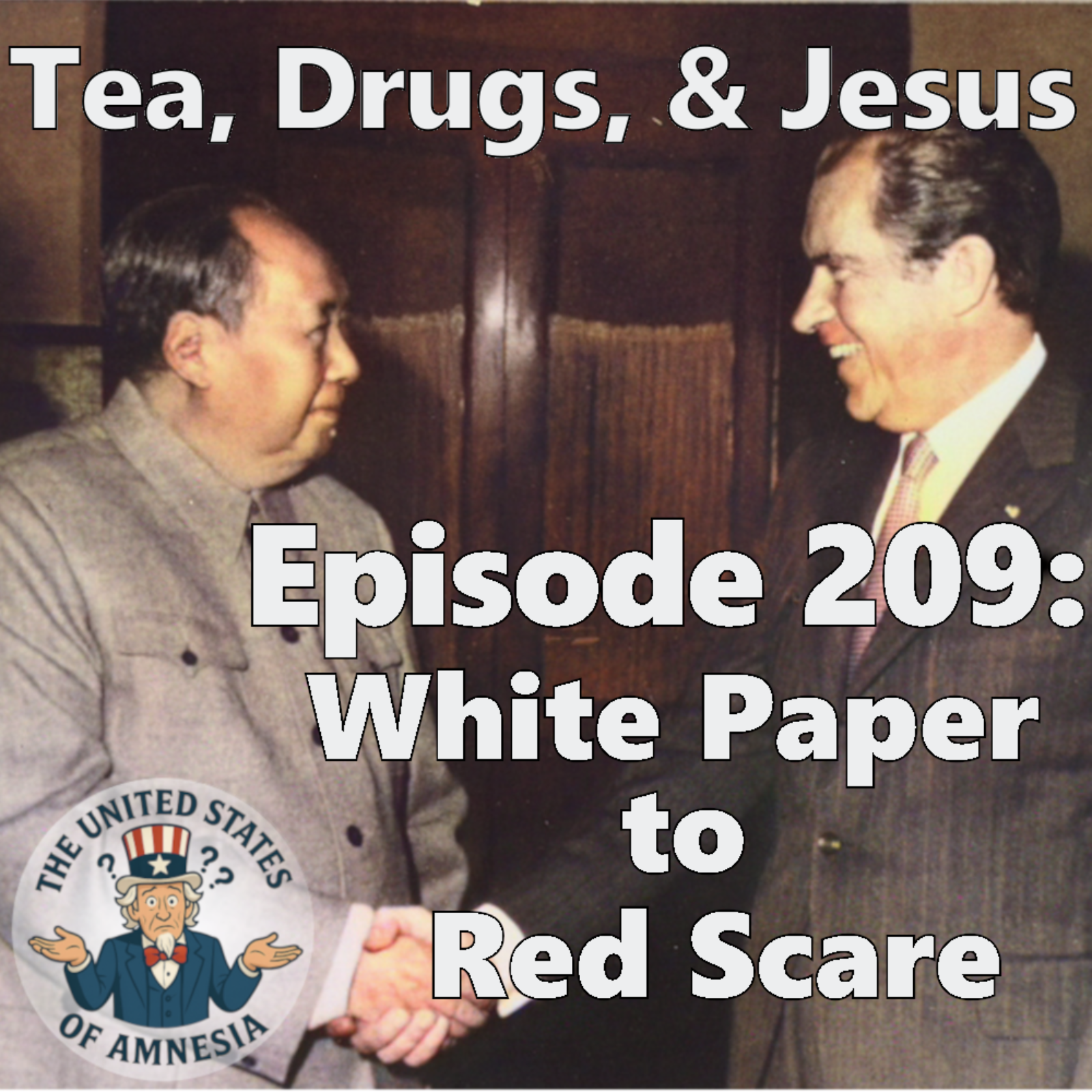
Marshall, Blake, and Mike engage in a wide-ranging discussion of American policy disputes over what to do about China after World War II. President Truman, Secretaries of State George C. Marshall and Dean Acheson, Madame Chiang and her family, General Claire Chennault, Joseph Stalin, Mao Zedong, the CIA, the domino theory, the American idea of monolithic “international communism,” and anti-colonial nationalist movements in Southeast Asia all play roles as Marshall lays out three options U.S. policymakers debated between 1945 and 1950: Should the United States follow the advice of the “China hands” by turning its back on the corrupt Nationalist government of the Republic of China under Chiang Kai-shek and instead recognize the Communist government of the People’s Republic of China as China’s legitimate government? Or should America take the view of policy realists that China had little strategic value to the United States and was a sociopolitical mess not worth being involved in? Or should America do what the “China lobby” — the supporters of Chiang Kai-shek — wanted and go all in with continued support to Chiang? When Communist Chinese “volunteers” intervene in the Korean War in 1950, the American idea that Communism is monolithic solidifies, leading to consequences in the United States that, ironically, give events in China far more influence over the United States than America ever had in China.
0:00 Let's take a macro view of things. I think this is a good opportunity for that. So there's three positions that emerge in 1949 as to what to do about China. And this is before, this is while the Civil War is still going on. Civil War is still going on. Before the PRC is declared. In October. And before there's a nuclear. Before the nationalists go to Taipei. Yeah. Taiwan. Okay. Things are making their way to Taipei. They're still fighting on the mainland. Yes. They're still fighting on the mainland. Yeah. Things like gold. and antiquities and some military equipment are making their way to to Taiwan because some people can see which way the wind is blowing but again they're still fighting welcome to the United States of amnesia we are the podcast that reminds us of what we have forgotten it is often said that history repeats itself Mark Twain allegedly said that history doesn't repeat itself, but it rhymes. But over time, many topics have become clouded by biases and oversimplifications, or have become mythologized and now are misunderstood.
1:05 Misunderstanding means learning the wrong lessons from history, perhaps, or even learning nothing at all. And that can leave us poorly prepared for history's next rhyme. In this episode, we engage in a wide -ranging discussion of American policy disputes and debates over what to do about China after World War II. Marshall lays out three options that U .S. policymakers debated between 1945 and 1950. One, should the United States follow the advice of the, quote, China hands, by turning its back on the corrupt nationalist government of the Republic of China, under shanghai sheikh and instead recognize the communist government of the people's republic of china as china's legitimate government two should america take the view of policy realists that china had little strategic value to the united states and was a socio -political mess not worth being involved in or three should america do what the quote china lobby i .e. the supporters of Chiang Kai -shek, wanted and go all in with continued support to Chiang. When communist Chinese volunteers
2:36 intervene in the Korean War in 1950, the American idea that communism is monolithic solidifies, leading to consequences in the United States that, ironically, give events in China far more influence over the United States than America ever had in China. So there's three positions. The first was to come to some accommodation with Mao. But again, since Mao does not have a government, how do you do this? What is your means of engaging with him when you don't have... Who is your head of state? Who is your this? Who is your that?
3:19 You know, who's your foreign minister? There had been negotiations between the communists and the nationalists in the past, and we had tried to broker those. Yes. How did we handle that then? Because there was no PRC government yet. There was no PRC government. How did we handle it? PRC was allowed to send representatives to those talks. Well, there was no PRC yet, but the Chinese Communist Party. Chinese Communist Party. Chinese Forces Party, yeah, we're allowed to. Yes. Provided, you know, and it was Zhou Enlai, who's later foreign minister, who is involved in that. But that was not considered a feasible way in 1949 to try to resolve anything. No, and it's actually the least popular. Of the options.
4:00 Of the options, yes. Of the three options. You know, there's nothing to accommodate. There's nothing to recognize. So how do we do this? The mechanics of this, because this all means something among people who are foreign policy professionals. Even though these things seem like little niceties to us, they are important. Yeah, you're not claiming to be a country. You're not claiming to be a government, at least not yet. So who exactly am I dealing with and who exactly am I recognizing? Just a bunch of insurgents. It makes a difference legally. If you do that, you could recognize, say, Black Lives Matter, or you could recognize ICE as a legitimate government, or whoever, if you take that attitude. And that's kind of what...
4:50 That attitude is... Who are you speaking for when you speak to me and you're just speaking for a bunch of bandits as far as I'm concerned? It's not the same thing as if you're speaking for a government. If you don't have a government and you don't have an intention to form a government, then what are you? Okay, so that was not a popular option for that reason. The people that were advocating that are people who had some close connection or contact with... the Chinese communists during World War II and the people that were going back and forth with Stilwell. These are people who are still employed by the U .S. government in the State Department and elsewhere, and these are the China hands who we'll get into a little bit more next time. These are the folks who I mentioned in an earlier episode. They had been going back and forth and coming to Stilwell and telling him that the Chinese communists were...
5:43 democratically inclined agrarian reformers. Yes. These are those folks. Yes. And they favored this approach. And I mean, they had basically been fed a line of propaganda, which they believed, just as the people who were proponents of Chiang had been fed a line of propaganda, which they chose to believe. There was no factual basis for that Chiang was some great statesman or that the Chinese communists were a benign and even helpful force. that for good in the world that only wanted agricultural reform so totally totally the positions were both were totally like they're they're emotional emotion -based yeah they're emotion -based and you're making me think too like when i was researching stillwell yeah for the for those segments we did on stillwell at one point they were discussing one of the uh chinese communist uh senior leaders or generals or whatever you know and yeah and um they had uh They were talking to him about this senior communist leader. And Stilwell said, oh, like most reds, he's a good egg. Yeah. You know, like most reds. You know, the communists are the good people. Yeah. So there was a constituency for this, I guess. And it was not based on real evidence.
7:00 It was basically propaganda, emotion. There was an inclination to believe it. I guess in contrast to what the other side was, which was a bunch of corrupt people in the nationalist side. Stillwell is a Yankee and he has got this sort of ascetic view of the world. And it's like, you know, Stillwell is the sort of person that if they're having to do an evacuation, he's going to lead it. He will put everybody on half rations and he will take quarter rations because in Stillwell's mind, if it doesn't hurt, it's not real. Almost. And so when he's seeing similarly inclined people who are willing to live in caves under very primitive conditions as compared to people who are, you know, using gold -plated toilets, he's going to go with the ones who are living in caves.
7:50 Still well had a reputation in the U .S. Army for being able to get a lot done with very limited means. Part of that was being pretty harsh about things, like you said, half rations, quarter rations. But it's true. He was able to get a lot done with very limited means. You could see why he would admire people who he thought were doing the same thing. And the same goes for the people who he was using as liaisons between himself. These guys actually could respect. You're dealing with an economy that's collapsed with a nationalist, and the only way you can get by is through corruption. This is not the view of China that they had been led to believe existed there, so they're absolutely disgusted by it. And then they see these other people who seem like, I am putting the greater good at a premium as opposed to my own survival, and so forth. And so that is... That's kind of where this is coming from, I think. I think it's almost an aesthetic choice that you make. So let's talk about the second position. And the second position was that China is totally irrelevant.
9:01 Now, that's interesting. And this is a position that Marshall had. And this is why Marshall was reluctant to contribute military forces. And this was also both during World War II. and also in the aftermath during the Civil War. So Marshall does not see a U .S. interest that is at stake, and he is constantly arguing with people over in the State Department and people over in the new Department of Defense. He basically takes that position, and Truman kind of. kind of takes some of that on, not for the reason that Marshall has. He is basically looking at Truman. Okay, so before we go to Truman, just to be clear for me and for everybody else. So Marshall's priority was, number one was Europe. Yeah. Number two, I guess, was Japan and then Korea as a way of defending Japan. and China was priority zero to him. Now, before we talk about Truman's view being different from Marshall's, let's talk about why Marshall thought this. I get that he thought Europe was important. I understand why. I get thinking Japan and Korea are important too. I understand why. But why China is so irrelevant?
10:25 He doesn't see a national interest at stake with China going in and trying to fix China. He doesn't see the U .S. getting anything out of trying to fix China, only a bunch of problems that are more or less insolvable as far as he's concerned. If I can just offer a story real quick here. I remember when I was in college, and this is back at the height of the Cold War, back in the late 70s. I had a professor talking to us about – I think it was a class on like Soviet -American relations or something. And he did – he talked about the Berlin Airlift of 1948 -49. And for those who aren't familiar with that, it was the Soviets closed access to West Berlin. They wouldn't let any trains in or anything. They wouldn't let any trucks in, which violated the agreement we had with them about West Berlin. And so we mounted this giant heroic airlift bringing food and supplies and things into West Berlin and kept West Berlin at its feet. And the historiography of it was that weren't the Soviets stupid to think we wouldn't care about West Berlin? Why did they think that this would work, right, that they could starve West Berlin and we wouldn't do anything about it? Why? And he said, well, what you have to understand is we're talking about 1948, 1949 was the Berlin Airlift. Well, at the time, we were doing almost nothing to help China, which was starting to be overrun by the communists. From the Soviet point of view at that time, it was, well, they don't care about 400 million people in China coming over. I mean,
11:56 to put it simplistically, coming over to our side, but in being communist, at least, they don't care about that. Why would they care about 2 million people in Berlin? And you know what? That's a good question. But it misled them because it turned out we cared about Berlin and not about China. But when you think about it in terms of population. I think that goes back to the bias that we have towards Europe. uh the bias i mean is a is it a racial thing is it you know we care more about europeans because so many of us are from european answer what i don't know i mean there's all sorts of things there but um it it's interesting to look at it that way isn't it yeah that we you know we didn't care about whatever 400 million people was in terms of percentage of the world population but it was a lot probably a quarter then yeah we just let it go well you're getting to that i don't i don't know that it's ours to lose Point taken. I mean, what I'm saying is the Soviet perspective on that is another interesting way of looking at it. Yeah. Just looking in terms of numbers of people. Why didn't you try harder to keep 400 million people and why are you trying so hard to keep 2 million?
12:57 See, these are the kinds of things that never were even brought up to me in school. That paradox was never even a thing. But I would again argue we do not have... as much leverage over events in China as some people seem to think that we do. Well, point taken. I mean, it's like, let me get through Truman, and then we'll talk about the third group. How did Truman differ from Marshall, then? That's where you were going. Well, Truman is kind of envisioning that things are going to set themselves right somehow or the other, that basically the communists will come in, they'll fail. And then they'll get kicked out. There'll be a different kind of government. It won't be as corrupt as the Nationalists. It won't be communist.
13:44 It'll be something better, and it'll be a good government. Now, I'm just going to say this. I do like Truman. I grew up hearing all sorts of great stories about Truman. But this is a totally unrealistic... way to assess an outcome here. And I would also argue that this is something that we see us doing in various other places around the world, not just China, but say, think about Vietnam, think about the Middle East, think about Iraq. You know, we are going to assume a positive outcome when we go into some of these places. That is – and even a democratic outcome, which is kind of what Truman – and again, we're dealing with – and we cannot stress this too much – a country with 90 percent illiteracy.
14:37 And you can't have a democracy without that. So this begs the question. Without literacy, you cannot have a democracy. Which all begs the question, why did Truman – why was Truman so sure, if that's the right word, sure, that the communists would fail? He viewed it as a system that did habitually fail. You know, he did not view it as a system that— I mean, the Soviets just beat the Germans. Yeah. That was a pretty tough fight, and they won. Yeah, but it's still— The Soviets were our big challengers on Earth. The Communists were doing pretty well in 1948, 49, 50, if you want to look at it that way. So why do you think that's going to fail there? Well, he felt it was a system that was incapable of— Lasting. Of lasting. And if you think about it, Truman is right about this because eventually communism does fail. It took another 40 years.
15:34 Yeah, I mean, Truman had been dead for like something like 20 years when it happened. Communism failed. China remains a communist government, but it remains that by actually. reforming itself to adopt a lot of capitalist ways of doing things, right? It's kind of this weird kludge of capitalism and communism now. It's more capitalist than communist. Yes. It's more of a dictatorship than it is... The Communist Party is the autocratic system that kind of perpetuates things in China these days. I get the idea that... you know communism is doomed to fail it's destined to fail okay but you sure are putting a lot of your eggs in that basket in 1948 or 49 you are i'm not just assuming like you're saying to assume a positive outcome of that nature at that point is you know A lot to assume. And it's not – but again, it is not just Truman that does this sort of thing.
16:36 If you look at stuff that happens with Vietnam, there is always going to be a positive – we're entering – we see light at the end of the tunnel, et cetera, et cetera, that things are going to right themselves and we're going to be able to walk away. And South Vietnam is going to remain a democratic government. And that didn't happen. Okay, so now we're comparing and contrasting Marshall and Truman. So if I understand you, the difference is Marshall didn't really care about China or think we had any interest there at all. And felt there were more pressing interests elsewhere. More pressing interests elsewhere. Truman felt that China mattered more, but he thought if he just left it alone, it would work out on its own without us having to commit too much to it. That's his initial going in. That's his initial proposition. So that's the difference between. Marshall and Truman, at least at the beginning. Yeah. Okay. Fair enough. All right.
17:29 You know, and Acheson wants to take, when he becomes Secretary of State, he wants to take an almost wait and see type attitude. He feels like things are too much in a flux. to actually come up with a solid policy that's going to have any chance of succeeding any one way or the other. And so Acheson is coming in at the beginning of the second Truman administration. So that would be January of 49. And of course, the nationalists don't retreat to Taiwan until December of 49. So he's got about a year to work with here where he's thinking this. Okay. All right. So the third position is to double down and support Chiang Kai -shek. Okay. Okay. So this is a position, you know, we need to think about that during the war there was this idea people went over to China as missionaries or on goodwill missions.
18:44 They were given a dog and pony show by. Chiang Kai -shek and his wife. They would be whisked off to these very lavish estates that they had. They would be given a vision for the future that included, in some cases, Christianity. Christianity would be in the back of everybody's mind here because both of them were Christians. So a couple of episodes ago, we talked about in the interwar period, 20s, 30s, 40s, the missionary influence and how they had been They bamboozled into thinking that, because they really wanted to think this, that China was going to modernize under Chung. It was going to work out. Well. We talked about that. And Christianize. Christianize and modernize.
19:27 Modernize and Christianize under Chung. Yeah. And we talked about that at some length. So this third position is them still saying that. Yes. As things go south in the Chinese Civil War. Yes. And I mean, a good example of this is. Congressman Walter Judd of Minnesota. And he is a former missionary to China. And he is, through the sweat of his brow, he gets elected as a congressman. And he actually went on a tour with Truman at one point in 1943 when he was a congressman and Truman was a senator to kind of speak on behalf of the United Nations. Walter Judd is also a very good friend with Madam Chang, and he is visiting her in Riverside, New York. And she wants to make sure that she's got him in her corner. Another person is Truman's own Secretary of Defense, Lewis Johnson, who is very strongly...
20:40 and favorably impressed by Madam Chiang Kai -shek. He basically, at one point, makes a comment to a congressman that he knew where they could get all the money he needed from a source that he declined to name, but it basically hinged on policy regarding China. Truman has kind of a divided government. He's taking a kind of utopian take on China. Acheson is taking, we don't want to get involved in China. And the Secretary of Defense is taking a position, we do need to get involved in China, and we do need to commit military forces there. Now, within that, because things are confused, CIA is kind of a new organization.
21:40 You have people involved in the CIA who are saying, maybe we need to be setting up covert assistance to some of the remaining Chinese generals that are still on the mainland and provide them with aid to be able to resist. Now, when you were talking about the Civil War continuing, the areas where these Chinese generals had influence were in the western part of China. a lot of people taking an interest in the defense of China thought Tibet was very much an isolated area that they could actually conduct operations from. And so covert planning, covert operations on a limited scale were ongoing mainly because no one had authorized them, but nobody said you couldn't do them. So people are like using their initiative to go in and involve themselves in these types of matters here. Go ahead and do it and apologize for it later. Yeah. Yeah. They figured that, you know, and again, CIA has just been set up in 1947. And it was the successor organization to the wartime Office of Strategic Services or the OSS, which was a sort of centralization of.
23:00 intelligence for the policymaker. They're basically channeling that old OSS spirit of daring do here in their approach to China here. So the thing that they're forgetting here, and I hate to keep hitting on this, is how do you support operations in the western part of China, in Central Asia? How do you supply that? How do you supply, if it's difficult for the Chinese to get to Tibet, it's difficult for you to get to Tibet because you're not in the country. So all of these plans that came up when I was researching this, they were all horribly impractical. And I'm just going to say, this is not the first time we're going to see people like the intelligence services come up with highly impractical operations which are cute in the sense that they're complicated, but by the fact that they are complicated, that means that they're highly likely to fail. We saw a lot of that in 1949. And when you think about what you're saying there, too, and again, we talked about this in the World War II episode, how we had that large airlift program project, the over -the -hump flights to get from India into China to support. Chung Kai -shek's government and later Chennault's planes and later the B
24:33 -29s bombing all that, but bombing Japan. I mean, but that was a major effort. And, you know, airlifts have their limitations. They can do heroic things, but there's only so much you can bring in by air. Hence all that fighting in Burma over the Burma Road that we talked about too, you know. But the Burma Road doesn't go to Tibet. I know. So, you know, that's not helpful if you're going to be based in Tibet. And you've got the Himalayas in the way and all sorts of stuff. Yeah. I mean, with Stilwell, Stilwell has an appreciation for logistics and for how you supply an army, some of these, or an air force for that matter. And this is not necessarily an appreciation that, say, some of these guys over. CIA was actually in a series of temporary buildings on the Mall at the time. They weren't out in McLean. For our listeners who aren't that familiar with Washington, D .C. geography, the National Mall that Marshall is referring to is the large park. It's about three miles long. It runs from the United States Capitol Building down to the Lincoln Memorial.
25:37 The Washington Monument is on the Mall. He mentions McLean, Virginia. McLean is a town. or a populated area anyway, in Northern Virginia across the river from Washington, D .C. That's right. People that are like living in these sort of temporary buildings over by the reflecting pool, they're coming up with... The reflecting pool, that's another Washington, D .C. landmark. It's an artificial pond that lies between the Washington Monument and the Lincoln Memorial. And at the time... This area was heavily inundated with all of these buildings that had been erected since World War I and even World War II, and this is where CIA was housed, and these guys were coming up with ideas. They aren't really being vetted in the way that they should be, and they have some resources that they can expend, but no one's really bought off in championing them other than, say, maybe...
26:33 uh secretary of defense johnson who's kind of like yeah we need to go in and get tough with with the communist year it's it's more like wouldn't it be cool if we could do this yes there's a lot of serious planning to do it yes yeah yeah that that you know People were impressed by the whole daring do of this. As Mao's forces are beginning to take territory and Chiang is moving gold, cash, and military supplies to Taiwan, Dean Acheson decided to have the State Department put down, how did we get there from here? And they did this in the form of a China white paper, which they wrote, which was meant to kind of go in and... look at what the United States had done as far as Chiang Kai -shek's government went, and what the response was. We don't hear the term white paper very often anymore, but that's a policy document, right? It's a policy document, and it's meant to inform policy and say, look, this is, in a manner of speaking, just given what the conclusions of the document were, was that... Chang was incompetent. All the aid that we had given them was useless. It didn't support anything. We should just cut them loose. Now, this is exactly what Madam Chiang Kai -shek is most fearful of, that this is the end of the gravy train. And so she is, again, entertaining all sorts of people at her, yes,
28:06 it's her sister -in -law's house. It's her sister's house. and brother -in -law's house up in upstate New York. And she's entertaining all these officials there, fearful that this is going to go away. And there was a lot of U .S. largesse that had basically been used to support her family, her immediate family, and her in -laws over the last 10 years. So her brother, her brother, TV sung. He's one of the richest people in the world at this point, and I don't think he got rich in the family business of printing Bibles. During World War II, he had been Chung's representative to the U .S. government. Yes. Chung Kai -shek's representative to the U .S. government in Washington.
28:50 Yes. Played a big role in that. And he was, you know, again, you know, when I said that... When I made the statement that what you have is the Song Dynasty coming in, you see all of these people playing different roles within Chiang Kai -shek's government through nepotism and so forth. I mean, they're an impressive family, but they're also corrupt as hell. And they're living off the fat of the land. What gets created is something that we can refer to and history refers to as the China lobby. And the China lobby is something that is financed by the Kuomintang.
29:33 Now, make sure everybody understands. The Kuomintang is the Chinese name for the nationalist party, the nationalist government. The nationalist government. Thank you for that. It's pronounced Kuomintang. You'll see it spelled as if it's spelled Kuomintang or Tang. You pronounce it Guomindang. That's what the Guomindang is. So when you hear that or the KMT is an abbreviation for it, that is a synonym for the Chinese Nationalist Party and government. So you have this political party that is basically taking resources and... And the China lobby has a real name, and it's basically the Million Man Committee or something like that to prevent the recognition of communist China.
30:22 But they actually set themselves up to become a force to be reckoned with on U .S. policy in China from 1950 to the 70s when one of the people who they are sponsoring, One, Richard Nixon, because he was part of this, basically decides that we're going to go a different route with China here. I want to ask you one thing, though. Yeah. You mentioned the three options. Yeah. One option I did not hear that you mentioned, right? I'm not saying it was an option, but I'm saying one thing I did not hear you mention among the options was this persistent idea, among some Americans at least, that the communists... were the good guys that the communists were the agrarian reformers right that they were democratically inclined now no there is recognition so that that is what i'm trying to get what i'm trying to get at is the first option is recognition of mal right well what i'm trying to get in what i'm trying to get to there is that must have fallen by the wayside for there to be only those three options because none of those include that possibility was there any I mean, maybe you couldn't have this in all the communist scare times and like that, but I'm just saying. We're getting to the communist scare times. Yeah, but was there any at this point? Had that been discarded? Was it still an active thing? Was it a minority opinion?
31:44 Where did it stand at this time? The furthest anybody was prepared to go was basically just to recognize Mao, you know, as the government. And that is as far as. policy was prepared to go at this point. But that was not considered one of the three options. That is one of the three options. That's the first option. Was to recognize Mao was the first option. And you couldn't do that because there's no government. Oh, okay. I'm with you now. Okay. Okay. I was confused there, right? I thought it was you couldn't recognize. Yeah, okay. Should we recognize Mao? No, we can't. There's no government. But that's not an anti -Mao statement. That's a... Just that there's no practical way of doing it. There's no practical mechanism to do so at this time. It doesn't preclude you from doing it. But the should we recognize Mao argument descends from the idea that these are the agrarian reformers who are democratically inclined. Now I'm with you. I've got it now.
32:39 And in terms of like anybody who's just like pro -Mao in this sense. that's really a minority position. I mean, if we're just going to say, like, we love Mao, that's very much a minority position that it's going to be limited to kind of the remnants of the Communist Party. which was not as influential as some people would have people believe. The American Communist Party. The United States Communist Party, yeah. I mean, there were people who were following this, but it's not the central part of the American Communist Party movement. I mean, that's Stalin. It's not Mao. Mao doesn't come into it. Like you said earlier, the Soviet Union and Stalin himself, he was the sugar daddy of all communists, wasn't he, at this time? You didn't have any... Other option. You didn't have any other options here.
33:37 And I mean, that's going to change. Because nobody knew what Maoism was yet or was going to become or any of this. I mean, there was a profound ignorance about the Chinese Communist Party and its officials. And this would persist until probably the 80s. And it's better, but it's not what it should be. What happened as 1949 progressed and the fall of China became imminent reactions became, particularly from this third group, even more hysterical. People asserted that Mao taking over China would lead to World War III. So the third group is the pro -nationalist group, right? Yes.
34:39 So again, this is trying to build a fire under Truman and Acheson to do more. Oh my God, the nationalists are falling. You guys have to do something about it. Yes, and there's all these consequences. And again, as we're seeing... As we're seeing in a number of cases, there's no factual basis for some of these conclusions here. Like World War III, why is it going to be World War III? You know, this is hysterical. This is something that will get people's attention and people will look at it and ponder it gravely. But it's like, what's your evidence that once Mao takes over China, that World War III is going to break out? You know, is he going, you know, Mao does not have a navy. He doesn't have an air force and he's not going to get planes and ships. until after the Soviets decide to give him them. And they're not going to be giving them aircraft carriers or anything that can do power projection. So again, where is your issue with this? Why does World War III come up? Another thing, and this is where we see the introduction of the domino theory. People don't understand that people are taking the monolithic, this is where we're getting in also into monolithic communism, but it's like, Okay, this is essentially an internal Chinese movement that began in 1919. That's what
36:11 the Communist Party of China is all about. It is not about, you know, some sort of thing that Stalin's pulling, lever that Stalin is pulling in order to destabilize the world. It has been a process that has been going on for a long time, and it is an indigenous one. It is not necessarily something that where we would necessarily see export. And in fact, in Mao's conversations with Stalin, he said, I need three to five years of relative peace to rebuild the country. The country's shattered. There is no appreciation for just what state China is in. Even though we've had people on the ground and doing this, there are statements that are totally ill -informed, and those are the two most hysterical ones. But they're asserted very loudly in the press and by people who are becoming part of this China lobby that's going to be... trying to support Chiang Kai -shek and his wife. Let's consider the domino theory for a second. Yeah, I was going to ask that.
37:21 So go ahead. What were you going to ask? No, you go. Well, I was going to say that, so the domino theory, the idea was that one by one, like a set of dominoes falling, the world was going to slowly go communist. Yes. And the only way to stop that was to stop it. wherever it was starting, wherever the first domino was. Yeah, by force. And if you lose, if you don't stop it at the first domino, you've got to stop it at the second, the third, the fourth, etc. And that was the idea. The domino theory is widely discredited now, but it was a very real thing for people back in circa 1950 and on beyond that, into the 60s and beyond. One thing I'll say about the domino theory, one part of it that was a little bit right. was that, in fact, China went communist and Southeast Asia went communist.
38:07 Well, we helped. Well, just leaving that aside, though. Just leaving that aside, though. It did go communist. So people would say, well, see, it was partly right. Well, it didn't get to Burma. It didn't get to Malaysia. Taiwan. It didn't get to Taiwan. Thailand. Thailand, sorry. Yeah, it didn't get to Thailand. And dominoes did stop falling. That's one thing. Although some dominoes fell, but did you understand what happened there is the other question. And the thing was, is we were still thinking about that in terms of monolithic communism. Okay, the communists, the communists have China now. Now the communists have Vietnam. Now they have Laos. Now they have Cambodia. Burma will be next. Thailand will be next. You know, whatever, right? Well, the thing about it was that what was misunderstood is that these were nationalist movements with a communist ideology. Yes. Yes, they gave some lip service to international communism like that. It was an ideological thing. But their basic thing was about China, about Vietnam, about Laos, about Cambodia. And so that's what was wrong with the domino theory. There were some superficial things that looked right. Communism took over China.
39:15 Oh, now look at Vietnam. Now look at Southeast Asia. Yeah. But that's superficial because it doesn't really get at what was really going on. And we're not here to talk all about Southeast Asia or anything. It's just interesting to put that perspective on it. Well, something to consider is that if you're talking about this as an intellectual matter, if you're going to be looking at any group that's going to be opposed to traditional imperialism, which is what these national movements are a reaction to, the only game in town are the communists at this point. Now, they have their own. reason for like promoting those types of things because it disrupts the the life and economies of the adversarial capitalist powers but at the same time these local these local movements they see something that they can build on you know It gives you a franchise you can use. It gives you a franchise, yes. To get your way, right? I mean, the same happens in the Middle East as well with some of those movements that come in post -colonial that are going to happen during the 50s and so forth. And sure, there's some common communist things about it. They're not so into private property. They want to do land reform. They want to take land away from the rich people and give it to the poor people.
40:35 They do things like that. Sure, they do communist things. They are communists. And it's autocratic, though. And it's autocratic. It always has that feature to it, too. But it's based fundamentally on nationalism, on anti -colonialism, on things like that. If you're going to just view it as an international communist movement, you're going to miss a few things. And we did. Yeah. Seriously. You maybe could have made nice with some of these communists. which they were, but gotten them to support them in their anti -colonial efforts, they might have liked you better afterwards. You might not have had the wars and things that you had later on. What we had under Roosevelt, and even though we talk about Roosevelt and the fourth policeman idea as being totally impractical and totally unrealistic, Roosevelt did get the big picture that anti -colonialism is coming, and he wanted to be at the forefront. He just didn't quite... have a way to get involved in this and his his only way was to find somebody who is a non -white asiatic power and all he's got to work with is in terms of independent countries or china and japan and japan's the enemy so that leaves you with china but it's like When we go in after the war, it's like we're put in this position, which sometimes we take the anti -colonial view, say with Suez, which was a 1956 crisis
42:06 involving an attempt by the British, the French, with some help from the Israelis to retake the Suez Canal from the Egyptians. But then we also get with Indochina. That's another matter where... Indochina is Vietnam. French Indochina is what is now Vietnam, Cambodia, and Laos. And the French were trying to reassert control, and we supported their efforts. Not because we wanted to support French colonialism, but because people who wanted to reestablish the French Empire were also trying to beat the communists, and we wanted to stop international communism. As we called it. As we called it. So we had the same... separate goals for what was going to happen in French Indochina, but they converged because in both cases you're fighting the communists. Yeah, and most people will not even realize when you talk about the Vietnam War that the French were there way before for a century or something like that.
43:07 And the French were bastards. They were absolute bastards in Indochina. In Vietnam, they were absolute, I mean, they treated the people there really like animals. I mean, there was racism in the British Empire, but people were at least recognized as humans, an inferior form of humans in their world. But the way that the French treated the Vietnamese, it was just like something that you would, you know, like a hamster or something that you would like tease or provoke or what have you there. These were people that lacked humanity in the way that they ran things there.
43:51 I didn't mean to derail us into a big thing about Southeast Asia because we're trying to hear, but it shows you, you know, it just shows you how these things all. work together to drive the United States toward a way of approaching these things, which on sober second thought years later, wasn't a very good one. But you can't understand things of the time without understanding the thinking of the people at the time. I know that our focus is China, but I do not. want people to come away from listening to the podcast thinking that we're only talking about china that china is the only application for this and so you bringing up southeast asia i think it's a good thing so um it's all part of a bigger it's part of a bigger issue that we're trying to address in terms of attitude understanding those kind of things towards other countries i mean you know if we if just one to belabor one more point on vietnam Poor old Ho Chi Minh had been approaching us over and over again like, hey, I want to play on your team. And people just freaking ignored him until we're fighting him. I mean, Ho Chi Minh was making overtures to the United States beginning in 1919 at Versailles, which he had made a special effort to go to Paris to try and engage Woodrow Wilson, who had very little time for him. What we were looking at after Mao did declare government on 1 October was to try and— 1949. 1949, to prevent
45:24 recognition of this new government by our allies here. I mean, who wanted to prevent it? We did. The United States wanted— Particularly Dean Acheson wanted to prevent it. Dean Acheson, okay. So Dean Acheson made overtures to— to Ernest Bevin, who is the secretary, or he is the foreign minister for the British. And Bevin is a staunch anti -communist. He was... As only a British labor leader could be. That was his background. But even then, the British felt like they had more interest in sort of maintaining a stable relationship with Hong Kong and various trade issues that they had with China. That was kind of, if we think back to the first episode, the sort of things that were driving British interest in China was trade. several months of the government being declared. This was a total defeat for the United States. We are not going to recognize China, just to look ahead. The People's Republic of China. The People's Republic of China. As the legitimate government of China. Until Jimmy Carter is in the White House. They were very proud of that too. But Mao at this point, if we want to look at where his attitudes are, he
46:56 perceives You know, some of this is Stalin kind of sweetening the pot there, but he perceives that the United States is very eager to overthrow him. He is unlikely to trust the European former colonial powers. So that leads him to have only one friend and one friend only, and that is the USSR, the Soviet Union. U .S. didn't have... any indication of what Mao's thoughts were at the time in terms of having deep understanding of Mao. And we had kind of been withdrawing forces from the region as Chiang Kai -shek's government and forces are disappearing. But, you know, one of those guys who had made friends with the communists back in... during World War II as an envoy might have been useful at this point. And who are you talking about? The China hands. The China hands, the people that had been telling Stilwell that these were agrarian reformers who had... Democratic inclination. Yes, but they also had established some sort of relationship. We had people in the U .S. government who had a relationship with the Chinese communists. During World War II, they were shuttling back and forth between Stilwell's headquarters and the communist capital. Yeah,
48:30 all the time they were shuttling back and forth. Yes, and so this... is a missed opportunity, I would say. Maybe this is something that is not realistic on my part to wish for or to hope for, but I still think that that would have been a good thing for us to have considered. Right. So those folks existed, but they didn't really have any voice. In policy matters. In policy matters. They were around saying what they said, but they had no voice. They had a kind of negative capability about the abuses of Chiang Kai -shek, and they were involved in the China White Paper, which the China lobby is basically saying. the conclusions are all wrong. We didn't do enough for China. We needed to do more, which... Which means for nationalist China. The China lobby is for the Chiang Kai -shek government. Yes, for the Chiang Kai -shek government. We didn't do enough for the Chiang Kai -shek government.
49:28 We should do more. And all we needed to always... was just a little bit more. Just a little bit more. A little bit more. All we need, this could be done on the cheap, even though we've spent billions of dollars doing things on the cheap here. Cash my check. Cash my check. Which is what Claire Chanel promised, right? Give me a few planes and I'll win this thing for you. And we got the same thing from CIA as well. All we needed to do was find some generals. that were still on the mainland. And Chiang didn't like this. He did not like this idea of, like, all of a sudden, all this U .S. largesse is going to go to a different general, and he's going to have no control over it, and there'll be other generals that are with him that are not sharing in the bounty of this. So even as he is sitting in Taiwan, you know... totally self -unaware that this approach has not served him well, this is still a concern for him. But this is deeply ingrained in military culture in China. At least, I don't know about the communist side, but in the nationalist side, and the warlords before them, and the imperial time before them. We've talked about this over and over again in this series, that idea that the largesse comes to me, and that's my political power within the system. And I don't want to use it up and get it all beaten up fighting somebody. Fiefdoms.
50:50 And it's my fiefdom. It's my power base is having that stuff. And even though those guys over there are fighting my enemy, I don't want to give it to them. No. We've seen it over and over again. Because I've lost control and I am no longer – It's not about us winning the war. It's about me winning it. Yes. If they win the war, then I lose. Even though they're on my side. They're on my side because now they're in charge of my country instead of me being in charge. So it's a whole – You know what? We're laughing. It's an understandable – if you change your mindset, try to get in their minds, it's an understandable way of looking at your role in your society, I guess, and how your society works. It makes your brain hurt. From our perspective, I think that it would work that way. But once you get inside the way they think, it kind of makes sense, I guess. But it's not an effective way to fight an enemy. Well, you see, that's the big problem that we're having with this. It's like we're trying to come up with an effective way to fight the enemy. Culture that has driven relationships within China. which we do not appreciate at all, even with having people there, even with having people having experience. Well, it's deeply alien to us to look at a war that way or military forces that way or how you supply a military or fund a military that way. But it creates problems when you don't take into account, and again,
52:24 it is not just China that we're dealing with in terms of not appreciating local culture, and how people relate to each other within the culture. It's not just China. Again, if we look through the 20th and 21st century, our inability to appreciate these things, not just in Asia, but throughout the world, this creates problems for ourselves, which we go around and are surprised by constantly. We ought not be surprised. We ought to take these things into account and prioritize them in terms of developing. deep and penetrating understanding of friends and adversaries. Before we finish up this episode, I'd like to leave it in Moscow in 1949. 1950, Mao decides after he forms the government, his first official act is to go to Moscow by train to meet with the man with the plan, Joseph Stalin. And again, he basically has only Stalin as an ally at this point, just based on his worldview, thinking that we're out
53:56 to get him. Stalin tended to view Mao as a supplicant. And this was not really Mao's, Mao did not really, Mao was one, but he didn't enjoy being treated that way. It was when Stalin had his birthday, when Mao was up there in Moscow, and Mao was kind of made to utter some lines at the birthday celebration of Bolshoi. praising Stalin as the great leader and so forth. It was almost like he was a performing dog. But when he wasn't brought out for ceremonial purposes, Mao was kind of treated like an afterthought, a loose end that needed tying up. So the quote that apparently the Russians knew this as well because the place was where... Mao was staying was heavily bugged and all the communications were intercepted.
54:58 But Mao basically in frustration while he was there said, I did not come to Russia to eat, sleep, and shit. So he was waiting to talk to – he was constantly on tether hooks waiting to talk to somebody like Stalin or somebody important who he could negotiate with. So Mao was an earthy man. Yes. We earlier observed that Ho Chi Minh was an earthy man as well. So Mao was as well. It's a communist leader thing, being earthy. Yes. Well, particularly if you're a base supporter of peasants. Yes. Yes. So Mao comes in, and I mean, this is, again, how little things change. Mao comes in and immediately requests $300 million in credits from Stalin. And Stalin looks at him and he says, what are you going to use it for?
55:48 Well, Mao did need – have an idea that he needed planes and he needed a navy. But he basically – his answer to this was, we'll figure it out. Just give us the money and we'll figure it out. Because Mao wanted to complete the conquest of all of China. Yeah. For the PRC government. He wanted to extinguish the Republic of China, the Kuomintang. Yeah. He wanted to – the nationalist China. They did not control everything at that point. There were some offshore islands. And, of course, there was Taiwan that was still under the Republic of China's control. So to get there, he's going to need an air force and he's going to need a navy. So you can see why he's focusing on that at this point. The nationalists were able to do some blockade actions off of Shanghai.
56:33 And one of their chief victims was a U .S. merchant ship pulling into Shanghai. This is sort of like how disruptive everything is. And, yeah, there was a huge shell that was fired at this particular merchant ship. But that just showed you just who had the command of the seas in the area. It wasn't Mao. Did this upset the United States? We kind of tended to overlook it at this point. Okay. All right. You know, it's like it's, you know, fog of war, et cetera. Oh, all right. Mistakes were made. Mistakes were made. Okay. So Stalin kind of, you could imagine Stalin kind of looking at this request from Mao for all this money and these resources and things. And he said, well, you know, you're in a pretty good shape, that he should be fined. Because the United States really doesn't want war with you, which probably, which was a change in his assessment that had been provided to Mao before. He said the Europeans are exhausted. They're trying to rebuild. So is Japan. And I think this is an interesting statement about what Stalin intended for Mao.
57:50 He says the only thing you have to worry about is North Korea. And by that meaning North Korea invading you because you're the only ones who are on your borders who have a kind of martial spirit that wants to do something. Stalin is the person who had control of Kim. That would be Kim Il -sung, and he was actually the founder of North Korea. Kim was constantly asking permission to go and invade the South, and Stalin was like, no, no, no, not yet, not yet, not yet. And then eventually he does. On June 25th, 1950. North Korea attacks South Korea. And Stalin's take with Mao was, and now what are you going to do about this? You know, he was very much, you know, Mao liked to keep people, I mean, Stalin liked to keep people kind of off -center. And so we have this invasion of Korea that happens. And I would argue that it is as much for the benefit of... of Stalin's relationship with Mao as it is Stalin's relationship with the United States.
59:06 So this actually kind of, in terms of how it affects the United States, we have a series of three events. We have the Russians gaining their own nuclear capability. We have the fall of China. And we have the invasion of Korea. These are the events that people draw together and conclude there is something called monolithic communism out there. And this is something I think we're going to get into. But that war actually created and solidified this. This also fostered the blacklist and the Red Scare within the United States. The irony of all this is we are going into China back in like, you know, the 1800s, during the 19th century, trying to change China with our missionaries and technical capabilities and things like that. China is actually exerting more of a control over our society than we are ever able to exercise over their society as we see what happens at the end of 1949 and by the middle of 1950. And what happens in the Korean War?
1:00:28 The North invades the South, the United Nations, in June 25, 1950. The United Nations responds, drives the North back up to the Yalu River, which is the border with China. And much to the surprise and discomfiture of the United Nations forces, China intervenes in the Korean War. With volunteers. The People's Republic of China intervenes. Not as a state, but volunteers. In October 1950. And shoves us all the way back. And so we did not realize the acrimony that the People's Republic of China held toward the United States. fully realize it, really get our arms around it at all, until that intervention happened. It shocked us, and it led to a break with the Chinese communists by the United States that would last for 20 years.
1:01:24 Now in response to this, and this too will have a big impact on U .S. foreign policy in the region and our relationship with China, the solution that kind of came to pass that both people like Acheson, who were realist, and people like the China lobby, which were pro Chiang Kai -shek and his government on Taiwan, was to establish a kind of buffer zone that surrounded China. It stretched from India all the way through to South Korea, Taiwan, and Japan. And our intention by establishing this was to create a kind of means of containing Asiatic communism the same as we were doing in Europe with containment over in the European theater. The area that's going to get us particularly excited is, of course, going to be Indochina or Vietnam, which is embarking on its own civil war. After they managed to throw the French out in the early 1950s. When was Dien Bien Phu? 1954. 1954. Which was the decisive battle. The Battle of Dien Bien Phu was the decisive battle in French Indochina that finally defeated the French. The French gave up on retaining it
1:02:54 after that. And that's what gave Vietnam, Laos, and Cambodia their independence. But with Vietnam divided into two zones. Yes. So we will look at some of the implications of all of these things in our next episode. Either way, email us at usa .amnesia at gmail .com and let us know what you think. Also, let us know about anything you think we missed or got wrong. We'd like to know about that too. And of course, please like and subscribe and let your friends and neighbors know about us. We also have a website. It's www .usofamnesia .com. For Marshall, Mike, and myself, Blake Hinckley. Till next time.