
 Spotify

 Amazon Music

 Apple Podcasts

 YouTube
205: Tea, Drugs, and Jesus - The Soong Dynasty
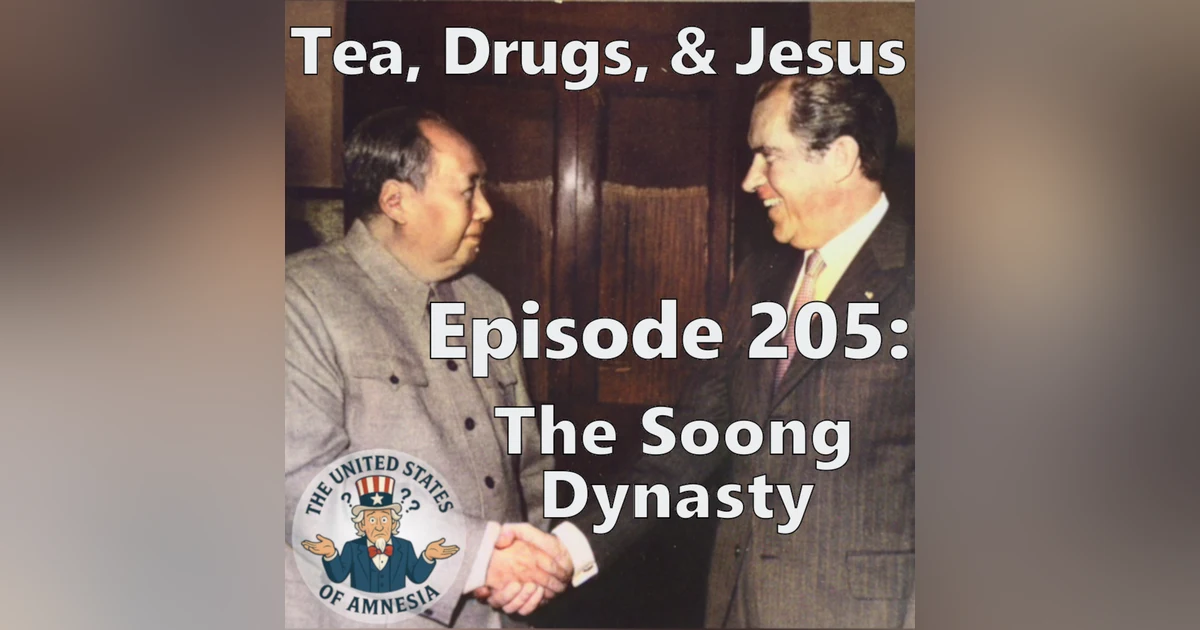
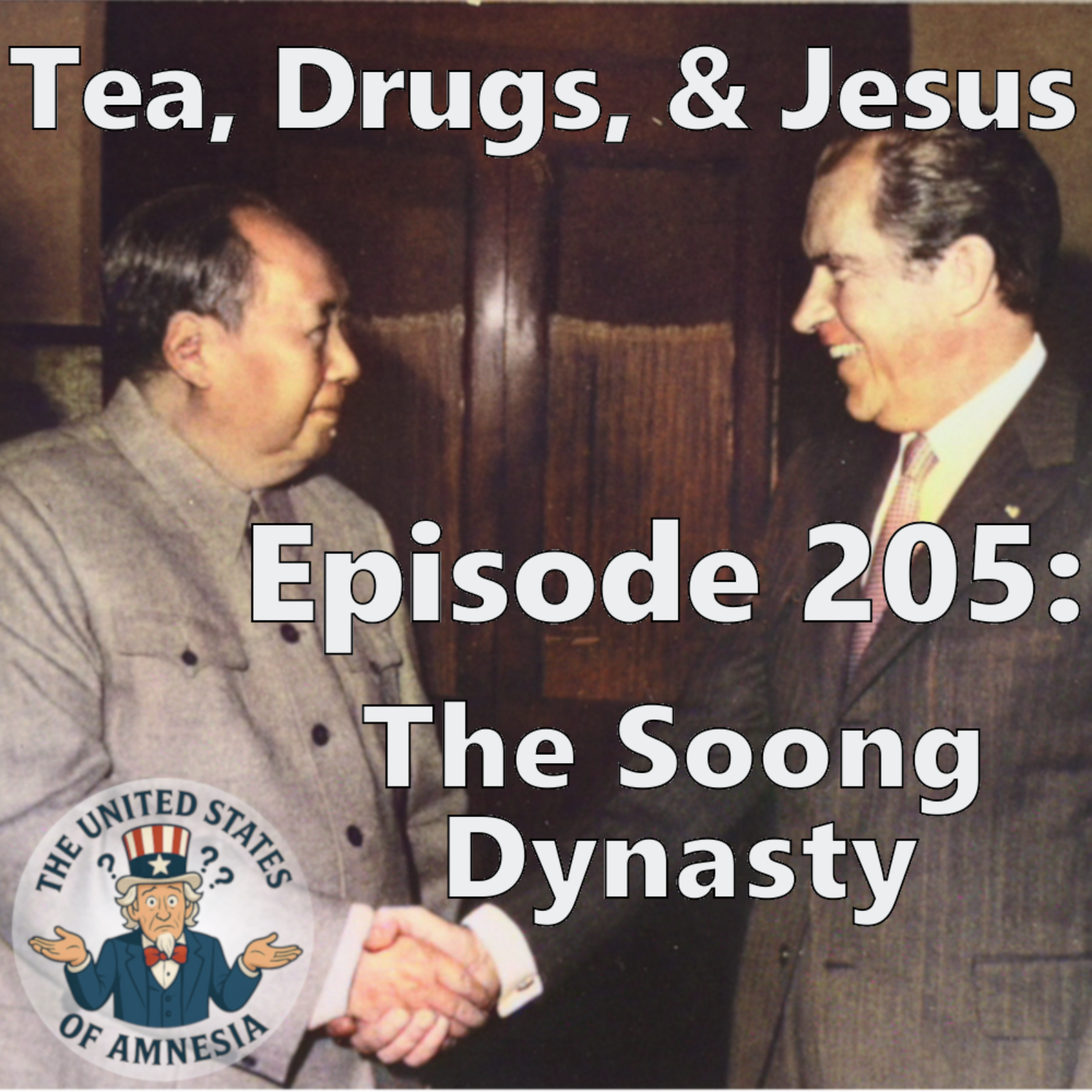
Marshall, Blake, and Mike discuss America’s view of China from the 1920s through the early 1940s and the strong influence Americans raised by missionaries in China, notably Henry Luce and Pearl Buck, had on that view. Chiang Kai-shek emerges as the leader of the Republic of China, and Americans contribute money to Chiang and his in-laws, the Soongs – who have become China's new "dynasty" – in the belief that they will use it to modernize China. But Chinese corruption, Chiang’s inability to gain control of the entire country from warlords and Mao Tse-tung’s Communists, and war with both the Communists and Japan obstruct that modernization and make it unlikely that China will emerge from World War II as one of Franklin Roosevelt’s “Four Policemen” of the postwar world.
For a more immersive experience while you listen, visit our image gallery for this series at https://www.usofamnesia.com/blog/photo-gallery-for-tea-drugs-and-jesus/.
Check out our website to learn more about us: www.usofamnesia.com
0:00 What we're going to look at now is what has been happening with regard to Chinese internal affairs and how this is being impacted by some of the missionary culture that we looked at in our previous episode Welcome to the United States of Amnesia We are the podcast that reminds us of what we have forgotten It is often said that history repeats itself Mark Twain allegedly said that history doesn't repeat itself, but it rhymes. But over time, many topics have become clouded by biases and oversimplifications, or have become mythologized and now are misunderstood. Misunderstanding means learning the wrong lessons from history, perhaps, or even learning nothing at all. And that can leave us poorly prepared for history's next rhyme. In this episode, we will discuss America's view of China from the 1920s through the early 1940s and the strong influence Americans raised by missionaries in China, most notably Henry Luce and Pearl Buck, had on that view.
1:21 Chiang Kai -shek emerges as the leader of the Republic of China and Americans contribute money to Chiang and his family in the belief that they will use it to modernize China. Several factors impede that modernization from being realized, specifically Chiang Kai -Shek's family's corruption, Chiang's inability to gain control of the entire country from warlords and Mao Zedong's communists, and simultaneous war with both the communists and Japan. These historical struggles inside China make it unlikely that China will emerge from World War II as one of Franklin Roosevelt's four policemen of the post -war world. The republic was established by 1912 and essentially what existed within China and people just did not have a sufficient appreciation for this. I remember reading books about Sun Yat -sen who was the quote -unquote president of the first republic and really he was President in name only, there was no real republic that exercised central control over the country as a whole. You had attempts to reestablish the monarchy. You had various warlords breaking out all over the place, attempting to reassert control. There was no central authority.
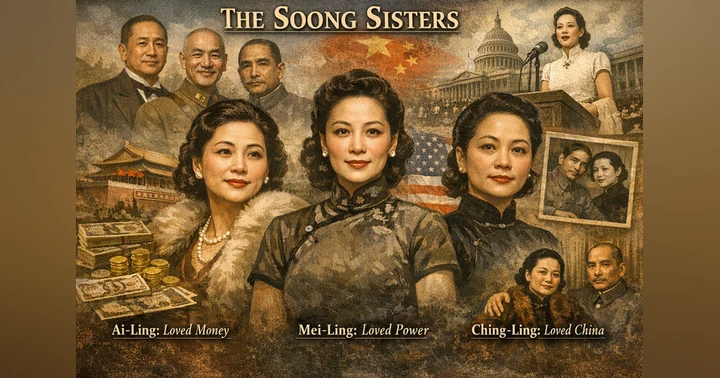
2:47 Central authority began to be asserted in the period of the 20s. and this was with Chiang Kai -shek. And he emerged as the leader of China, the leader in terms of who people associated as being the leader of China, even though he never would be able to truly consolidate total control over the country. After many attempts to establish a republic, he was dubbed the heir presumptive of Sun Yat -sen. It certainly didn't hurt his chances that he was related to the father of the Chinese Republic. He was in fact his brother -in -law. He married Mei -Ling Song, sister of Sun Yat -sen's wife. And despite making great gains in the larger cities of China, Chang would never be able to establish much control over the countryside and the Chinese peasantry. Chang represented this sort of modern movement to kind of bring China in the 20th century, and this was not necessarily something that, in some respects, considering all that this involved, something that the Chinese peasant was necessarily interested in doing here. It certainly made things great.
4:05 for people living in places like Shanghai or Beijing. So initially Chang was collaborating with the Chinese Communist Party to eliminate some of these warlords that had taken control throughout the country. If Chang had been subjected to the same level of scrutiny as say certain writers and performers were during the McCarthy era, a period ushered in by his US supporters, it is likely that he would have been regarded with some suspicion. In his early days, both Chang and even Sun Yat -sen saw opportunity in collaboration with the Soviet Union. So he would have been blacklisted. He would have been blacklisted.
4:45 By his own supporters in the United States in the 1950s. I mean, Chang had, you know, if you think about this, all of the people who would get into trouble for things like, say like James Cagney, who got into trouble for sending money to provide an ambulance to the Spanish Civil War. a humanitarian gesture, and he had to go make Yankee Doodle Dandy to prove that he wasn't a commie for this, that here's Chiang Kai -shek. He's going to the Soviet Union. He's enrolling in the WAPOA military academy. His political chief of staff is Zhou Enlai. Zhou Enlai was an important figure in the Chinese Communist Party and eventually became the first premier of the People's Republic of China. and also the foreign minister yeah foreign minister he's a fellow traveler and that did not stop him from murdering countless communists but i think it's funny just given the level of collaboration that chang did have in these early days up until the kind of seizure of control in in in shanghai he had a lot of association all of these guys knew each other you know, I don't think that Mao would be someone that he knew at this particular stage, but he certainly did know Zhou Enlai, and he's probably about as senior as you're going to get. The flirtation between China and the
6:16 Soviet Union went on for many, many decades. Yes, but in this case, it's the people that are anti -communist that are collaborating, and that's what's kind of funny. Stalin and This is something I don't know whether people appreciate it or not just because of the secrecy. Stalin kind of didn't really think that China was going to be a place where world revolution was going to happen. The whole Marxist doctrine that you have to have an industrial proletariat. to serve as the vanguard for revolution. That really did not exist. There was in the large cities, there were industrial workers, but this is tiny by comparison with the population as a whole. Even though the same could be said in some respects of Russia, Russia was certainly more industrialized than China was at this point. particularly if you look at percentage of the population as a whole, they saw Chang and his party, the KMT, the Kuomintang, as being their way, the way for the Kremlin to kind of have some influence within China. as part of their whole message of anti -imperialism, because all the other countries, as Mike mentioned last episode when we were talking about the Boxers, they all had concessions, they had all taken on these unequal treaties, so this
7:51 is kind of how communism comes to enter China, and it enters China through, not through kind of committed communists as much though certainly they're part of it, but it's also with the sort of people that are part of this whole missionary culture, westward -leaning, reform -minded, the kinds of people that Americans are eager to support and see take charge. These are the sorts of people that are also doing business with the communists and nobody seems to care at this point. Chiang Kai -shek was perfectly happy to collaborate until 1927, and this is when he massacred thousands of communists, and if you want to read a good fictional account, that's detailed in Andre Malraux's book, Man's Fate. And this is how the civil war with the communists actually occurred. He decided that he was going to consolidate power against them. This was when he made his move, and This struggle with the communist is gonna be the focus of the government until it ceased to exist on the mainland. So this is just a narrow power grab by him. It wasn't ideological in nature, really. Is that what you're saying? I would argue that he's very flexible when it comes to ideology at this point. I mean, I think that he is getting in good with kind of... You know, people like
9:23 his, he has not married his first wife yet, who is very much part of the money delete of nationalist China. But he is certainly, he's certainly in part of that sphere because he is associated with Sun Yat -sen. They are seen as a means of getting, of helping to fight this problem with the warlords. And so in 1927, he makes his move in Shanghai. and all hell breaks loose and continues to break loose, and this becomes his focus. Yes, there may be that he has a different vision for China, but it's certainly more palatable to the West than, say, what the communists are proposing.
10:06 because the sorts of people that are going to be involved in looking at China, they're not necessarily going to be supporting Workers of the World Unite. And Chiang is also considered far more reliable than the Chinese Communist Party by now. Trotsky was very critical by the way of this approach that Stalin was taking and saw this whole massacre of Chinese communists in Shanghai, which really decimated the party.
10:47 It really did. I mean there was still a party to exist, but kind of the best and the brightest were kind of like decimated. during this action by Chiang Kai -shek, and very brutally so. I mean, they were like burned to death in some cases, at least according to what you see in Mao Rou there. For those who don't know, Leon Trotsky or Lev Trotsky was a senior member of the Communist Party in the Soviet Union until he was exiled for opposing Stalin. Chiang was flexible enough to convert to Christianity. It's not clear that this is necessarily a Out of conviction. Not really out of conviction, yes. It's more a case of it works for him and it certainly does work in terms of bringing him to the forefront of people in America. I have a book over that I consulted, not so much factual but more for tone. It purports to have Chang and his wife Mei Ling to basically be They're the agents of conversion of China to Christianity. And of course, if China converts to Christianity, the gospel is being preached in all nations of the world, including places like China where it had never been preached before, and this is gonna promote the second coming of Christ. So how purposeful is this on his part? I mean, we've established his flexibility in terms of religious conviction
12:19 and political beliefs, right? Yes. Fine. How much of this is purposeful in terms of him trying to cozy up with the United States for backing? Is that a purposeful thing here where look I'm Christian now and anti -communist and you'll like me better or or not it when you say the United States we have to make a distinction because at this point I think that it's not so much the government as it is people substance within the United States that it is allowing him to cozy up to. People like Lewis, people like Jock Whitney. Jock Whitney, or John Hay Whitney, was among other things the publisher of the New York Herald Tribune. So these people will find Christianity and anti -communism more appealing, and they will... And also the vision that they have for modernity. for modernity. I mean, one of the things that I would say was kind of a bridge too far, not unlike a bridge too far in Iran, for example, female equality. This looks good.
13:27 You've gone from like women going through the process of having their feet bound to women becoming people of agency. And this is... a cause that was championed by Chang's wife Mei Ling. She was very much a proponent of this. Also building railroads also and and the sort of program that he's advancing is something that From the perspective of an industrialist, someone's gotta sell them the railroads, someone's gotta sell them telegraphs, there's money to be made and it goes back to what are we gonna sell China to make money? Railroads instead of sea cucumbers. So he's appealing.
14:11 He's appealing to private interest. Yes, he is appealing to private interest. But with a goal of modernizing China. The goal is the vision is to modernize China. The goal is to like improve things like sanitation and living conditions. But he never is able to follow through on a lot of these projects because he doesn't control the whole country. There would be a lot of aid that would be coming in. But as we'll see, a lot of this aid has a tendency to just vanish. And this is aid from American private interests. Money that they would raise. And that's or just give to the Chinese give to the Chinese. Okay.
14:54 I mean like loose had a whole Coterie of donors that he could call upon Some of which I've mentioned David O. Selznick producer gone with the wind with someone who was who was big on supporting China What were these donations? intended for Achieving the vision that they were Trying to promote. I mean it was general welfare. Okay, you know sanitation hospital schools Education, I mean did it it's trying to get it is did it go to foundations that were supposed to oversee this Did it go to the Chinese the nationalist government who who who received this money in China? Well to be honest, it's the four families that I mentioned before is who who received that money Chang's relative, T .V. Kung, who was the J .P. Morgan of China, he didn't get that way by playing Tiddlywinks. So you would give the money to these four families in China and hope they would make the most of it, do the best with it that you intended. And and and really there's no oversight that's going along with this You know money goes into china and then who knows what happens to the money. Yes. I mean they can you know They had a whole dog and pony show That when people would come to china They would trot trot things out and it was like when loose loose made several visits to china He always got this dog and pony show like we are making extreme progress in our vision for the future no and
16:28 people would look at this and they would say this is marvelous this is what i want to see happen but if you're not there 24 7 and you're just watching this this you know watching these presentations and you go back to your penthouse in new york city or wherever then how do you know that this money's being spent well well that that's The next thing I wanna ask you then, from your research then, I mean, did they achieve anything? Did they have anything to show for it? Were there more railroads and telegraph lines and hospitals and orphanages and schools and better port? I mean, did anything come of this or? There were some limited improvements in the urban environment. A little here, a little there, but it's not the sweeping. Right, yeah. Epic, epic. You didn't get a lot for the money that you were giving them. Yes. You didn't see a lot of results for that. You just got told things were great, and you... Getting back to your point, Mike, I mean, the fact that he converted to Christianity and took an anti -communist stance would seem to have helped keep these pumps flowing. Absolutely.
17:41 That's what it sounds like. That's what it sounds like. So the pumps are flowing based on that. but I'm kind of then wondering, okay, the pumps are flowing into China and are we seeing anything come out of it? And the answer sounds like, well, a little, but maybe not all that much. But if I go and put the dog and pony show on for you, let's go back to your Manhattan department and go, oh good, I've made things better in China. I'll send them another check next year. We are making phenomenal progress. That was the sense that when Luce was over there, he would see this and you would get to meet Chang and his wife was very appealing she was she was she was quite the charmer. Madame Chang, she began to know that. Madame Chang, yes. The rest of her life she was quite a figure. Yes, she was she was always always always always on the list of ten most admired women. There was no sense of no understanding of the level of corruption that was endemic to there was China there was there was it We'll get to that. Okay, so get to that these people giving the money knew there was corruption or not It depends on the person. Okay, and I'm gonna I'm gonna focus on loose with this.
18:52 I will let you carry on I will I will I will carry on with this Already, Americans, even though you can't come here and immigrate, there's a certain emotional commitment to China that America has. Chinese cannot come here. Chinese cannot come to the United States. Chinese cannot immigrate. We still have the Exclusion Act that prohibits Chinese immigration to the United States. That was done in 1880s. We are now, say, 30s, 40s now. That is still... In effect. In effect. And when the Japanese attack, there's no similar debate as to who are the good guys and who should be supported like we have in Europe in World War II. And you're talking about when the Japanese attacked China? China, yes. In 1937. Well, in 1931, there was the Mukden incident in Manchuria.
19:46 But let's just say throughout the 30s, the good guys are the Chinese. They are not the Japanese at all. Even though there was all this admiration for the Japanese during the Boxer Rebellion, this has been long overdrawn at the admiration bank here. Since that they are most definitely the bad guys. There is no Japanese pressure group in the in the United States To kind of say oh, we just want to go over there and arrange flowers. We need our living space This is what's fair for us this the arguments that are being put forth by the Germans That promote this kind of appeasement attitude that we talked about in the previous series There's nothing similar or comparable that's going on to that the Chinese need to argue against. It does not exist. The Chinese and the Japanese switch places in the constellation here, don't they? In Japan, we don't need to get into a big deal about Japan, but in Japan, the Japanese military of 1900 is not the same one. that it was transforming into in the 20s and became in the 30s and 40s. It became more of a death cult. It became more cruel and vicious toward, you know, prisoners of war, all these kinds of things. It took the samurai Bushido code and warped it into something that was prone to all these atrocities, which it really had not been before, that kind of thing. Japan
21:16 went that direction and became much less appealing. to the Western world. But then you look at Chiang Kai -shek and China, well, they've overthrown that terrible, you know, corrupt, imperial government. And they're building the future. That supported the Boxers. That's gone. So now we have a whole new, you know, it's a do -over for China. They have a new regime. And they are embracing, they're trying to become Little America here. And now Japan is attacking them. To subvert this. Subvert this, subjugate them. And you can see why this... This thinking would change, can't you? Yes, but the biggest influence on this change was none other than another product of the missionary environment, and this is Pearl Buck. No one, no one altered the perception of the Chinese in America than she did. She was part of the whole missionary school. She was a product like loose her parents were missionaries. She didn't take as charitable view about missionaries. She didn't dismiss them, but she really romanticize the life of the Chinese peasant. These people who say in, in. earlier times were kind of like considered to be somehow racially and and morally inferior they take on a kind of different stereotypical view a much more positive stereotypical view unlike say opium smoking heathen chinese in the 19th century these are stoical they're admirable a lot of the things that she has say in her book
22:48 the good earth which is kind of her magnum opus That was published in 31. We read the good earth in school. Yes So did we and the the the sorts of hardships that agricultural workers are going through with the good earth Are not unlike what's happening in the united states in the 1930s with say things like the dust bowl So the struggle of the chinese farmer Which is portrayed in in that book and she also kinds of kind of allows kind of the almost like British novels. She said she was very influenced by Dickens when she was putting her books together. She wasn't so much influenced by Chinese literature, but she was kind of taking British literature and kind of changing it, using it to kind of tell the story of Chinese peasants, something that people could actually relate to. So she wins the Pulitzer Prize in 32 for The Good Earth. And then she is the first American woman to win a Nobel Prize in 1938. There is a film made of the good earth which uh against her wishes included Americans in yellow face. White actors. White actors basically.
24:07 paul muny and louise rainer uh pretending to be chinese and it's it's kind of funny there is there is a chinese actress anna may wong and she really wanted the female lead in this and they basically said she could not she could not play the female lead uh in the good earth because as a chinese she couldn't be engaged in any sort of like romantic engagement with paul muny who is paying her husband who is made up to look like Chinese. So such are the, such are the racial politics. They did say she could be the concubine and she said, I'm not going to be, play the role of the least appealing person in the whole book.
24:49 And she just stormed off. But people, people who look at Asians in the movies say this is a, this is, she probably could have won an Oscar just as Louise Rainier, an Austrian woman who got made up to look Chinese. won an Oscar for playing for playing the uh matriarch of the family in the good earth. It said though as well we talked about the Chinese Exclusion Act it actually gets repealed in 1843 or 1943 in 1943 and a lot of people credit her portrayal of humanizing presenting it is it is a stereotype that she's presenting I don't want I don't want anybody to think that she's providing a complex view.
25:35 She is providing a stereotype, but it's a positive stereotype and it actually works in favor of people having a greater respect for people going through things in China. Her experience of China was, can you very quickly run us where she came by her experience of China? She was the daughter of missionaries. Daughter of missionaries, okay. And then like them, she made her way over here. So she spent her childhood in China. Yes. So she's very familiar from growing up. She's very familiar with China. She did kind of try to explain how China was different than most places, but she was also... She's also very good about getting out there and she didn't just write The Good Earth, she also wrote books about Chinese peasants, Dragon Seed, which was made as a movie with Catherine Hepburn as the Chinese freedom fighter. who is who is going after the Japanese there. She never wanted Americans or or in some cases British people to be portraying Chinese people. She always wanted Asians. She could never convince Hollywood of that. So let's turn back to kind of what we were seeing with regard to Henry Luce because Luce and Pearl bucks their paths are going to cross at some point. Luce is taking the view where Pearl Buck is looking at Chinese peasants.
27:07 Luce is looking at the elites within China, and he thinks Chiang Kai -shek is the most important person on the planet for like 200 years, given the consequential work that he is undertaking to modernize China. And he makes that case in his publications. So Luce would visit China along with his wife, playwright and politician Claire Booth Luce. They were kind of a power couple of their day. She was a successful Broadway playwright, author of The Women, and she was also a congresswoman from Connecticut. And they would establish what amount to a friendship with the Chang family.
27:51 They kind of saw certain parallels between them, both of them being kind of couples of destiny. Interestingly, another couple of destiny. Luce absolutely despised and that was the Roosevelts. He hated them and Clare Booth Luce hated them as well. They were Rock River Republicans. But the Changs they got along with rather well. This seemed like this whole family was on the verge of promoting improved transportation, modernization, sanitation, and in particular equality of women, which was Mayling's big cause here. You know, they were, I mean, it sounds very much like the way they were thinking about China and its future.
28:35 They were like 75, 80, 90 years ahead of themselves. What we've seen happen since, when you want to start at the 1990s in China, certainly in the 21st century, China did raise rise in all these ways. They thought something similar would happen. Under Chiang Kai -shek back and back at that time though is they thought yeah modernize and rise in that way and And who knows? Yes, and who knows if Chiang Kai -shek could have consolidated control over all of China if he had found a way to kind of incorporate the communist come up with some way of not having a civil war with them, whether that means eliminating them or incorporating them as sort of coalition partners or something, who knows what would have happened.
29:26 If Japan had not attacked. If Japan had not attacked while he's trying to consolidate control. In fact, I'm probably getting ahead of us, well ahead of us, but it's useful to note that one thing that really armed the Chinese communists and helped them get rolling in the Chinese civil war after World War II was the fact that the Soviet Union went into Manchuria Captured a bunch of equipment and supplies gave them to you know gave them to the communists Yeah, we then took them and use them against the nationalists. I'm getting ahead of us That's like in the late 40s, but you know a lot of what -ifs here where it could have gone very differently It could have gone a lot of differently, but you know, but you know it didn't it didn't loose is just he's perceiving Chang is the man of destiny Okay, so while the loose publications are eager in this period to portray China as this nascent, modernizing democracy, corruption was rife, probably even more so than what existed under the imperial system, under the Chang dynasty. It's no longer restricted to a narrow cadre of officials. and a court. You have corruption on a much wider scale with greater opportunities for corruption during this period in time. Lipservice is certainly
30:58 portrayed democratic notions of plurality and freedom of expression, particularly when Americans are present. But these are never really realized. Chang is practicing what was called the White Terror at certain intervals, and the reforms that made Qing popular in the West are not really effectively implemented, nor were they necessarily as popular among world -dwelling, tradition -minded Chinese. And they couldn't be implemented because the pervasive fact of the matter is that Qing never gained effective control over all of China.
31:39 Despite the invasion of China in 1931 with the Mukden incident, Chang's focus would always be attempting to eliminate his former allies, the members of the Chinese Communist Party. And it's hard to reform a country over which one exercises only limited control. Let's note that Marshall referred to the Mukden incident. The Mukden incident was an incident in 1931 manufactured by the Japanese. with Chinese Manchuria. Yes. In order to give the Japanese an excuse for taking over Manchuria, which they then proceeded to do. And so Henry P. Puyi. Henry Puyi, who was the last emperor.
32:20 The last emperor. There's a movie, The Last Emperor about him. That movie, yeah. But he was the Chinese emperor and they set up a government. Puppet state. A puppet state under him in Manchuria. So China lost control of Manchuria in 1931, and there were a series of military confrontations between China and Japan after that. But the major war between Japan and China, which was the second Sino -Japanese war, did not begin until 1937, just so everybody understands what we're talking about. But there is a clear and present threat from abroad that would grow with time, and the point being that Chang is not really focused on that, as he is trying to go in and achieve final victory over the Chinese Communists. I'm not trying to downplay the Japanese threat. The Japanese are on the march. That's pretty clear.
33:13 They have other ambitions and intentions in the Pacific and East Asia. That's also very clear. And you can see them coming. You can see more is going to happen with the Japanese. But there is a period from 1931 to 37 where there isn't, well, there isn't that much open combat. There were Japanese There was Japanese involvement in some things, like the Nanking incident, it was well done, Nanjing later, right? Yes. Things like that. I'm sorry, the Shanghai. The Shanghai incident. Nanjing was the 1937 one. The 1932 incident in Shanghai, where the Japanese went ashore there and there was civil disorder and things that they got involved in. There were a few things. But the Japanese were not... in constant combat with the Chinese again until 1937 when you mentioned the white terror I was gonna ask about that because I didn't like terror is basically trying to suppress radicals and other dissident notions that were existing in China that were outside of the KMT Chang's political party So white is like the same thing as like the whites fighting in the russians so whites anti -communist anti -communist Anti -radical and reds are the communist. Yes. Okay. I just I thought that's what that was But I want to make sure that we're all on that that when when just just to uh, we've jumped a little ahead when after after chang and company make their way to uh, taiwan white terror becomes more or less the norm in taiwan for possibly I want to
34:47 say 60 years I might be mistaken about that but it was we are not looking at the the origins of plurality here and To his credit Chang would have said well, we we aren't in a position for plurality, but you're also asserting That you are promoting democratic ideals democracy Western approaches to things but at the same time you're being more repressive than the government that your regime kind of sort of replaced. I mean, the Manchus are not going to be worried about people's ideology except if it disturbs the natural order of things. They had a problem with the Taiping Rebellion, but say if somebody is prattling on about Marxism in Canton in 1848, they're not really going to care. And I mean, maybe that's the fundamental weakness of the whole imperial system, but you're dealing with greater degrees of repression, but you're certainly not doing anything to kind of create the world that you allege that you're trying to build. Yeah, I mean, if you're going to compare the Manchus, the Qing dynasty, with... Chung was trying to do. It's fundamentally different. The Qing dynasty is trying to maintain what it's got. Chung is notionally
36:21 trying to create a new China over which he doesn't have complete control, as you've been saying. The two are completely different political situations. You know, how would you carry out all these reforms in an environment in which you have to fight with warlords, you have a communist insurgency, you have Japan knocking at the door? These are all factors that are going to tend towards authoritarianism, not towards enacting democratic ideals. Exactly. It's the rare country that can come up with democratic ideals and enforce them. under the circumstances that China was was facing in the 1930s. But we did not appreciate that. There is a total, we're going to get into this later on, but there is an idea that there is a sort of deliberate incompetence on the part of Chiang Kai -shek, and that if only there were competent officials, kind of like, you know, my favorite excuse for why there wasn't Peace in Vietnam a negotiated settlement this this this this sort of like slogan You know to sort of advance things we need to kind of grade him on the curve here but we also need to be mindful of the fact that what people are expecting to have happen and That it's not happening.
37:42 That is that is part and parcel of where we're gonna have the dilemma That we're going to have as we get involved in the war. So I think what you're saying is the American misunderstanding of China at this point is that we think that the problems are Chiang Kai -shek's fault. It does not really have to do with China inherently or intrinsically. It's not It's not the political, that they're fixable. It's not well, it's not the sociological and political situation in China, which is at fault for what's going wrong. It's Zheng Kai -shek who is. Yes. A competent person would overcome all of these things. Yes. All of these. And create a Jeffersonian democracy and throughout China. Apparently. And we will see that this, that the pendulum swings in the opposite direction. When we, when we look at, we look at how people are viewing the communist.
38:37 To move on, a lot of proponents for Chang, including Luce, they're tending to ignore all of these inconvenient facts, these shortcomings of the regime, as did the general population in the United States. They all have positive views of Chang, particularly if they're hoping to see China Christianized. Chang himself was probably not personally corrupt, but his family certainly was, and this was not really understood. So over the course of Chang's regime, they managed to make off with about $20 million, which would be the equivalent of $463 million today. The extended family almost gloried in the extent of their corruption, particularly at the war with Japan brought in extensive American aid and this of course was only the tip of the iceberg because the only thing that I'm talking about here is just what Chang and his Circle managed to get away with or I should say Mei Ling and her circle managed to get away with there are ample opportunities for poor corrupt officials to better themselves Can I ask you though when you say they gloried in their in their corruption?
40:01 Yes. What do you mean by they gloried in it? Conspicuous consumption. Conspicuous consumption. Okay. She was, Mei Ling was one of the best dressed women on the planet at the time and her country is at war. I mean you're not seeing Mrs. Churchill strut around in designer fashions. So did anybody say, how could this... How could she afford such nice dresses in the middle of a war? Did anybody say that? No. Or it was pretty much just ignored? She was a woman of style and grace. She was a woman of style and grace. One of the most admired women in the world, so that's the way you dress. Yes. You know, we're not seeing her strut around in fatigues, as is the case, say, with the Chinese Communist women. Wearing them like Mao suits.
40:42 Yeah. You know, it's not the message that you're seeing in in Luce's publications, and this is not a view that was promoted by the U .S. government, who tended to love China, along with other wartime leaders under the threat of the Axis. And this is despite, just to show how flexible Chang is, in the 1930s he was very, he had written some very positive things about Adolf Hitler and fascism, and he thought fascism was just a ducky. This is all ignored by us as we are embracing him as a wartime ally. And what exactly the regime stands for. You can see how that happened. There were a lot of people who, you know, Mussolini made the train run on time. And I mentioned earlier, you know, how you could easily not understand that that what Hitler was up to in the 30s until you actually saw what he did later. It was easy for someone like Hitler or Mussolini to bamboozle a lot of people and make it look like they were some kind of actually, in a way, progressive.
41:46 It's funny to say that word, but some kind of progressive force that was making their countries better. And you could cherry pick things that could, quote unquote, prove that. You can see that. I'm going to give Chang a little bit of a pass on that because That was that was actually a fairly common way of looking at things I'm losing in the 30s and then later in the 30s Mussolini Hitler both it took a while for people to really turn against To really see Hitler for what he for what he was and particularly since Hitler's on another continent, too So while Chang's early flirtation with fascism is ignored in 1941 Luce in this period is not totally averse to discussing the issue of corruption and even competency in his publications. He permitted during this period, prior to the US involvement in World War II, some discussion of corruption. His china correspondent Theodore white who will discuss more on later Made a great deal about Mention about this But It's not they don't go far enough. That's what's that's what's kind of a little bit alarming you have these people on the ground and So things
43:17 have gotten so bad with the Chinese that the economy had collapsed Effectively there was no economy now nothing of this dire sort appears In the report in the reporting of the time this is something that we find and maybe it's a question of access and history and so forth, but No one's really seems to be aware about this in the contemporary period in the popular press. We're not really having people upset about this, say like when the Russian economy collapsed, as it periodically did in the 1990s, everyone's aware of this. There's no sweeping it under the rug. You don't find this reflected in the reporting that is made available at the time. uh to to westerners you don't really find it reflected you you find them going through dire circumstances brought on by the japanese but nothing quite as bad as things really were uh there's no really real understanding of just that the japanese control most of china's pre -war industrial economy at this point and much of the wealth that existed came from this agrarian sector which is not necessarily being all that supportive of Chang's attempts at modernization with things like female equality and so forth.
44:52 The source of revenue is not really being appealed to in the way that it could be. And this gets us back to just how well things are being managed and what is indeed possible in China. Under this environment. So even pearl buck was brought in and she produced an essay in 1941 That discussed among other things the extent of the corruption by the chang regime. This was in life The the sort of flagship this life was so influential that one quarter of the households took a subscription to it Something that is unimaginable. I was gonna say that is Astounding, really. Yeah. And that is, those are the people that are going to be counted on. I wish we could get an audience like that for podcasts here. I'd love a quarter of the population to be. But when you have that kind of access, it's not just, you're not just limited to 25%. Those are the people you can count on to read you week after week. It's not newsstand sales, it's not anything. It is impossible now in the fragmented media that we have to contact or come to any sort of comparison that would fit in this case, in terms of the ability to impact. A quarter of the population. A quarter of the population week after week after week.
46:17 You don't think Fox News has that kind of reach? I do. A quarter of the population. It's probably close. But they're not, you know, I don't know, I don't know. When you look at cable news, viewership... On a typical night, it's like two million people are watching Fox News and a million and a half are watching MS Now and a million or 750 ,000 are watching CNN. Those are the kind of levels you have now. That's not a quarter of the population. No, it is not. Of course, it's not the same. I mean, that's how many people are watching at any given moment. I mean, more people than that might watch each night or each week or whatever.
47:02 But the magazine is sitting there on everybody's coffee table. It's gonna be saturated all over the place You know, it's it's hard to compare the two but clearly well in addition to that I mean, this is this is kind of going a little bit beyond China But if we're just talking about the impact of loose publications and loses message Not just China, but just in general He did have the March of Time Which was a radio show? That was on CBS. This is kind of before they had network news So this was network news and there were newsreels and they would you know if you if you want to know kind of what what this looked like if you've ever seen Citizen Kane this is what they're doing at the beginning to try and construct a biography of Kane this is kind of the march of time that they would show RKO was the original distributor for that and then Paramount. and this persisted until 1951. So there is a lot of impact that he can have. He took a multimedia approach. He took a multimedia approach to marketing.
48:13 Now, when I was researching this, I did not find anything specifically related to China, but I'm just saying there is a reach, a grasp that exists during that period. And is that specific to Luce or are there others? That's specific to Luce. I mean, Hearst also had a pioneer, had an even more sophisticated media approach. Now William Randolph Hearst, FYI, was a publisher who owned a nationwide string of newspapers and also published a number of magazines and books. He's also known as the founder of Yellow Journalism. And he was the inspiration for the film Citizen Kane. His is more entertainment than it is news. News is an important part of it, but you know, he would have, stories would be developed in publications which would be made into movies and so forth.
49:08 You know, one would feed the, and then publicity would basically drive that. And he could intimidate people with ads, whether or not he would allow people to purchase ads in his publications. With Luce, To get back to this essay by Pearl Buck, Lewis decided that that was enough. Okay, we've explored the full range of corruption. We don't need to be talking about corruption anymore. And it didn't really lead him to reevaluate his assessment of Chiang Kai -shek being the most important person in the last 200 years in all of human history. He felt like corruption has been addressed. It's not necessary to go on to anything more. He's treated as a proponent of democracy along the lines of Winston Churchill.
49:55 He's key to the salvation of Asia. And it's important to consider that when we're talking about China here, there is the Asian component because because people who are you're either a colony or you're China or you're Japan. Who espoused the salvation of Asia? Where does that phrase come from? That is a phrase that I found in the book that talked about Christianization by Chiang Kai -shek and his wife. I think it's called Christianizers of China. So it's religious. It's religious, yes. Okay. But to carry on, we're kind of blurring things, but we're, you know, I think we're kind of at the wartime period here. You know what, Marshall, before you go on though, I mean, one thing that's a little... bit of our discussion that makes me think of is Americans are always prone to looking at other countries and trying to find like their George Washington. Yeah. We do that over and over again. Yeah. And we often even openly say, well, he's the George Washington of that country. And we're generally wrong about that. You know, I just look at this and I'm thinking like, we're looking for a George Washington and Chun Kai -shek seems to be the George Washington of China. At least to Luce. To Luce he does.
51:08 Yes. and others. I mean, Luce is not alone with this. I'm picking Luce because Luce is the one who's trying to make opinion about this and is actually encountering a counter -narrative to this, which he is, if not ignoring, then trying to suppress. So Chang, in this case, has kind of treated it along the lines of Winston Churchill. And Luce is insisting that his publications provide a positive presentation of Zhang, his family, and his government, even if this is false. Because he feels like it serves the greater good in the long term So when you say when you say he's viewed like Winston Churchill, so we're talking now about the war year We are talking more years in Europe United States is not in the war yet Yes, the war years in Europe the war years Churchill is standing alone and the England is standing alone Britain's thing alone against the not Chang is standing against the Japanese Chang is saying is the Japanese. Okay, gotcha, you know and and so it's like 1940. Yes Into 41 that that era and loose is very critical of roosevelt in this thing in this period of time because he doesn't feel like roosevelt's moving far enough or fast enough, which is again Almost the direct opposite position as people are taking with regard to Involvement in the european phase of world war two, although he was pro -intervention pro involvement and he wasn't he was anti -isolation loose was
52:40 Let's look at some other folks and their attitude and and let's deal with uh, perhaps The person that uh loose hated most in the world and that was franklin roosevelt Franklin Roosevelt was a proponent of Chang. Chang didn't leave China, but his wife Mei Ling, Madame Chiang Kai -shek, she left China and she was frequently put up at the White House. She was invited to the the nightly cocktail hour and Roosevelt tended to evaluate Chang as a kind of freedom fighter and described him as having a post -war role. as one of the four policemen who would provide stability in the post -war world. The others being the United States, the Soviet Union, and the British Empire. Looking at everything that we can see about the state of China, and I mean, Soviet Union's going through hell, British Empire's going through hell, but Chang is by no sense in this league at all. He never really was able, I cannot emphasize this too much, consolidate power over all of China and would never do so after 20 years. Military and financial aid that was provided seemed to go through a sieve of corruption. And despite being an ally and supposedly opposing Japan, he's focused mainly on a strategy that provided that prioritize opposition to his one time communist allies over actually fighting
54:12 the war with Japan. To look back, back in the back in the 30s, some of his generals were actually annoyed with him for opposing any sort of collaborative effort with the communists to try and fight the Japanese, that they ended up kidnapping Chang without his false teeth, which kind of created some difficulties for him. And they only agreed to set him free if he would prioritize fighting the Japanese. This is how bad things are with regard to the government. And this is something he agreed to, but continued consistently to provide only lackluster support. Chang was so anti -communist that he actually felt the Japanese POWs were better and more reliable than having Chinese people maintain order in areas that had been liberated. So rather than turn over control to the Chinese communists you would leave Japanese officials in place and urge them to basically fulfill obligations and Orders that way so you're saying he captured his forces captured Japanese.
55:27 Yes Soldiers yes, and He released them. Yes with the expectation. Yes that they would run Those portions of China liberated parts of China his government liberated meaning back under his control. Yes In the interest of the nationalist government and not of Japan. Yeah boy That's a new one on me and now just imagine if I don't think World War two Japanese work that way, but well It would be like if we had gone into France and liberated parts of France and say like because we don't like de Gaulle, which we didn't, let's leave the Germans to run the parts of liberated France in 1944 because we don't want de Gaulle taking control. This is kind of what I would say would be the would be kind of the kind of crazy equivalent to that. I get him thinking the communists are the bigger problem in the long run than the Japanese are. You can make an argument for that. You know, I guess I mean in the end letting the japanese go to run to run china for you because that's better than having the communist do it Oh, I don't know. Well, he is regarding. I don't know about that one I mean like the comparison that he himself made was that he viewed the chinese communist as a cancer a malignant cancer And the japanese as a superficial threat and we should
56:59 keep this in mind the japanese were fighting like hell in in in china Chang is having to shift capital from that from 1937. Yeah, especially in 37. They made huge gains Yes, and into 1938, you know when I misspoke earlier and talked about the Nan the Nan King incident Yeah, and what I what I was to add my mind there was actually at 1938 that the terrible massacre and things that happened in Nan King and 38 as opposed to when I met Shanghai earlier You know, all of that happened then. That's what he was dealing with at the time. Nanking was his capital at the time. Right. He had fled that. Yeah, he fled that. Well, actually, their capital was never Peking, or now it's called Beijing. It never was. It was Nanking, now Nanjing. And then, like you said, they moved it to Chongqing to get away from the Japanese. Yes. Just to clarify that for everyone. So, I mean, it's, you know, the idea that you're going to trust people that are causing you to take it on the lam there kind of shows the extent of his sort of tunnel vision with regard to the the communists there. Well, let's realize the Japanese and Chinese were fighting each other for centuries. But. centuries. I mean, I did not necessarily incorporate this into the book, but Nanjing, there is a book by a woman named Iris Chang, and a lot of the stuff about World War Two and China did not necessarily make it into the historical record. So if we're looking
58:29 at stuff that's that's been forgotten or been ignored, I would say that that is that is part of a front in the war that does not receive the attention. She did a book about Nanjing and the massacres that occurred there by the Japanese, and these are freaking horrendous. It is not, you know, We kind of knew something horrendous had happened, but it was so bad It was so bad that the Nazis the Nazis thought this was horrific Because this was the capital there was a guy who had diplomatic standing that I remember in the book and he was just Sending notes to Berlin saying you cannot believe what the Japanese are doing here One example, which is a level of cruelty that never would have occurred to me was You've seen in movies when soldiers do bayonet practice.
59:21 So they have like the dummy that they go up and they stab or something The Japanese at Nanking were using Chinese prisoners for bayonet practice and things live Chinese prisoners. Yeah, that's how That's how ugly it was. That's just one example of our barbaric, atrocious, what they were doing there. Well, I mean, for the war in general, there were all sorts of biological experiments that were akin to what Mengele was doing. They had an active, the Japanese had an active chemical warfare, quite advanced chemical warfare program, and they used Chinese prisoners to practice, to test the chemicals. Yes. Yeah. You mentioned them, you know, fight, Blake, you mentioned them fighting. for so long. Centuries. That's why it's appalling that Chiang Kai -shek would actually trust them. Well, and, you know, over -communist.
1:00:09 Over -communist. And what for them was very fairly recent times, right? This fighting here from 37 in into 19 well actually all the way to 1945 is considered the second Sino -Japanese war which is what we're talking Yeah, but there was a first Sino -Japanese war in 1894 1895 That's how the Japanese got control of what is now called Taiwan It was known as Formosa in those days, right? But that was it that island was under Japanese control from 1895 to 1945 wasn't till the end of World War two That it was returned to China. You had the Japanese involvement and fighting in the Boxer Rebellion You had the Mukden incident we talked about earlier, which gave the Japanese an excuse to seize Manchuria in 1931. The Shanghai incident in 1932. Now you've got the second sign of Japanese war in 1937, 1938, which is the most intense of all, you know, probably. Japanese wound up capturing like most of eastern northern and eastern China during these campaigns 37 38 rapid advances on things So yeah, it was a huge fight. So we're not looking at the most competent of policemen I mean we find I would find it hard to imagine Germans being used by the Soviets or the British to sort of like Hold on to things there after you know after after we occupied Germany We had to run the place and so yeah We took some of like the minor Nazi officials the mayor's and things and had them keep running the cities because we needed someone to do it And things like that we would do that but the idea wars over arm. Yeah, the war is over but armed soldiers During the war. Yeah who you've
1:01:41 taken prisoner and putting them in charge of part of your here go shoot a communist Have you seen any communists go go get them is a pretty bizarre idea. I yes I think we've beaten out to death But uh, it's it it is a bizarre idea and of course the research that I did for this podcast I I want to try to present not necessarily excuse this idea of Chang as one of the four policemen, but kind of there are there is scholarly work that has been done on this, some of which was actually presented at the at the Roosevelt Presidential Museum as part of their lecture series a few years ago. But one of the assessments was that Roosevelt was very much an anti -imperialist.
1:02:24 If anything, he wanted to see the end of the European empires. And that is, I mean, he was willing to sort of go along with having the British, because the British controlled one quarter of the earth's surface at the time, for crying out loud, and also the Soviets. But he didn't have someone who wasn't European. And China is really the only non -European power that he could reach out to. I mean it's either you know there there are precious few when the world has been carved up. So out of necessity he's looking at Chang as being almost like a poster child for anti -imperialism as a kind of counterbalance to say like Britain in particular and could be used to counter any sort of other European imperialist power in the post -war world. Far be it for me to dispute people who've done scholarly research on FDR's motivations, right? But I just think there's a whole conversation to be had there in the sense that Roosevelt clearly had an idea that culminated in the United Nations, right, being formed after his death, but the idea of collective security. the idea that instead of
1:03:56 having all these world wars again, we'd have everybody working together on the same side to contain threats and all of that. He had that. I don't want to say it was completely unsuccessful. The United Nations has accomplished some things, but it wasn't what he envisioned. It turns out countries all look out for their own interests. They might ally with each other for collective security, but they're still looking out for themselves. I just wonder how much of it is his... I mean he seemed to have an idealistic, you know, almost naive view of what the post -war world would be like. Yes. I mean, you look at Wilson fighting, you know, with World War I and the 14 points, and we were going to create this whole new world, you know, make it safe for democracy. We talked about that in the America First series. And the League of Nations. Yeah. The League of Nations.
1:04:39 Which he tried. Which then we didn't join. Yeah. And it also failed. But I mean, I kind of see some of that again in Roosevelt. You know, here he is. He's... He wants to have this world with collective security and an end to all these wars. He picks four countries. Of course, the United States being under him would be the obvious choice. In fact, probably this was the idea of a lot of Americans and what we were creating in World War II. Probably, you know, he's reflecting that view. But that's uniquely American. You know, he's against imperialism, as you're saying. But he includes the British Empire. Now the British are closest to us politically and culturally and in many ways I get that part of it But when you look at especially towards the end of World War two The British are fighting to maintain and protect and restore that pre -war Empire that they had and a lot of their operations are designed to do exactly that And we were saying to them. We're not gonna help you restore your empire You know, we're gonna go fight the Germans and the Japanese and finish that off You know, they had different war games than than than Roosevelt did, than the United States did, in that sense.
1:05:46 There were some overlapping ones, but they did not, there was a total... Many overlapping ones, but there was still not a total convergence of views on the post -war world. Which is kind of what sentimentalists like to pretend there was. Yeah, so there's that. The Soviet Union, need we point out, need we point out that they were not... He included the Soviet Union! Yeah, you know, that we and now those, the Soviets, the Russians, you know, we're simpatico now because we fought that same terrible, you know, fascist enemy and now we're going to cooperate. That's completely fanciful, as anybody who's aware that a Cold War happened would know. And then we come to China, and that's the whole point of what we're talking about here, but China, really? Come on. I guess what I'm trying to get at when I say that is Americans, not just FDR, and we talked about this, just have this idea of China as being, they have this idealized idea of China.
1:06:38 It comes up over and over and over again in US history. and according to your research, Marshall, all the way back to the very beginning. To the very beginning. You know, we're looking at China this way, and Roosevelt is no different. Now he's doing that again. China will be one of the four policemen. It'll be this, apparently, you know, a model democracy in East Asia. I gotta have an Asian one. Obviously that's gonna be I gotta have somebody who's who's not white who's not white in this and and you know They're gonna they're gonna be an effective thing. They're gonna be one of the four policemen. Yeah, it I mean he did not I don't think that he would assume that China was gonna be as capable as the United States or even the British but it's like so this is kind of like I need to have somebody and I've kind of run out of countries that aren't Somebody else's colonies or an adversary and I and I get that idea, right? But I also have to wonder how much of it is that in Roosevelt and I have no idea what the answer is How much of it is that? Fairly cynical maybe is too strong a word, but but more cynical view. I need to have a non -white Country involved in this somehow.
1:07:41 Okay, maybe you do. Yeah, that's not exactly idealistic It's just that I need to find myself a non -white country. I know I'll pick China There's that because that's the only one I got it's only one I got but then also there just is this issue of this Idealized idea of China that seems to infect so many Americans that seems to fit to me with his overall worldview his idealized view of what World War two is gonna culminate in in the post -war world and it's so I don't think you can just sell short that that that it was as Much his idealism about all of this and fanciful view of China as it was any more practical notion of trying to get a non -white country involved. Yeah. Am I wrong to say that?
1:08:22 Do the scholars who looked at this contradict me completely? If they so, then I defer to them, but I mean, I can't quite see it. I'm not necessarily, and they're not necessarily saying that this is a good idea, but this is his idea, if that makes any sense, if that distinction. I'm questioning how much it's his idea. I'm making a more basic question. Was that really his idea? That really was his idea. Or was it really that he had this idealized idea of China and this idealized idea of the post -war world and the two of them converged to mean China would be one of the four policemen? Yes. That's a different answer to the question than saying, oh, he wanted to have a non -Asian country as one of his four policemen. Well, I would say that... Perhaps both are true? I think both are true. Okay. I think both are true in this case. I just wonder if he would have picked China if... He'd had a more realistic view of what China was. Well in the end we ended up picking Japan Because that's what happened That's another story. That's another story. That is another story US and Japan. So let's push on I just I just think that that there's a conversation we had there and I mean Roosevelt is also approaching this with you know Roosevelt had like a kind of mixture between Wilsonian idealism and Roosevelt Teddy Roosevelt Realism so there is there is a famous incident in which Roosevelt is trying to make sure that French Indochina does does not become French So he offers Indochina Vietnam
1:09:56 to Vietnam Cambodia and Laos. Yeah, or what we're what yes now Yeah, or what French Indochina is now. Yes. Yeah. Well Laos was Laos was no garden paradise either Cambodia was Okay, until we screwed it up under Nixon with with the bombing of that that took away Cambodia's neutrality He did offer the Chinese Indochina to take over after the war, to go within their sphere of influence. And when we start getting to spheres of influence, we're definitely talking about something that is not idealistic. We're dealing with something that is more balance of power, spheres of influence.
1:10:38 This is this is totally, totally different animal. Now, to Chang's credit. And historically, historically, those, you know, what is now Vietnam had been on the kingdoms of Anam. Yes. Cochin or Cochin, China. Yeah. Which had been tributaries of the Chinese Empire for a long time that it might have resented it, but they were this was not Ho Chi Minh's vision in fact Ho Chi Minh actually preferred the French to take over after the war because he said I'd rather smell French shit for 10 years than smell Chinese shit forever He was an earthy man apparently. Yes, but that was that was that was his rationale. He figured I can defeat the French easily, much more easily than I can having to deal with China having control over what I want to be my country here. And he was right. And he was right. As he did in a lot of other circumstances, we can probably say FDR is overconfident in his ability to persuade leaders to serve as effective instruments for the cause of building a post -Cold War world. One of the things that I think blinded FDR is his grandfather's involvement in the China trade. As we've mentioned, FDR's mother's father was totally enmeshed in selling opium, which was legal in the United States at the time. And if you go through his
1:12:09 house at Hyde Park, there's all sorts of remnants of this China trade, which his mother, who actually lived in Hong Kong for a while, had managed to collect and maintain hair. He did fancy himself a China hand, but I don't think that he really was. I think this is a matter of overconfidence, something that we also see happening with him and Stalin, where he figures he can persuade dear old Uncle Joe to live up to his agreements and promote democracy. To get back to what China represented, he felt like having China on board as one of the four policemen's, and this is, according to scholarly research, that this would provide an international sense of racial equality in a post -Cold War settlement. Again, reflecting his opposition to the kind of imperial systems that existed up through World War II. He needs to be commended for that. He is. There is a remarkable series on Roosevelt at war that kind of discusses where he clashes with Churchill is basically over this matter of whether it's going to happen to the... To the empires. It's the war about returning things to status quo ante or is it about? Building a new world and he wants a new world and he wants like like like I said the
1:13:41 the European You know the French the British were trying to restore their empires The Dutch too for that matter they're back in and fought in in the Netherlands East Indies now Indonesia to restore that I mean they were all trying to get their empires back. Yes after the war that we we did not care about that or support it But we also covered over the fact that sometimes what they were doing in their choices of fighting late in the war were focused more on that than it was on what we would have preferred. Well, you know, Theodore White, who we will get into shortly, he published his memoirs in the late 70s about what it was like to be a correspondent over in Asia during this period. He was appalled by some of the things that the French did, just as a matter of fact, in what became Vietnam.
1:14:31 He would go on vacations to Hanoi and places like that. And I'm not going to get into some of this stuff because it's not for family viewing, but it's kind of disgusting and appalling what they would do. So finally, the third thing, again, having China on board. as a partner would broaden the appeal of his vision for the future. I mean, it's interesting because there are all manner of freedom fighters that emerge after Roosevelt's death in some level of prominence that could probably have done just the same and kind of did. Nehru, for example. Of course, India is owned by the British. It's not that there's a problem with his method. The problem is with his choice Who he's actually choosing to do this and just how I I think he thinks that chang that chang is going to be more malleable than he actually is Well, also he Your research indicates he fancied himself to be a china hand. Yes because of his grandfather. Yes, uh work in china's sales of opium. Yeah, you know and and uh Yeah, and so you thought he had like a received wisdom Based on his grandfather's experience that that made him knowledgeable enough about China that to know what he was know what he was And there's a fallacy with this it doesn't mean you know I mean there are there are you know If that were
1:16:04 the case I should be a mathematical genius on the basis of my of my of my father there You don't get this stuff by genetics here or osmosis or osmosis So we've kind of talked about people who had a positive view of Chiang Kai -shek and his role in World War II. There were even more stronger feelings about his lack of impact on the war and his ineffectiveness in dealing with the threat from the Japanese. Because this is kind of a big topic, we're going to cover this in our next episode where we'll focus on General Stillwell, who was Chiang Kai -shek's American advisor and chief of staff, but we'll also focus on some of the other naysayers for Chiang Kai -shek as well in that and also a subsequent episode.
1:17:01 That's it for this episode of the United States of Amnesia. Thank you for listening. We hope you learned something and we hope you discovered new ways of looking at things you had already heard or thought about, or perhaps hadn't heard about. If you enjoyed it, that's great. If we made you mad, that's okay too. Either way, email us at usa .amnesia at gmail .com and let us know what you think. Also, let us know about anything you think we missed or got wrong. We'd like to know about that too. And of course, please like and subscribe and let your friends and neighbors know about us. We also have a website. It's www .usofamnesia .com For Marshall, Mike and myself, Blake Hanke. Till next time.