
 Spotify

 Amazon Music

 Apple Podcasts

 YouTube
201: Tea, Drugs and Jesus - The Flag Follows Trade
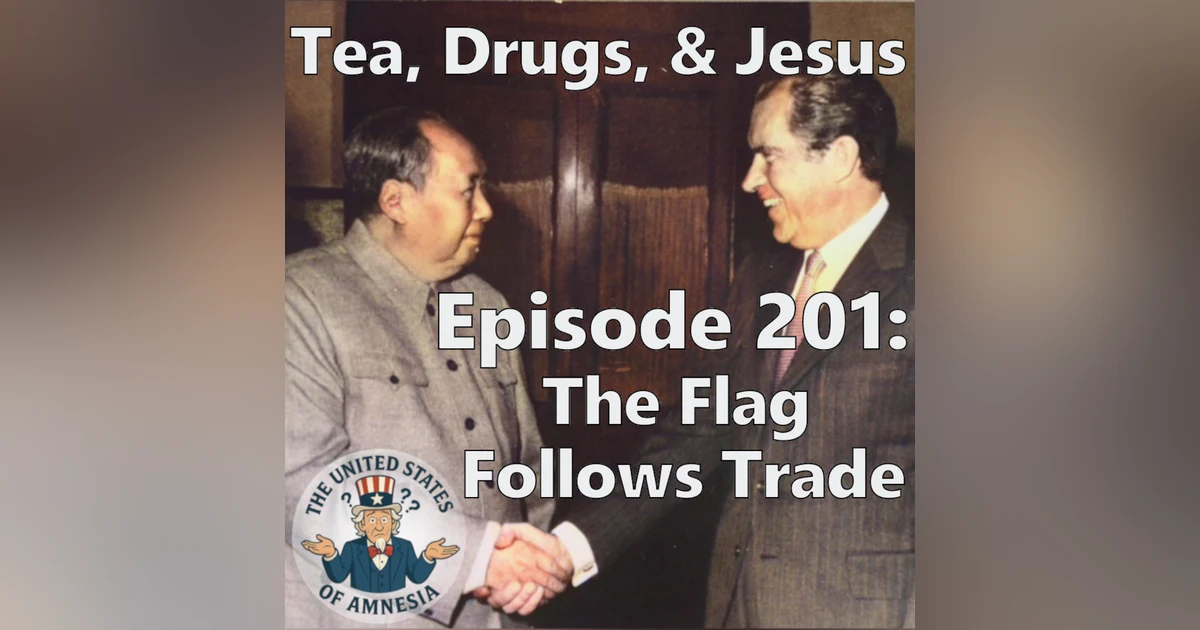
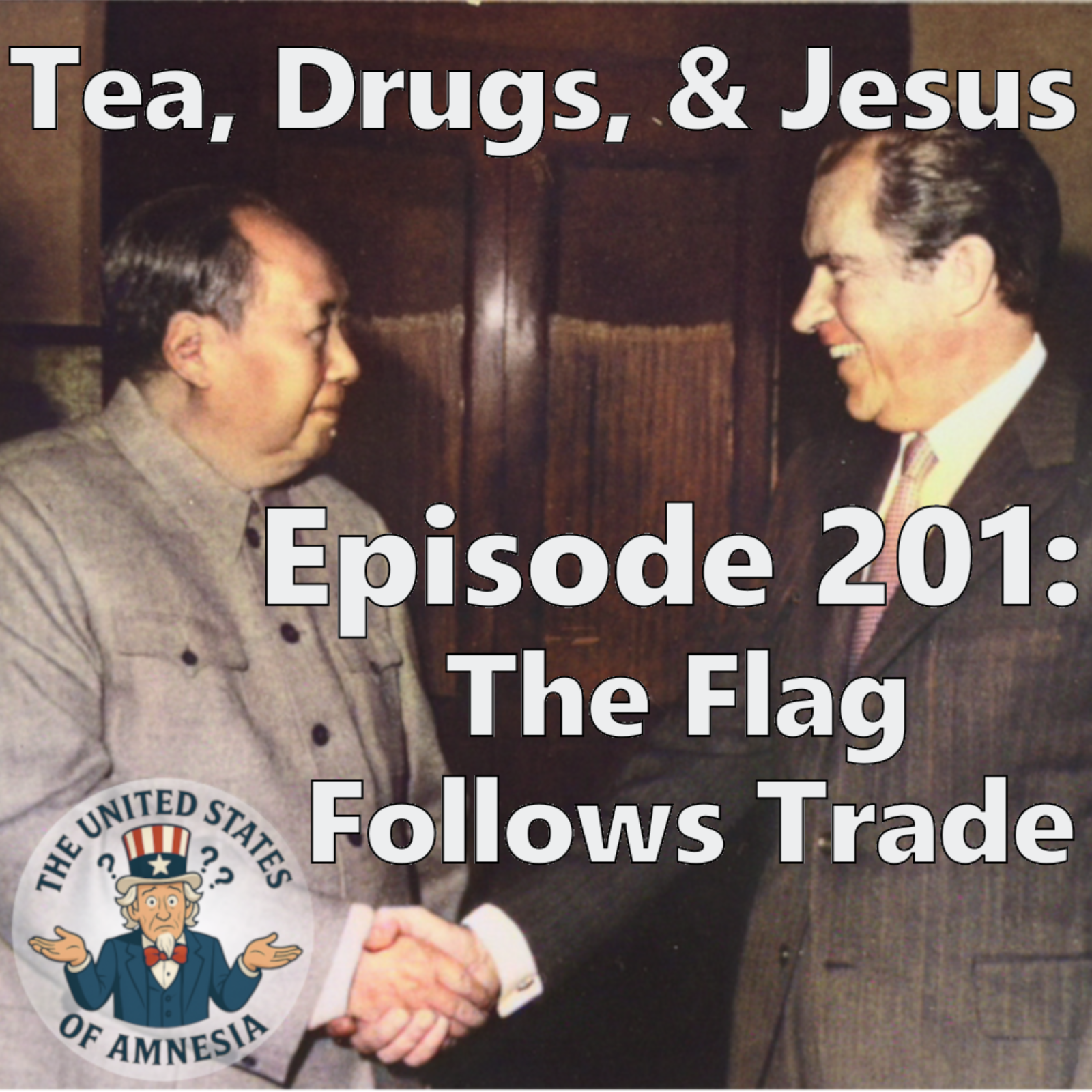
Ben Franklin got China wrong, and America still does today! Marshall again will lead our discussion in a new series, “Tea, Drugs, and Jesus,” looking at how the United States keeps misunderstanding China, in no small part because American political leaders often refuse to listen to experts on Chinese affairs. In the first episode, we set the stage for what is to come by exploring the environment in which the United States became involved in the China trade in the 19th century. We discuss China’s isolationism and stagnation, Britain and the East India Company, tea and silver, silk and porcelain – and opium.
For a more immersive experience while you listen, visit our image gallery for this series at https://www.usofamnesia.com/blog/photo-gallery-for-tea-drugs-and-jesus/.
Check out our website to learn more about us: www.usofamnesia.com
0:00 Thus among the Chinese, the most ancient and from long experience the wisest of nations. Honor does not descend, but it ascends. If a man from his learning, his wisdom, is promoted by the emperor to the rank of Mandarin, his parents are immediately entitled to all the same ceremonies of respect from the people. This ascending honor is useful to the state, as it encourages parents to their children a good and useful education. Benjamin Franklin 1784. Now, where did Benjamin Franklin get these ideas about China from? Well, you know, this is the Enlightenment period and so people had a tendency when writing and trying to promote certain agendas to kind of latch on to little factoids about other places far away that apparently had a higher culture, cultural level, than the West, particularly amongst moral issues. So what Franklin's trying to do is he's trying to promote an idea of morality using China as an example. But as we'll find out, this is not exactly what the realities were about China.
1:18 And America would be constantly over the next 200 years butting its head up against fictions about China which they had difficulty reconciling. Welcome to the United States of Amnesia. You found us. Thank you. We are the podcast that reminds us of what we have forgotten. It is often said that history repeats itself. Mark Twain allegedly said that history doesn't repeat itself, but it rhymes. Ecclesiastes probably said it best in chapter 1 verse 9, quote, everything that has been will be again everything that has been done will be done again there is nothing new under the Sun close quote but over time many topics have become clouded by biases and oversimplifications or have become mythologized and now are misunderstood misunderstanding means learning the wrong lessons from history perhaps or even learning nothing at all and that can leave us poorly prepared for history's next rhyme. Your hosts are Marshall Newman, Mike Mendenhall, and myself, Blake Henke.
2:33 In this podcast, we will cover topics of history, politics, and religion, and how they interact, and also how they relate to modern day events and themes. We will try to cut through the biases over simplifications and myths. to learn better lessons from the past and to see what they can tell us about the present and maybe even the future. Today we are beginning a new series involving the history we have forgotten in terms of our relationship with China from its beginnings all the way to Richard Nixon's trip there in the early 1970s. We are going to explore the impact of tea, opium, God, railroads, eugenics, racism, and even the sale of sea cucumbers have had on how the U .S. and China have responded to each other. Also, the fate of so -called experts when they are wrong and the penalties faced by real experts when they are right. In the first episode here, we set the stage for what is to come by exploring the environment in which the United States became involved in the China trade in the 19th century, including China's isolationism and stagnation, Britain and the East India Company, tea and silver, silk and porcelain, and of course, opium. In the 18th century, Enlightenment figures
4:07 like Franklin frequently employed anecdotes from places like China. to promote what we could call the Enlightenment agenda. Very little facts were known about China and other places around the world, places such as Persia and other exotic areas. And then so much the better, because these imaginary places, because that's essentially what they were, promoted the ideals that the Enlightenment leaders wanted to promote in Europe and America. In Franklin's case, he was promoting a more educated citizenry and a meritorious, a meritorious agenda for the New Republic. Commendable goals, but no one looking at the history of the Qing dynasty would assert that education was a universal goal for Chinese parents, most of whom were were barely getting by as subsistence farmers and were lucky to be able to survive.
5:04 much less pay for costly teachings of the Chinese classics. This was the moral education that Franklin was referring to. We will address in the course of this series what happens if one succeeds in the process and more importantly what happens if someone fails in his attempt to join the civil service along with the body count. And again, turning to the actual history of China at the time, the Mandarins were probably no more moral than the other group of officials at the time, which is to say they were corrupt and easily bribed in most cases. There were of course some sections, and we will cover a noteworthy example.
5:51 This is not to insult Franklin for suggesting that a higher moral order existed in China, but to demonstrate that throughout American history, Americans have had ideas about China that have had nothing to do with the reality of the place. Most impressions of China and what China wanted in Franklin's time were derived from popular pieces of porcelain, which the Chinese exported to the United States and the world. The enlightened vision of China would not be the last mis - misconception and as we will see in recent history, China is not the only place that the United States got wrong. We hope to show that there are certain common elements associated for these times when the United States frankly is more interested in a compelling narrative than actual facts.
6:39 I think that in fairness to Franklin and in fairness to Americans who are getting China wrong as you're describing, right, I think in fairness we have to acknowledge though that There is a history, a tradition, a culture in China of scholarship. Yes. And in fact, thinking back to my 10th grade Asian history days and studies since then, there was a large and very, I suppose, originally very efficient bureaucracy, important bureaucracy anyway, that ran the sprawling Chinese empire dating back into ancient times. And to become a civil servant in this bureaucracy, you had to pass a test. And it was a pretty rigorous test, right? Scholarship was involved. Three days. Three days. And if you stood for the exam and if you passed it, you then joined the bureaucracy.
7:28 And this is a status symbol in China to be part of that bureaucracy. It doesn't have the negative connotation that modern Americans use for the term bureaucracy. But I digress. The point just is that we have to acknowledge that. China did have this aspect of its history, its culture, and its traditions. And if you heard about that and were aware of it, that would help feed your opinion of China as being a place of mandarins and these other things that you're bringing up, right? Yes. In fact, my understanding too is that the bureaucracy, becoming a civil servant, was not necessarily a class -based thing. Not intrinsically it wasn't but you kind of had to have money to pay for classes in order to become familiar with these Confucian era classics so in effect you had to be I guess at least middle -class to be able to afford this kind of thing or something right or maybe more you had to be kind of more because there's not much of a middle -class and there's hardly any middle -class Yeah, right. Yeah, so I'm just I'm just trying to put it some context there though that There is there are some valid reasons to have at least thought this about China Yes, it's not like and I mean we're gonna see this happen again and again Over the time period that we're gonna be dealing with.
8:47 Yes, there is valid fact -based Sources for people's impressions. However, what what becomes dangerous is people are going to take that and run with it and they're going to be attempting to simplify what is a very complex and ancient society and in the course of that get what is wrong about it because they're not necessarily thinking these things through. The kind of evidence that they'll be using is somewhat questionable. And if you kind of like try to turn this around and say, well, I'm going to go look at Sevra pottery and get my ideas about Rococo France from that, that would be ridiculous for anybody to do this. But whereas people are familiar with France in the 18th century, they're not necessarily as familiar with what's going on in China. And some of this is not necessarily willful ignorance. It's also attempts by the Chinese to control any potential contamination that they might get from the West that would upset the stability of society. And that does sound kind of paranoid, but as we're going to find out, well, it kind of did. They were kind of a little bit right about wanting to kind of keep the West at arm's length because of what happens when the West intrudes upon the
10:19 Middle Kingdom. There were two compelling fictions involving the United States that pre -war isolationists clung to. This was that the United States at some unspecified time did not venture out into the corrupt world and minded its own business in its own hemisphere guarded by its two oceans, its inhabitants practicing the virtues of yeoman farmers and pursuing manifest destiny in line with the wishes of both the founding fathers and presumably God. As we're hoping to demonstrate, the reality is somewhat different. Trade has always been a component of the United States.
11:11 Trade with Europe, trade with Asia. The need to expand United States exports has driven the United States to venture abroad and has shaped U .S. policy. That's why we're so insistent on freedom of the seas and have been since the republic was founded. Exactly. Because seas are the main avenue of commerce particularly then then and now then and now yes i mean there are other ways around this but definitely this is this is where if we i mean a lot of people dismiss this and saying it's just pure uh imperialism it's not you know it's not like we're limiting we're insisting on this as a as a right for ourselves and nobody else it's everybody gets the same right as far as it goes here but kind of like uh And this is almost part of our inheritance from being a colony of Britain and Britain's mercantile traditions that were kind of in full flower in the 18th century. America was a maritime power and this meant it was very much a part of the world. And it's not, you know, the idea that we were kind of living our own best lives cut off from that world is just nonsense. And hopefully we'll see what develops and how that fact is just proven in this episode. Because while we're not seeking overseas territories, not yet, gaining control of North America was enough to keep us busy in the 19th century. The United States was
12:44 definitely involved in the world despite a lack of understanding of various parts of that world. In this episode, we are going to be looking at how the United States became increasingly involved in China, in the China trade, and just what it meant for both countries and how some of these actions still resonate today. The Chinese, whereas we have forgotten What happened in the 19th century and we don't I don't think that the average American knows much about How the United States interacted with China in the 19th century? This is still a big deal over in China. This is the century of unequal treaties which propelled a revolution beginning that overthrew the imperial dynasty the imperial Qing dynasty and then led to the communist revolution so In the aftermath of the American Revolution, the United States found itself independent but also excluded from Britain's imperial mercantile system. It was cut off from the profitable pre -revolutionary trade with the West Indies. A lot of people think when looking at the United States and the revolution that that the 13 colonies were like this this major economic powerhouse that Britain mismanaged.
14:03 Well the big economic powerhouse was the West Indies because the West Indies produced sugar and this was white gold. We had various things that we were producing but we were in no way in the same class as the West Indies and we were part and parcel of the empire with, that was an important part of our trade over in the 18th century. Now the United States after the Revolution was certainly free to buy all the goods it wanted to from Britain, but selling items We were kind of cut off. Well, we didn't really have a manufacturing base of any kind yet. That was very significant.
14:45 We had to import most of the finished goods we wanted. Yes, but raw materials is what we are exporting at that time. We are exporting raw materials, right. You know, and there are things like lumber, things like With trade with Russia, we were actually exporting some naval stores during the 18th and night late 18th and 19th century So things for the Navy like sail cloth and various other things like that were we were exporting But by and large it is raw materials is what we're exporting This would pick up and change when when cotton becomes king because we were a major trade Partner with Britain, but this did not happen until after the war of 1812 and with the Industrial Revolution Well, let me ask this after the American Revolution. Yes, we were cut off from Trade some of the trade with with Britain. Yes, he's selling to me. Yeah.
15:44 Now was was this Were these policies that were enacted by yes the British This was a way of kind of like saying okay, you think you're independent Well, we'll show you that you're not necessarily as independent as you'd like to be, and it's a way of kind of trying to maintain leverage. You know, there is this notion that, yeah, you're independent, but maybe you're not. And in addition, you have to understand the mercantilist mindset of the time too, right? I mean, the idea in, I know in the British Empire, and presumably other empires as well at the time, the idea was that your colonies were important. for extraction purposes, right? You wanted raw materials from your colonies. You could use those raw materials to produce finished goods. You can manufacture things like furniture or whatever back in the home country, then export that back to your colonies, right? Now we were this upstart colony that had broken away, but when you think about the overall mechanicalist idea of the economics of the British empire, what they were trying to achieve by having an empire economically, it made sense to treat us as an upstart. Calling you that broke away, which is what Marshall's describing right, you know, so Sell them finished goods and import raw materials from them. That's how I had no idea That's how Britain gets wealthy is by doing that. Yes, that was the thinking of the time, right? I should be selling you you should be sending me the wood I should be making the furniture and selling it back to you at a profit And that was the thinking and this thinking is what is gonna drive British policy which is linked with US policy in China Because Britain was very sensitive
17:18 as were we to a sort of like imbalance in in the in in Trade arrangements we did not want to have a trade deficit Where more money was flowing over to a country that we were buying things from or the British were buying things from and so we're constantly both countries are looking for ways to avoid that. And it was a hopeless situation just given the trade dynamics which we'll get into later on at the time. But this is kind of what, this is the economic sureties. These are the things that people paid a great deal of attention to and it drove policy throughout the period that we're dealing with. You see what happened with America, What we ended up doing and this is this might be a topic for another another episode, but we started going and trying to get in with trading partners over in Europe and in the Middle East particularly the Ottoman Empire This in turn leads to us developing a Navy believe it or not because when you start sending ships out you might encounter things such as pirates or hostile countries so you need something to defend them. That's kind of one side of the story but what happens with China, China becomes like this little engine that that
18:50 affects maritime technology ultimately. There's also a very interesting dynamic about how both countries, both Britain and the United States, attempted to leverage and run this whole association. So essentially, we are looking in the aftermath of the revolution, because we're broke, and the government is being funded by Tariffs. Tariffs, yes. Not so much in the early stages, because there's not much of a government either, but this is kind of like a progressive thing that's happening as far as the United States is going.
19:35 But there is a need for trade. There is a need for money. There is a need to kind of rebuild the economy. And this is kind of what's going to be driving America's relationship with the world in an economic sense in the early days of, right after the revolution in the early days of Republic. So new markets are necessary and initially this leads to us going to the Ottoman Empire. Why? Because it's close. But in 1784, the same year that Franklin is making his remarks about mandarins, There is the first voyage of a U .S. merchant ship to China. This is the Empress of China and it set sail from New York City on 22 February 1784. This is Washington's birthday and it was not by accident that this happened on that particular day. It arrived in Canton or Guangzhou as we now call it in August six months later. For purposes of convenience, I'm going to refer to the port as Canton, since that is what it would refer to in the time that we are talking about. Canton was the only port city in Imperial China that was open to the West.
21:00 It was illegal to teach a Westerner Chinese, and these two factors ensured that the West remained generally ignorant about China, both in big issues and small. They knew what they could buy in Canton, what they could get in Canton. They didn't know much about what life was like there because everyone is restricted to this one port city. And that's not just, there are something like 16 nations, I believe, that were involved actively in the China trade, even countries such as Sweden that you wouldn't necessarily think were big players over in Asia there. But the Empress of China was to make its return voyage back to New York on 11 May 1785. Just think about how long that is, 15 months later. This successful voyage proved profitable, earning its investors a profit of $30 ,727, a significant sum at the time. It probably would not be an overstatement to compare the voyage of the Empress of China with the U .S.
22:08 space race to the moon in the 1960s. The voyage itself was certainly a source of pride on the part of the founding fathers with both Jefferson and Madison taking interest in the voyage. Jefferson, who is the U .S. ambassador to France at the time, sent a lengthy account to the French foreign minister celebrating this American triumph. source of pride because it proved we could do something difficult like this. This involves sailing down the coast of South America, over into the Pacific, and then charting a course for Canton, which, Canton is actually the closest port to both Europe and the United States in China. So that's also a reason why it became popular. No Panama Canal yet. No Panama Canal yet. That didn't open until 1914, I believe, right? Yeah, right on the eve of World War I. World War I, yeah. So you had to go all the way around Cape Horn, and that's dangerous water, so it's actually a dangerous voyage as well. Yes. Very stormy waters down there. So it's quite an achievement to be able to do that. But the profits could be vast if you were successful. What year was this again?
23:17 This was 18? So 1784. 1784. Let's see if we can get a... idea of how much $30 ,000 was worth. There are calculators for that. $30 ,000 in 1780 is worth about $707 ,000 in 2025. So that shows you how profitable that voyage was. This also inspires not just voyages out of New York City but also the China trade spread to places like Boston and also the city of Salem and if anybody's ever in Salem a great opportunity to kind of look at the China trade is in the Peabody Essex Museum. which is located there. It basically features a lot of treasure trove of information about the early days of the China trade and also the history of whaling. So if you're a bit of a maritime geek, here is your museum. It's kind of funny because they have stuff about, they have like a whole Chinese house that they brought over, somebody brought over that you can kind of walk through, a merchant's house. But they've also got like all sorts of sailing. paraphernalia as well. That's interesting because you often hear about the whalers from New England, but not so much the China trade in my experience.
24:45 It being from New England. Yeah, but there is plenty, if you actually go up in Massachusetts, there's plenty of evidence about that up there, particularly in some of these old port cities that ran ships over to to China. Let's talk a little bit about Canton. which is going to be the site of most of the action in this episode.
25:27 So Canton is historically the terminus of the old Silk Road, so its association with the West goes back centuries. And again, like I said, closest port for Europe and America. Canton to foreign trade was an attempt by the Qing dynasty to prevent the Middle Kingdom from being contaminated by Western barbarians. It actually was kind of a progressive effort on their part because before it was kind of sketchy in terms of what one might see, particularly from the Portuguese and others coming into China prior to Canton. So here we have this legal well -regulated trading posts that people can come into, purchase goods from China, and go off on their merry way. In this period of its long history, the Chinese were more forward -looking than the West and more self -sufficient, a virtue that Jefferson found as interesting as did Franklin. The Chinese had experimented with maritime trade in the 15th century prior to it being undertaken. by the Europeans. Between 1405 and 1433, the Chinese sent literally hundreds of ships, crewed by thousands of men to the South China Seas, the Indian Ocean, and as far as the east coast of Africa, even up to the Red Sea. However, the Ming dynasties,
26:59 virtuous mandarins, of Franklin's imagination, were not comfortable with this level of contact, fearing that contact with other cultures could undermine the well -defined hierarchical, Confucian -based society that China operated under. These expeditions were costly, and it was not clear that they provided good value for the huge expense that was required to fund them. None of these expeditions made it as far as Europe. It's tempting to wonder what might have happened had Chinese established contact by sea with Europe before Europe actually was able to go out and explore the world itself. I'm just going to interject something here. There was a book called 1421.
27:43 Yes. By Gavin Menges. Yes. It was later debunked. This was referring to the exact same period the Zheng he yeah, John John he or John he John he yeah Flotilla that he postulated actually made it all the way to the Americas, which again has been I Don't widely debunked. No, no, I don't think it's true anymore. I mean very interesting read I mean like one of the if we're gonna go off on on little things a little tangent here One of the things one of my favorite exhibits in the British Museum is There is it's just an ordinary connection of pottery shards and it's like they were found in Zanzibar And kind of what the Chinese found out is that the Indian Ocean has various times in which the current flows east -west and west -east, and this facilitated trade. But they didn't really do anything with it. It's kind of like, okay, we're hitting our heads against like, okay, so this is great to know, we're sending all these ships out, we're providing trade goods, but what is this getting us? If they had made it say around to the west coast of Africa and up to Europe Just think about this. Okay. So China is the one who's basically taking the lead in maritime trade right and and
29:17 There is no reason for Spain or Portugal to go out and explore Because and and trade is flowing east to west Not ships going west to east And when does America get discovered then? You know, because everything's concentrated in the Eastern Hemisphere there. So these kind of voyages during the Ming period are kind of like, you know, if somebody wanted to do an alternate history, this would be an interesting alternate history, wherein China becomes like, almost like the British Empire, the workshop of the world, and is trading with you know, whatever they could get from Europe at the time and maybe becomes a little less insular than it actually does because it becomes like this huge maritime entity. But this also could break apart the whole civilization because it kind of undermines the whole hierarchical system that kind of drives things there. the Ming emperors changed the policies that made Zheng his voyages impossible in the future. Apparently, they made the construction of ships with more than two masts a capital offense, and basically, they ordered the destruction of all ocean -going vessels
30:47 by 1525. Right? Right. And they took all the information that was gained in those voyages and burned a lot of it. And they turned inward. Yes. Right. So they were focused on being the Middle Kingdom. The rest of the world was ancillary around them, whereas the Europeans were voyaging out and finding. The world around them what they could exploit in it right and the rest is history But that's how we wound up where we are today Well, we might be saying seeing them do a China first policy China first China first policy in which China becomes, you know, everything else is corrupt and We need to like squeeze people Order to trade with us. We don't need all these foreigners here. We don't need all these foreigners here They're just coming over here and undermining the integrity of our civilization Etc and we see and and I just say think about what happens when you pursue that policy for a couple of hundred years Where does that leave China China? Has is kind of like good at what it does and it's certainly the history of science that it has is second to none During what they were able to do. It's just The West leaps ahead because it becomes more innovative because they kind of have to when you're when you're reaching out and you're trying to maintain your status that's
32:20 a powerful incentive to keep on innovating and to create this kind of cultural of innovation where we assume there will be innovation over and over again that's part of what we do with say under China's Confucian -based society it's about stability and it's about hierarchy and if you have something new, you want to integrate it so it doesn't produce change. It produces positive, there's a positive reaction, but you're not going to kind of undermine the basic nature of society. We do that all the time. This is kind of what people bitch about when they're like saying, you know, we're not the society that we once were and that things have changed and and so forth and I don't like this but you know this is kind of the same mentality and so I would say that there's a lot of lessons in this story about the U .S. and China and one of them being don't let this happen to you where people where your society becomes calcified because that's how you fall behind. Insularity leads to calcification. Yes. And you fall behind, yes.
33:44 So we have the Ming dynasty falling in 1644 and we have the rise of the new Manchu or Qing dynasty and They did not really have any change in attitudes towards the West while China had access to spices silk and porcelain and tea, there was very little in the way of Western products the Chinese wanted or needed. Apparently clocks were popular in say like the 17th century because this was something they had never developed in this and maybe some equipment for observing the stars which the Jesuits brought in. But other, you know, massive shipments of Western goods you know, cloth or anything of that nature. This was just not needed or wanted.
34:35 The West had to be able to, if they did pick up anything in China, such as tea, they would have to pay for the commodities in silver. And Chinese like this. I mean, it's kind of like interesting to look at this dynamic between the West and China. We're obsessed by things like tea. They're obsessed by getting the silver because the silver is actually funding the government, funding the army. It's not necessarily funding innovation and change, but it is definitely like playing a significant role in the revenue of the state there. Eventually, in 1757, the emperor opted to restrict trade just to Canton. This is when that actually happens. This is when they're trying to kind of control what is previously a kind of chaotic process. And again, people, the city had access to the goods that the West wanted from the hinterland and it was removed from the capital Beijing. There was a very strong desire to avoid having a bunch of Westerners running around the capital city and stirring the pot up here. The Chinese insisted that relations be decidedly unequal and in China's favor, and we're going to see how that dynamic kind of shifts as time progresses here. Like I said, all transactions had to be conducted in silver, and the two countries that produced coins that were that were deemed
36:06 to be most desirable were Spain and the United States. High quality of silver, high quantity of silver in the coinage. At this stage, countries like Britain would grant monopoly trading rights and it was rare for the government to intervene abroad. So you had these companies, in this case it's the East India Company, they have monopoly on trade there. They really lacked the capacity to deploy government forces over vast areas of territory. So it's kind of like if you're a merchant operating out of China, you're kind of like on your own. There is no large area where they can deploy assets to be able to defend your rights.
36:58 This is going to change. No one has colonies near China in the 18th century that are operating at a high level. And India is also part of the East India Company's sphere of influence. Yeah, my understanding is the East India Company's turf started kind of at the Cape of Good Hope, right? Once you rounded Africa, you were on their turf. Yep. And there were very strict laws about trading anywhere. in the Indian Ocean or East Asia. You had to be a licensed ship. There were severe penalties for trading if you were not a properly licensed ship, licensed to the East India Company. Yeah, they were a very powerful thing for a couple of hundred years or so, two or three hundred years there operating in the Far East. Well, they actually had a larger standing army than the British did. They had a standing army of about a quarter of a million and this is deployed all over the place and it you know but the British never had that kind of standing army to be able to you know unless we're talking the need to kind of mobilize during war but the East India Company had this all the time they also had fleets of ships a navy that would be consistent with a somewhat powerful country.
38:30 I mean, it's probably not up there with France or the UK, but it's certainly something, and particularly in this area of the world, it was probably significant. The British government granted them a monopoly for that portion of the world, and under that they operated as a state within a state. Yeah. And this is gonna change. So, The two things three things there were three products that the Chinese exported very successfully silk, you know going back all the way to the Silk Road export porcelain these are very popular products and and to the extent that they were utilized, the Europeans came up with their own methods for silk production and also their own porcelain. This was kind of like a contest, but it was something that the Germans were heavily involved in. But there was one thing that they couldn't produce on their own, and that was tea.
39:31 And we kind of take access to tea for granted here, but it was a huge thing. Up until the 19th century China had monopoly on tea cultivation. There was no cultivation of tea in India until the middle of the 19th century when the British kind of moved in and the state was running things. In the British world, which also includes North America, tea drinking was introduced by Catherine of Braganza. She was the wife of Charles II, and she, being Portuguese, was familiar with the product because Portuguese had a lot of trade relations with China at the time. And, of course, if you've got a royal behind you, it's going to have this snob appeal, and this kind of spreads throughout the upper and middle classes to the point where tea becomes just an absolute We can also think about America here, where tea arrived legally under the auspices of the East India Company, but it was also smuggled in, where merchants could basically go to other countries that had trade with China and get maybe the tea at a lesser cost and bring it in, almost the way that liquor was brought in during Prohibition. So think about, you know, during the early days of the American Revolution, tea was being smuggled in by people like John Hancock and others in Boston. So the U .S. appetite for tea and other commodities remain unabated even as a result of the trade
41:02 disruptions during the American Revolutionary War. We made something like tea, but it was kind of... Nasty. So no one really wanted, they wanted the real thing. So dispatching the Empress of China in 1784, it was intended to eliminate reliance on British sources for goods from the Far East and brought a jumpstart U .S. commercial activity. which had suffered as a result of the American Revolution. China was not the only place the U .S. sought to establish trade relations with, but it soon emerged as one of the most noteworthy and profitable. So once Americans were able to make it to China, which was a six -month voyage initially, the problem that they faced, and this is going to be something that's going to affect the British as well, was what do they have to trade with China? that would offset the cost of goods that was purchasing. And this is kind of, if you want to look at the larger history, this is kind of what's going to be driving the history of U .S.-Chinese relations up until the 1850s. So the problem that the British had was that just as tea drinking continued to be popular, More money is going to China, more hard currency, more silver, because that is the only way that you can purchase anything in China, is going
42:34 to China than the British were able to offset by sales of goods that they produce, such as cloth and other manufactured goods. Trade imbalances were not tolerated. This ran counter to received economic wisdom of the 18th and 19th century. demanded that you make a profit off other countries, not that you trade with them in a mutually beneficial way. Yes, and particularly if you're having to pay for this in silver, you know, precious metals are leaving. That is used to back up your currency. So as precious metals are flowing out, there's not the same concept of credit. And it's like if you look at the kind of history and the dynamics that's going on during this period, you kind of like want to say, gosh, if you all could just come up with an internationally recognized system of credit where we're not having to worry about silver leaving Britain or having to come up with the silver to pay for it, a lot of problems would not have manifested themselves, but it didn't occur to them to do this. Well, and it's because the thinking of the time was that The wealth of the world is a fixed amount. Yes. And you get your slice of the pie and you want to make your slice of the pie bigger, but that has to come at the expense of somebody else because you can't make the pie itself bigger. Right.
43:56 You're limited by the resources and overall wealth of the world, which always has been fixed and always will be fixed. Yes. And if you think about it that way, it really eliminates the idea of growing an economy or doing anything like that. or a mutually beneficial trade arrangement where both sides benefit, because by definition that can happen, because one side must be making their slice of the pie bigger, and the other, by definition, must be making their slice of the pie smaller. Yeah. Zero -sum game. Zero -sum game. There's no concept of making the pie itself bigger through economic growth. That will come later. Yes. And that would â this is just a mentality that just doesn't exist back then. The idea of growing the pie. Growing the pie. What the British solution is, is to sell, or as time progresses, smuggle, opium into China. This is the one commodity that seemed to have no limit on its appeal within China. The East India Company, which operated, as Mike had said, almost like a state within a state during the period, had a monopoly on trade with Asia. And it could get opium from India. It had its own fields. And it could also
45:26 acquire additional opium from other traders within India. Most of the fields that the East India Company operated were out of the Bengal region. It's somewhat impossible to imagine the resources of the East India Company just in terms of what it was able to do in terms of promoting opium as a trading component here. Opium gets sold for silver because silver is the means by which transactions occur, and so we're practicing the British want silver in payment for its commodities that spring just like the Chinese are. Silver is used to purchase Chinese goods like tea, porcelain, and silk, and this kind of gradually cuts into China's trade surplus. and continue to create economic, social, and ultimately political problems for China. So in a sense, you know, these people are kind of doing, engaging in very harmful policies that have long -term negative implications mainly for China, and China at this stage is calling the shots. because we have the tea that you want and we have this one port that we can kick you out of anytime we like and you don't really have the resources now to respond to this in such a way to do that, to undermine our policy here.
46:55 So it's kind of hard to say when you're dealing with something like drug smuggling where you don't really have official records, and official records are kind of a detriment. It's estimated at this point that 90 % of the opium entering China came from Britain, and the remaining 10 % came from the U .S. And we're getting our opium again from the trade with the Middle East, with the Ottoman Empire. Our opium is coming all the way from Turkey. Britain's opium is coming Just from India if that makes sense, but opium was legal then Correct in this country and in Britain it most definitely was that's what I thought and so there is this kind of You know with with the British it is You know, yeah opium is legal.
47:51 You don't have any right to complain about it It's not something that we regard as being a harmful commodity here drug laws as we understand them today didn't really begin until the beginning of the 20th century, maybe the very end of the 19th. For example, Coca -Cola, it's called that because it had cocaine in it until 1903. I didn't remember that, yes. And it wasn't actually made illegal until the Pure Food and Drug Act in 1906 made it illegal to include cocaine in food. Now, cocaine comes from a different plant, the coca plant, right? Poppies. Opium poppies. Well, I mean, just to make the point that these things were not illegal then. For us, in China though, they were illegal. They became illegal. Now I understand. Judge's scourge. Well, laudanum, which laudanum is something that we see... people taking in Victorian novels after a Shock or something horrific happens. They'll like give them a spoonful of laudanum. Well laudanum is just opium. It's liquid opium and You know, it was it was perceived as being like just regular old medicine that you'd give somebody who's stressed out It was a painkiller. It was a painkiller. If you had someone say dying of cancer They were in pain you would give them laudanum to relieve the pain, right? So or it's Prozac Yeah, I mean you could
49:24 you would you would use this and so I mean, you know back in the time period that we're talking about here It's kind of You know to take opium. It's kind of Adventurous in some degrees if you're doing it purely for recreation you have someone like Samuel Taylor Coleridge who takes some opium and writes Kubla Khan You know in Xanadu did Kubla Khan a stately pleasure dome decree all about China And then you have in our own country you have Poe and Poe used opium Kind of when he couldn't get liquor, but he would use opium recreationally as well So it's also in all sorts of patent medicines and nerve tonics And the reason why it probably didn't get the attention that it did was that alcohol was far more of a problem than opium addiction. You know, people were far more likely to be drunks than drug addicts.
50:28 Than as now. Yeah. Yeah. But that's a story for another day. That is a story for another day. Yeah, we should do something on prohibition. We're uniquely qualified to talk to this. And we'll just leave it at that. So opium addiction became a problem in China, becoming popular among civil servants in the military who actually had the greatest access to it. Addiction in China though can't be really tracked because The records are just incomplete. You've got anecdotes about addiction. You don't really have statistics on it. It wasn't something that people were actually trying to follow. But famously there were opium dens. Yes. In China. Yes. Where you would go and get your... And elsewhere. Well, and elsewhere.
51:24 Well, we had them too, yeah. We had them too, right. You know, and ours were kind of like very exotic because it was meant to mimic that kind of... orientalist fantasy that was going on, but there were opium dens and it becomes difficult to be able just to see and track addiction. And we can ponder which is worse, criminal activity or a trade imbalance. So in future episodes, we're going to be looking at some of the mistakes the US made in its dealings with China. And these are by no means unique to just the Chinese experience.
52:04 We can see parallels with other relationships in other areas of the world that these same mistakes get repeated over and over again. But with China, there is a certain relevancy. just given the state and importance of U .S.-China relations in the 21st century. The U .S. relationship with China, as we'll see, will have a profound effect on their respective histories. The U .S. initiated contact with China starts out as a means to offset post -revolutionary trade imbalances due to the exclusion of reciprocal trade with the British Empire. Over time, We're going to see China become even more important within the U .S., not just as an economic source, but also as a featuring in a campaign to promote the second coming of Christ. And also, in further episodes, see it serve as a pillar of global stability throughout the world. That China didn't really want to be involved in either campaign will lead the United States to react in ways that will prove destructive to its own best interests both at home and abroad.
53:25 By the 20th and 21st century, Americans would advance an argument that China needed to resolve its difficulties by emulating the United States, a militantly ignorant view of how China of China, avoiding all understanding of Chinese history and its culture. The solution, as with other areas of the world that it was attempted throughout the 20th and 21st century, was something the Chinese were disinclined to do more than just pay lip service to, mainly as a way of extracting money and assistance, particularly in the middle of the the early to middle 20th century. The U .S. would, as usual, respond to these failures by taking a more insular approach to the relationship with the world, not really understanding the implications of what can only be described as insular internationalism. Thank you for listening.
54:40 We hope you learned something, and we hope you discovered new ways of looking at things you had already heard or thought about, or perhaps hadn't heard about. If you enjoyed it, that's great. If we made you mad, that's okay too. Either way, email us at usa .amnesia at gmail .com and let us know what you think. Also, let us know about anything you think we missed or got wrong. We'd like to know about that too. And of course, Please like and subscribe and let your friends and neighbors know about us. We also have a website. It's www .usofamnesia .com. For Marshall, Mike and myself, till next time.