'Heritage, Not Hate' - The Ugly Truth of 'America First'
Heritage, not Hate
In our series on “America First” we got to see how far nativists would go with their xenophobia in the 1920s and 1930s. Using fashionable but unscientific study of eugenics American nativists assessed Jews, Catholics, Asians, African Americans, people from southern and eastern Europe as physically and mentally inferior to White Anglo Saxon Protestants and having no right to full citizenship or a place in America. Although these notions became less popular after World War II, there was no formal denunciation as these ideas as innately anti-American. Lately a similar movement has come into being that claims that only people whose families have been in the country for many years, unless they are African American, are entitled to be making the decisions and having an outsized role with the affairs of the republic. Naturally, because of the long-standing intellectual nativist DNA of the Republican Party advocacy is coming mainly from this quarter. Unlike the scientific pretensions of eugenics advocates, this movement appears to rely on a kind of magical transformation that can only occur to produce good citizens whose families have lived for a lengthy period in America.
Explanations as to how being in America makes one a good citizen are as much explained as asserted. No explanation is made about how this process apparently broke down in the 1860s and huge numbers of people whose families arrived in the United States in Colonial Periods suddenly committed treason by seceding. I would ask of the advocates of this position, “what is up with that?” I doubt if a reply would be forthcoming.
For me, with the majority of family arriving before 1720, this should be a good idea. It might be nice to insist on certain things and have them enacted over the opposition of lesser mortals. Who better than those of us who have been here for so long to ensure that America stays the country it was when established, white, Protestant, and northern European? But what did the people who founded America think? What is their idea of Americanism? Were distinctions by birth something they were comfortable with establishing? How American is this latest attempt to redefine Americanism?
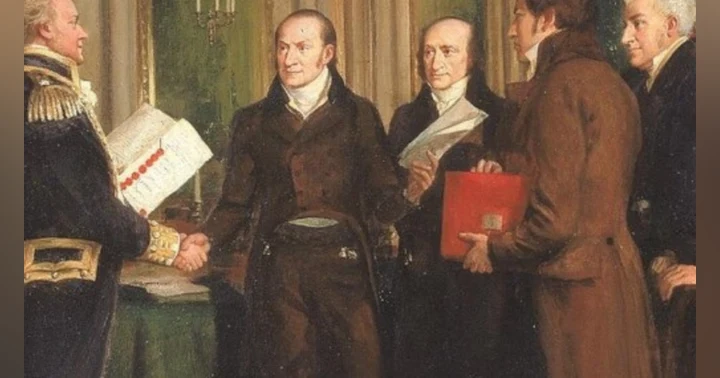
When the American Revolution concluded many of the officers in the Continental Army, believed that the establishment of a new nation would include the establishment of a new republic. Throughout 1781-84, there were rumors and attempts to establish Washington’s officer corps as a permanent upper caste.
These rumors and proposals were not as ridiculous as they sound today. Based on European history, there was every reason to believe that the military men of the continental army were likely to become members of a privileged class with Washington as the first “king of the United States.”
Washington assuming this regal title was actually proposed in a letter to Washington by Colonel Lewis Nicola on 22 May 1782. Although Nicola did not include a defined peerage system, it was widely assumed at the time that a monarchy headed by Washington would include privileged positions for Washington’s senior officers. It was the norm in European courts. The creation of a king generally included the establishment of a court with officials to maintain this institution, along with titles, pensions and hereditary distinctions.
Washington was horrified at the very idea. He replied that “no event during the war had caused him more painful feelings.” Washington added that Nicola could not have found anyone to whom such a proposal would be “more disagreeable.”
Washington was wise in several respects. First he was committed to a republican system of government. However, had Washington been tempted, his death in 1799 would have lead to a succession crisis as Washington, father of the country that he was, did not have any offspring.
Later in 1783, the Continental Army, encamped at Newburgh, New York refused to disband because it believed that the Congress, never having a reputation for lavishly funding anything, would renege on promises to provide the army with benefits to include back pay, reimbursement of expenses, pensions, and lifetime protection against personal bankruptcy. The Army sought to threaten Congress to compel them by refusing to return to civilian life. The military sought to establish itself as privileged force immune, like European nobility to limits placed on most citizens under the law.
Washington was similarly horrified at this response by the army and managed to urge the disbandment of the army by appealing to their sentiments regarding their shared comradeship of the revolution. A remark Washington made before putting on his spectacles, that he had grown blind in the service of the nation, apparently elicited genuine tears from his officers who were leading this rebellion against civilian authority.
Creating hereditary distinctions was expressly prohibited under the Constitution in article 1 which forbid the government and the states from granting hereditary titles of nobility. This ban reflected the republican ideals of the founding fathers.
The appetite for creating distinctions over service to the republic and length of time in the country has generally been satisfied by the creation of fraternal organizations like the Society of Cincinnati, founded by one of my relatives, the Colonial Dames, the Daughters of the American Revolution and the Sons of the American Revolution. While membership in the Society of Cincinnati is limited to officers in the Continental Army and hereditary, membership in the other organizations is generally voluntary. None of these organizations generally has a political agenda that it pursues.
Regardless of the generally benign nature of the Society of Cincinnati, the early founding fathers, Benjamin Franklin, Thomas Jefferson, and John Adams expressed varying degrees of uneasiness regarding the hereditary principle associated with the organization. Washington, though he assumed the presidency of the organization urged the Society to eliminate hereditary membership, political activity, and aristocratic trappings, some of which was adopted.
Although there have been political dynasties that have arisen since the founding, such as the Adamses, the Roosevelts, the Tafts, the Kennedys and the Bushes, we can conclude from these attitudes expressed by the founding fathers that they were categorically against any notion of distinction driven by strictly hereditary. People were meant to rise and fall by their own innate value and no particular European ethnic group was held to be superior to the other. Enslaved people of course were a significant exception. But no one felt that birth or religion should determine one’s place in the hierarchy. The diversity of religion in the period before and after the revolution would make the idea of the republic unworkable.
Today things are different and there are many voices who wish to see a reversal of the ideas of the founding fathers to apparently re-enforce tradition by violating it. People who helped “settle the country” or who have been in America for greater than three generations or more are to be granted “special privileges. Let’s look at some of these proposals and who is advocating these crazy positions and then as a pure thought experiment examine the implications.
To summarize the sentiments of the advocates of American hereditary privilege, they believe that America is not merely a set of abstract principles open equally to anyone who becomes acitizen, but it is also “an inherited country” created and maintained by particular historical communities. The descendants of those communities possess a deeper attachment, greater moral authority, and a stronger claim than recent immigrants.
All of the people advocating for hereditary privilege are long on generalities and short on specifics. All of this advocacy of principles alien to the founding of the United States sounds good to certain people, but no one wants to discuss the implications of implementation. Here are a few examples.
This position received nation-wide attention following J.D. Vance’s July 2025 address to the Claremont institute. Vance said that America was “a particular place with a particular people.” He suggested that someone whose ancestors fought in the Civil War had a greater claim to the country than others. He did stopped short of proposing legal distinctions of citizenship based on heredity, but he did imply a defense of an inherited single-minded national sense of belonging. How this was accomplished is unclear. The process by which this alchemy takes place is not detailed. It probably would be ridiculous to assume that this “greater claim” represented a monolithic mindset. I would tend to share the view of hereditary distinction that the founders advocated against. In my mind these somewhat alien and tribal notions of citizenship that the vice president is asserting involving a process that sounds like black magic.
The desire to create these sorts of distinctions is not limited just to the Vance, other advocates have urged distinctions should be applied to those who are descendants of colonial settlers, families present before the Civil War, and European “old stock” Americans (Northern Protestant Europeans). The preferred term for the old line Americans is “heritage Americans,” which is probably formulated to make things seem less racist than they actually are.
According to the 7 October issues of the Atlantic Monthly, a guest on August 2025 edition of the Tucker Carlson, Auron MacIntyre, podcast darkly hinted that the United States faced a fundamental rift between “heritage Americans” and “the new political class.” Heritage Americans are people “whose last names could be found in a Civil War registry.” They embody a specific set of of people who represent “an Anglo-Protestant spirit” and have ties to history and the land.” Presumably the new political class probably includes people whose names were not found on the military rolls of the Civil War, but that did not prevent them from fighting to defend this country, often in the face of prejudice from “heritage Americans.” There is also the question of how patriotic those “heritage Americans” were who fought against the United States and on the side of the Confederacy. How did these people, whose “greater claim” should have ensured their loyalty to the United States, actually commit treason? How many heritage Americans were involved in the attempt to destroy the constitution on January 6th at the behest of a second or first generation American? More about that later.
Senator Eric Schmitt of Missouri at the National Conservative Conference in September 2025 said: “We Americans are the sons and daughters of Christian Pilgrims that poured out from Europe’s shores to baptize a new world in their Ancient Faith." Of course had any of the Pilgrims of Plymouth encountered Schmitt, who is Roman Catholic, he probably would have been burned as a heretic. In the 1850s, people of his faith were viewed as interlopers by the Know Nothing Party and Catholics really could not be elected to the presidency until 66 years ago. Had it been the 1920s, much as he regards the newer immigrants, Schmitt would not have been recognized as Christian (Al Smith wasn’t when he ran for the presidency in 1928) and viewed as a potentially dangerous interloper to the American experience.
However, perhaps the major problem with the heritage American theory of is that it crumbles when examined from a factual perspective. Not everyone in America has ancestors just from Europe, the faiths they advocated were hardly ancient, particularly if we are speaking of people arriving in the 17th century, and the only people whose faith was “ancient” and who arrived in
America were Jewish and they arrived in the 1880s in significant numbers. Finally, not everyone who has a relative who arrived in Jamestown or on the Mayflower married other Jamestown and Mayflower descendants. Why? Because outside the world of Boston Brahmins and some southern aristocrats, for most people religion, not hereditary was a more common means of discrimination when choosing a partner for child bearing. And after World War II religion became less of a factor.
And there are other considerations. C. Jay Engel, a self described “heritage American” has said that some African Americans of “the old south (enslaved people in other words”) might have a claim to this title as well. Heritage Americans seem to value time in the United States as a primary means of establishing bona fides. African Americans arrived in the English colonies in 1619 before Jamestown and the US ceased importing enslaved persons from Africa in 1808 . Clearly African Americans meet one of the most significant requirements. They also made major contributions to the settling of the continent while enslaved. However, for some reason Engel just doesn’t think this is good enough. He has argues that the majority of African Americans “cannot function within old European cultural standards (whatever those are?). Engel believes that the concept of “heritage American” implies “the domination of “European derived peoples, their institutions, and their way of life.”
Anne Coulter, who has never been immune to making extraordinary and ridiculous claims has asserted that people running for president ought only be permitted to do so if they had relatives that went back three generations in America. Personally this doesn’t sound like a bad idea as it would have prevented Donald Trump, a second or first generation American (depending on which parent counts) would not be allowed to be president. Barak Obama, whose mother’s family dates back to colonial times, would presumably be eligible (birther nonsense notwithstanding). Of course this hereditary principle, despite being convenient in this instance and beneficial to the nation, is contrary to the principles that the United States was founded on and those of the founding fathers and therefore UnAmerican.
It is always dangerous when people who know very little about culture appoint themselves to be cultural arbitrators. America’s original native culture includes jazz music and its offshoots, studio based filmmaking and abstract expressionism and the literature written in the wake of Huckleberry Finn. American culture only got better when it ceased to try and imitate European models and developed its own indigenous artistic vocabulary. Jazz was the largely work of African musicians and Jewish composers, neither of which are considered to be “heritage Americans,” based on statements made by the concept’s proponents. Immigrants from Eastern Europe. Most of these innovations were not the the exclusive creation of the Protestant Americans of Northern European descent. American culture, the kind developed in America itself and not an attempt to emulate European masters, was created by people not included in the category of “heritage Americans.”
It probably is worth considering what Washington himself thought about non Christians and their place in America. This he articulated in 1790 in a letter to the Touro Synagogue in which he stated that “happily the Government of the United States, which gives to bigotry no sanction, to persecution no assistance, requires only that they who live under its protection and should demean themselves as good citizens in giving on all occasions their unconditional support.”
Thomas Jefferson, in language that would horrify MAGA, FOX News and the entire nativist cabal, also insisted that Muslims should enjoy the same civil and religious rights as Christians and should not be excluded from the full array of rights of American citizenship or public life merely because they are Muslims.
The language by these two founding fathers strongly indicates the contrary view of what constitutes being an American. It is not a matter of birth or longevity, but acceptance and support of a system of ideas about man and his relationship to the state regardless of the amount of time his family has been in the country.
It’s probably useful to look at the language that advocates of the heritage American concept use and what that might be interrupted as meaning. These proponents of a heredity form of citizenship speak of “European values” and their importance. Well, ask a European about his values and these include universal government health insurance, six months of maternity leave with pay, four weeks paid vacation, subsidized mass transit, and free or low cost higher education. Socialism is also a European creation and value. All of these are hills that the proponents of “heritage Americans” have been foiling for the past 100 years. People advocating for this primacy of “European values” ought to understand what this means and has meant for at least the last 100 or so years or even longer in some cases.
As for the religious mindset of colonial America, some colonists came here for religious purposes and those that did tended to regard the other religious refugees as “heretics” and imposed penalties on them for failing to conform. There seems to be a lack of understanding what constitutes American culture, European culture and the religious culture of colonial America.
Roughly two thirds of the United States was not settled by Protestants or Northern Europeans. The lands of the Louisiana Purchase were originally settled by French Catholics and the west was originally settled by Spaniards. Don’t they have a claim on the land too, particularly as the Spanish arrived and settled the continent prior to the English or other Northern Europeans? If you look at the cultural level of Spanish colonial settlements, the quality of the paintings was superior to anything being executed in the colonies as were the large number of Baroque churches. The colonial Spanish prose was probably as good if not superior, although both largely consisted of religious texts of one sort of another.
If “heritage Americans” were to become enshrined as distinct and legally recognized class, it is not clear how this would work. Because the descendants of people who arrived in America during the colonial period did not necessarily marry other people who arrived during the colonial period. What does that mean if one has ancestors who came over on the Mayflower as well as those who came over after the Civil War, as it is in my case? Do I get some privileges but not all of a “heritage American.” Are there gradations within the class of “heritage Americans?” This does not appear to be an issue for the advocates of special status for “heritage Americans,” it would be if implemented as social convention or law. Clearly a court of Heraldry would need to be established if we are going to introduce gradations into the concept of citizen.
Then there are those people who do not, for one reason or another do not measure up to being by any definition of the word “heritage Americans?” What cultural and civic penalties are to be imposed upon them? If “heritage Americans” are to be permitted as yet to be determined special privileges, what happens to you if you are not one? What about if you could be a heritage American,” but for whatever reason “cannot function within old European cultural standards?” Where does that leave you? Do you still have to pay taxes? Are you allowed to vote? Serve on juries? Do you still have the same rights under the law as other people as guaranteed under the 14th amendment?
But perhaps the strangest aspect of this concept is the idea that values can be absorbed through genes and chromosomes and that patterns of thought are a matter of inheritance. I certainly would be considered a “heritage American.” I have ancestors that came over on the Mayflower and settled in Virginia near Jamestown. I can claim descent or familial ties to many
founding fathers both in the Continental Army and among the leading figures of the early days of the American Republic. Yet I reject this notion that I should be afforded some sort of special status as a result. So again we are confronting a false generalization that of “heritage American monolithism,” implying everyone with ancestors who arrived before the American Revolution of the Civil War thinks exactly alike (“the right way”).
Such notions have not really been entertained in intellectual circles since before the Second World War when notions of eugenics mysteriously elevated its white Anglos Saxon Protestant advocates to the summit of of human perfection and wisdom. These ideas were discredited by the war, but as memory recedes they appear to be on the march again, but the claims are being advanced by even more dubious propositions.
The heritage of the early American Republic is in fact a system of ideas that form the basis of the American system. The motto the founders settled upon was E pluribus Unum, out of many, one. One’s family’s presence in North America never was meant to convey status. As we have seen this is something that the most of the main founding fathers went on the record to oppose. Hereditary rights are proscribed in the first article of the constitution. The sentiments of the republic in its early days was to be more inclusive than exclusive. This is the real heritage of America, which is certainly more deeply rooted in the nation’s history than “heritage American.”
Upcoming Episodes!