Gilding The Lily
From an A-Cup to a D Cup and in Gold!
'Great nations write their autobiographies in three manuscripts: the book of their deeds, their words and their art.” John Ruskin “St Mark’s Rest: A History of Venice” (1885)
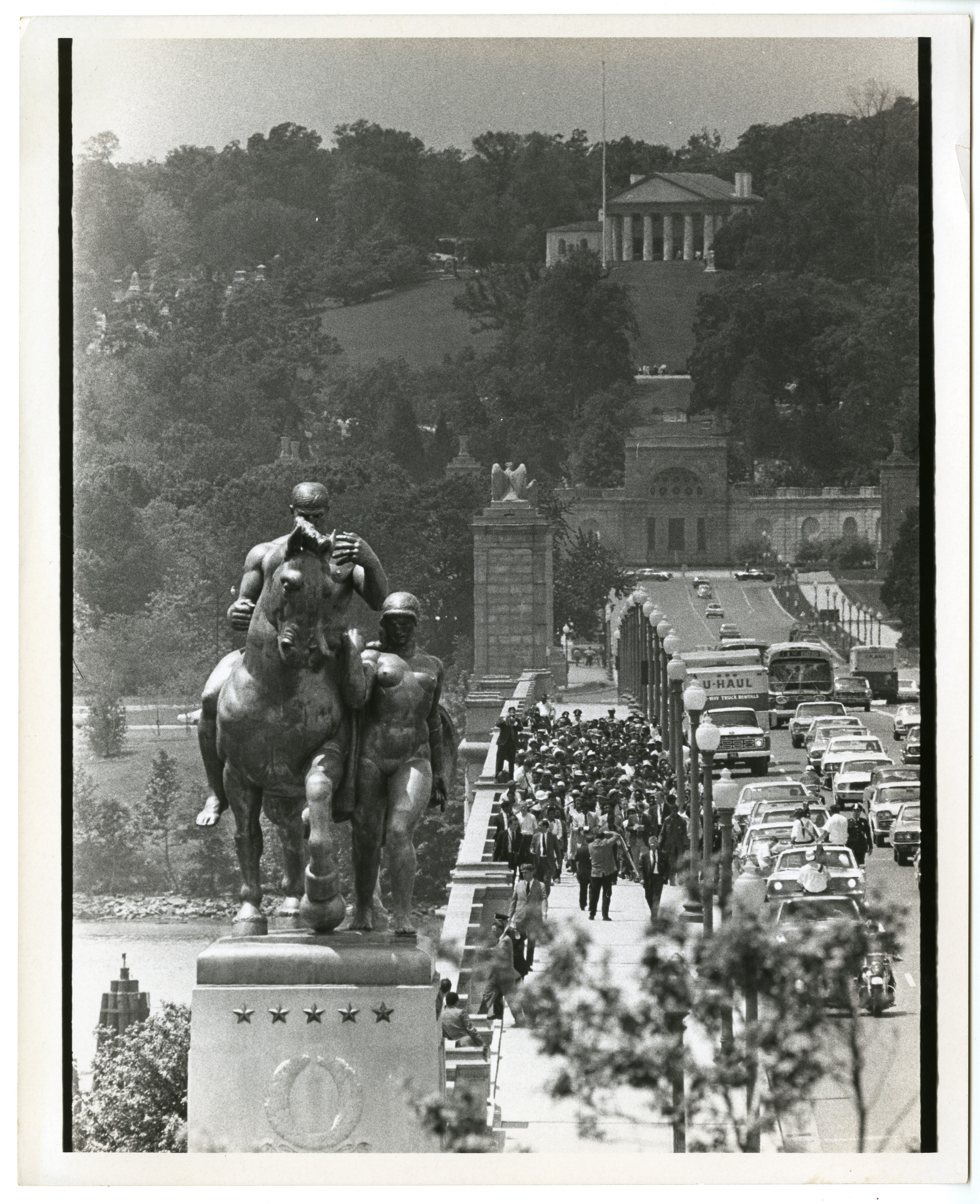
One of the more outrageous “improvements” from Trump’s misguided sense of aesthetics has been the gilding of the statues on the Arlington Memorial Bridge in Washington DC. Previously these statues were rendered in bronze and were Neo-classical representations of the “Arts of War” and “The Arts of Peace.” Casual observers have insisted that the breast size of the female figures have also been increased, but this might only be an optical illusion due to the layering of gold leaf.
Aside from cheapening the look of the statues, the idea of gilding statues done in the Neo-classical style runs counter not only to the standards of good taste, but also aesthetically. In terms of the history of the United States. It can more easily than the insistences of Trump’s evil red baiting mentor, Roy Cohn made in “The Red Scare” that this is “anti-American.”
The bridge was completed in 1932 and represented the culmination of a number of
longstanding impulses, first to improve connections between the District of Columbia and
Virginia, a plan that had initially being proposed in 1886, but did not progress during the
intervening years due to political disagreements. Later the 1922 dedication of the Lincoln
Memorial, the installation of the 1921 Tomb of the Unknown Soldier in Arlington Cemetary and the 1932 bicentennial of the birth of George Washington focused resources on the construction of the bridge which enhance access between Washington and Virginia as well as connection between the Arlington Cemetery and Lincoln memorial and Mount Vernon, the home of George Washington via the George Washington Parkway.
The statues themselves were originally the work of the venerable architectural firm of McKim, Meade and White, possible the most distinguished design firm in the late 19th/ early 20th century. Laws were passed in the 1960s to protect the integrity of such distinguished workmanship, from vandalism. This was begun under the Kennedy Administration which Trump gracelessly attempts to ape and always unsuccessfully.
However there is a deeper reason to be appalled by this latest offense to good taste. It has to do not only with dueling aesthetic priorities from the time before America and the choices that the original founders made in terms of creating a country and a capital that represented certain values.
The style Trump appears dazzled by was initially developed under Louis XIV, much more
stylishly in the 17th and 18th centuries when the palace of Versailles was created in a swampy area outside of Paris.
Versailles not only featured real gold leaf as a fashion statement, but furniture made out solid silver that was as uncomfortable as it sounds.
This gold was meant to convey as statement about Louis XIV as the sun king. It was meant
not only to convey his wealth, but his absolute control over all political, cultural, aesthetic and religious aspects of French society. Versailles stood for 18th century absolutism and soon even the most ridiculously pretentious German courts, to say nothing of those in Russia, Spain, Scandinavia, and Italy, all of whom wanted their own Versailles to inspire shock and awe.
One royal dynasty that did seek to live in or promote the absolutist aesthetic and this was the Hanoverians. As alternative to the French loving, absolutist loving Stuarts who preferred the continental European Baroque art with all its gold leaf and silver furniture and halls of mirrors, The kings who came after the Stuarts, they were Protestant, somewhat obedient or at least deferential to Parliament and eager to portray themselves as downright republican Roman in comparison with the Baroque and authoritarian French.
The initial voice for this answer to authoritarian Baroque architecture was William Kent, the early Georgian architect who favored the strongly influenced Palladian style which was heavily influenced by the architecture and design of republican Rome. He was the father of the highly unregimented English garden style which contrasted to the highly structured gardens of Versailles where the trees look as though they are soldiers on a parade ground.
Georgian architecture featured symmetrical facades, classical proportions based on Greek and Roman design, featuring finely crafted wood, brick or plaster interiors, multi-pane sash windows, doors with pediments and columns and balanced room arrangements, similarly symmetrical. This can be seen in many of the stately homes preserved in England and Scotland as well as colonial or federal period buildings in the United States. Builders tended to rely on pattern books that were published in England and Scotland and expensively imported to America.
Kent also painted a mural on one of the staircases at Kensington Palace in which the servants of George I in modern dress were given the same prominence as mythical gods on the continent. Louis XIV in Versailles had himself depicted as Apollo or Zeus with family members portrayed as other Olympians. Commissioning a heroic mural of ordinary people is about as democratic as one gets in a king’s palace. The Hanoverians though still concerned with magnificence were very much aware of the need to work with Parliament and not just asserting rights provided allegedly by God and reenforced by loads of gold leaf all through Versailles.
The design of Georgian architecture crossed the ocean to America and the restrained aesthetic simplicity was much in vogue with the founding fathers. Georgian architecture, with its harkening back to the aesthetic ideals of Rome, as understood by the founding fathers, was the dominant style and was meant to reenforce the values of the founding fathers associated with the glories of the Roman republic and later. The evacuation of Pompeii which coincided with the early days of the American Republic reenforced these ideas. Independence Hall, Washington’s Mount Vernon, Jefferson’s Monticello are examples of this appropriation of British architecture. The rise of Neo classicism on the European continent went hand in hand with the rejection of French absolutions and the coming of the French Revolution. In 1790, the French royal family left Versailles, never to return in a symbolic dispatch of the political notions of Louis XIV, all that gilding meant to support his alleged God given role.
As the 18th century drew to a close both right and left wing representatives as diverse as
Edmund Burke and Robespierre claimed to be embodying the virtues of Rome, which were in vogue both aesthetically and politically. In the United States, the construction of the White House during the administrations of Adams and Jefferson with its severe Ionic columns was similarly meant to convey the stoical Republican values simplicity and elegance of Republican Rome.
Georgian architecture continued to play a role even in the Gilded Age. The 1876 Philadelphia exhibition provided the public with a vision of the cultivated tastes of the 18th century. Which was viewed, despite its British origins was believed to be authentically “American,” particularly due to the association with the founding fathers. The buildings executed by the wealthy tended to be larger and more comfortable versions of the 18th century, although Beaux Arts, Renaissance, and Gothic styles (combined in a mishmash of styles in some cases also provedpopular. The Petit Trianon at Versailles was also popular as the newly rich robber barons used their taste in architecture to reenforce the new gospel of Social Darwinism. Surviving examples include the Vanderbilt Marble House at Newport. Most of these buildings lasted only two enerations at most as the income tax prevented the leaders of society from living in absolutist splendor. Among the less exalted middle class, Georgian/Federal style architecture was the dominant style in middle class housing through 1940.
In the 1960s, particularly in the wake of the founding of the 90.000 object museum
Winterthur in 1951 and Jacqueline Kennedy’s restoration of the White House in
1961-62, Federal and colonial style became increasingly popular again due to the
association with a unique American style associated with the founding fathers.
So what does the tacky gilding of two statues on the Arlington Memorial Bridge mean?
Well to someone as ignorant of American history as Trump, probably nothing, he just
thinks fake gold looks pretty just like all the great marble bedecked buildings that infest
Manhatten when they would be more suitable to one of the mafia neighborhoods on
Staten Island. If he is trying to recapture anything by making perfectly good bronze
statues so they look like something for sale at a county fair midway, he probably isn’t
capable of articulating it.
But if history teaches anything, in America, rejection of traditional American
architecture with things like gilding statues tends to really support an absolutist
aesthetic, generally put forth by insecure types who not unlike the newly rich of the
gilded age were desperate to win social approval after winning their ill-gotten gains.
Were Trump’s finances in better shape, so that grifting off the American people was off
limits he might be considering marriage involving one of his awful children to a member
of distress nobility.
Back in the 1980s Trump used to haunt the elite celebrations involving VIPs from
overseas. Being there, standing in the corner hoping someone would talk to him
developer from Queens that he was, was only part of the struggle. He would also
interrupt conversations that people like Katherine Graham and Pamela Harriman were
having with other movers and shakers, desperate for people of that ilk to acknowledge
him. When that didn’t work, he was not averse to phoning up these self same DC
movers and shakers insisting that they had agreed to meet with him for lunch, dinner or
some other occasion. Few people that Trump targeted were so desperate for a free
meal as to endure his incoherent self serving monologues, then as now, they were
about as amusing as being hit by a two by four.
If anything, the fake gilded statues on Memorial Bridge are likely a form of revenge and
a desire to impress the self same people who rejected his attempts to woo them with
meals involving overcooked steak. Aesthetically, these statues with their enhanced
gilded breasts and more prominent nipples are meant to graft on an alien tradition of
absolutism which people embraced because they believed Haitians were eating cats
and dogs.
Population Expansion Under Internal Improvements